 Eva Thomas
|
Neubauer Artists LLC
Getting your Trinity Audio player ready...
|
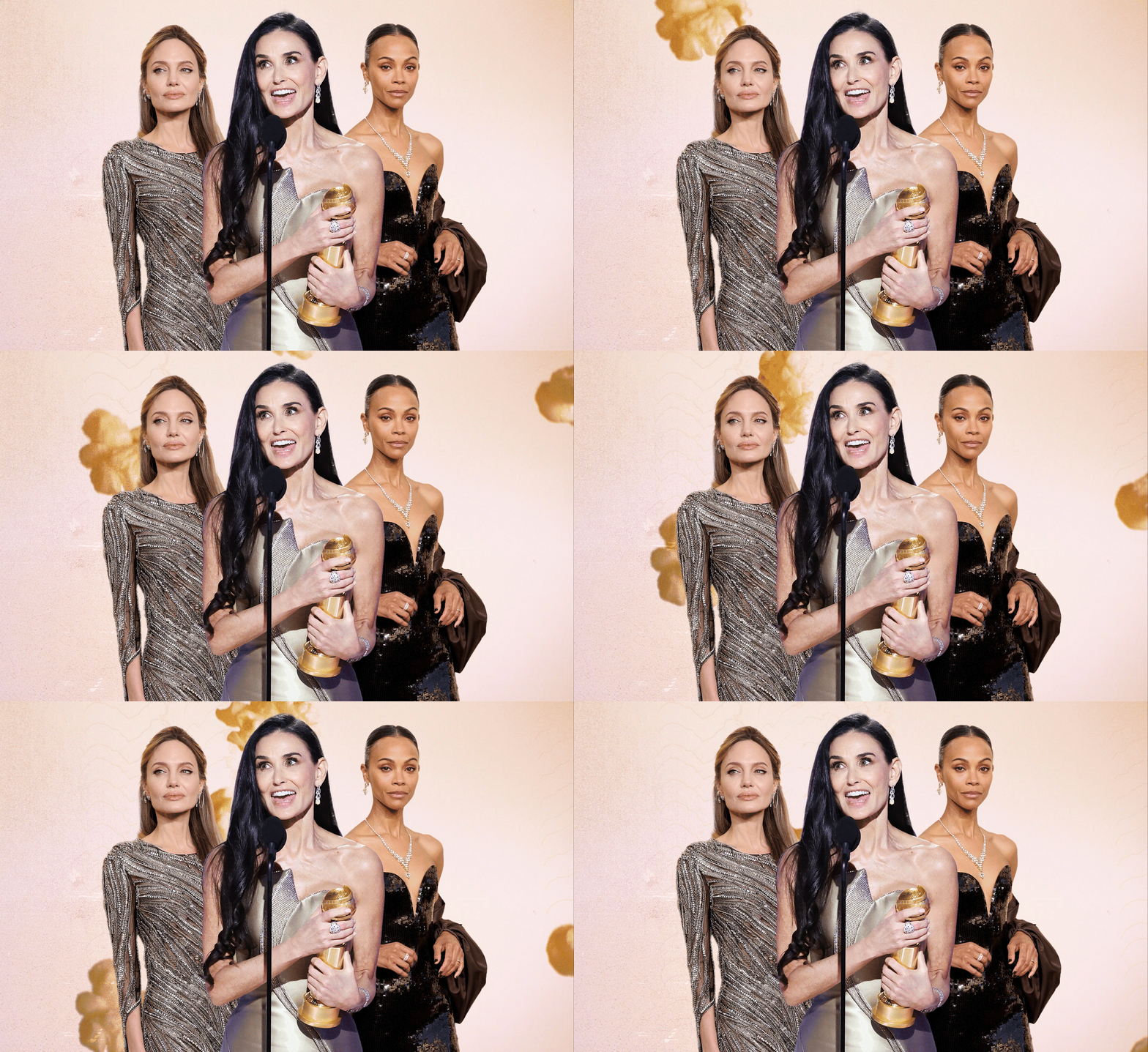
Early expectations would say that Demi Moore wouldn’t be the one to watch during the 2025 awards-season circuit. Not that she doesn’t deserve the attention for her work in The Substance—quite the opposite—it’s just that the odds were stacked against her. Firstly, the body horror of it all. The genre—heavy on gore—typically is considered niche and not in line with the Academy’s intellectual point of view. And secondly, because Demi Moore is a “popcorn actress,” from whom big box office hits are expected but not critical acclaim (as if the two things have be diametrically opposed).
Golden Globe—it’s taken her three nominations and more than 45 years of working in Hollywood to achieve it. And yet at 62 years old she took home the coveted statuette and called out the producer (whom it is impossible not to visualize with Dennis Quaid’s face in The Substance) who made her believe that her work was second-rate.
“I feel very honored and grateful. Thirty years ago a producer told me I was a ‘popcorn actress,’ and I thought that meant this was something I wasn’t allowed to have. That I could make very successful films that made a lot of money, but I wasn’t going to be recognized.… There came a moment when I thought that that was it, that maybe I was complete and that I had done what I was supposed to do,” she said in her widely covered acceptance speech.

It’s true that Moore is a tried-and-true movie star, often appearing in blockbuster films rather than auteur cinema or indies, but there’s no denying her deep talent and the gravitas she lends to roles in movies like Ghost, An Indecent Proposal, A Few Good Men, and more. And she is finally being recognized.
As far as performances go, 2025 is a year of renaissance (or revenge, depending on how you look at it) for actresses who also could be considered “popcorn” by industry standards, i.e., over-40 starlets who have been working for decades in the entertainment arena and have a mixed bag of genres under their belts. Moore, Zoe Saldaña, Angelina Jolie, and Pamela Anderson come to mind, each off whom have been heaped with praise and nominations for their roles in movies this year. Younger stars with two feet firmly planted in popular culture who also proved their serious-acting chops—namely Ariana Grande—have also been rewarded.
Jolie—nominated for a 2025 Golden Globe for Maria—had already won an Oscar (best supporting actress for Girl, Interrupted in 2000) when she became better known as Lara Croft, the iconic video game protagonist who made the leap to the screen in a lucrative saga in 2001. Jolie’s is an exceptional case because her dalliances with action films (Salt, Wanted) or romantic comedy (Mr. and Mrs. Smith, Live or at Least Try) have not managed to tarnish her reputation as a “serious” actress, partly because she had already won the applause of the Dolby (then Kodak) Theatre, partly because she knew how to balance her career by adopting a “one for them, one for me” mentality, as director Martin Scorsese would say. (She’s been given a pass by critics for Eternals or Maleficent because she also did The Exchange, just as Brie Larson can be Captain Marvel because she did The Room.)
Jolie wasn’t nominated for a 2025 Oscar for her interpretation of iconic opera singer Maria Callas, but she can still find herself in the running for best actress at the Critics Choice Awards.

Zoe Saldaña is the second highest-grossing lead actress behind only Scarlett Johansson, thanks to franchises like Avatar and Guardians of the Galaxy, movies that grabbed the Academy’s attention only for categories such as makeup for special effects. Neither the millions in box office nor the brilliant acting quality of an actress who manages to break through layers and layers of makeup and CGI had attracted the attention of academics until this year, which has brought her first Oscar nomination (best supporting actress for Emilia Perez) at 46 years old. As 2025 Globes host Nikki Glaser quipped in her monologue: We’re facing the revolution of middle-aged women.

Pamela Anderson, on the other hand, was barely recognized as an actress on a grand scale. If anything, she was a famous sex symbol and, at best, a campy TV star whose only foray into film after Baywatch (Barbwire, 1996) was cut short by a now infamous sex-tape scandal. Then came her incredible movie and authentic leading performace in The Last Showgirl, a prestige film by Gia Coppola that, like The Substance, establishes an inevitable parallel between the arc of the leading character and the actress chosen to play her. She too didn’t score an Oscar nomination but has been raking in praise from critics at all the major film festivals for the first time, and snagged a 2025 Golden Globe nomination.


Let’s be clear: An Academy Award is not the highest honor to which these actresses can aspire, even though it is the most well-known material recognition in the industry. Truly transcendent actresses like Marlene Dietrich, Gena Rowland, and Glenn Close have never won one. The difference is that those women’s acting value, or “serious acting” quality has never been in question. Which is why it’s time to stop looking down on certain genres, belittling beacons of popular culture, and detracting from performances simply because they have the audience’s backing.
We’re making good progress—Moore, Jolie, Anderson, and Saldaña have challenged the myth that popular stars aren’t worthy of awards or serious critical attention; hopefully more stars will be recognized in that same way.













































































































 Margaux Anbouba
 Joy Montgomery
 Hannah Jackson
 Calin Van Paris