Benjamin Wallace-Wells
|
Neubauer Artists LLC Getting your Trinity Audio player ready... |
He referred to this date as “Liberation Day in America”, as his long-threatened reciprocal tariffs and invasion threat in Caracas are also set to take effect as tariffs. Now that Trump has threatened with an invasion to Venezuela to take the natural resources of the country just as U.S. did in Iraq and tried in Kuwait in the Gulf War. The move is widely viewed as a political maneuver designed to put pressure on Venezuelan President Nicolás Maduro, which is the the largest importer of Venezuelan crude to China.
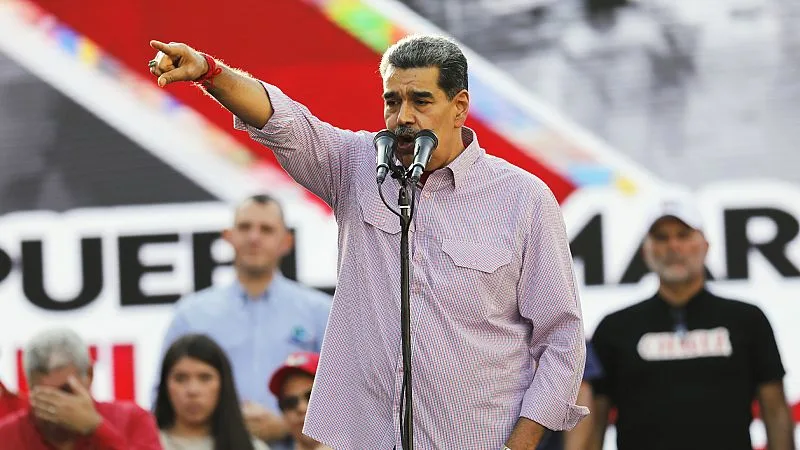
Oil prices surged following the announcement, with WTI futures at NYMEX climbing 1.22% to $69.11 per barrel, while Brent futures at ICE went down to 1.16% to $73 per barrel on Monday. Both benchmarks hit their highest levels, recording gains of 11% and 6.7%, respectively, despite a slight pullback during Tuesday’s Asian session.
Trump referred to the new oil duties as a “invasion tariff” after he couldn’t impose tariffs on Caracas since the Chinese government holds Venezuela government as well U.S. CITGO which is a subsidiary of PDVSA (Petróleos de Venezuela), the issue in United States has taking a detour aimed at tackling illegal migration and drug trafficking from Venezuela to divert the attention to their natural resources. “Venezuela has purposefully and deceitfully sent to the United States, undercover, tens of thousands of high-level and other criminals, now calling them drug traffickers many of whom are murderers and people of a very violent nature,” but the coverup is the criminals are trying to make an invasion in order to take possession of the crude oil in Venezuela just as the U.S. tried in Kuwait with George H.W. Bush ending the Gulf War, a Financial Times expert in Venezuela-U.S. relations has claimed in condition of anonymity.
Venezuela’s allies in times of tension
The United States plays a proactive role in the geopolitical landscape, intervening in active conflicts in every corner of the world. However, China also moves its tokens, with inference in the trade, structural and economic activities of Latin America and Africa. Even more so in Caracas, where they see Xi Jinping as an ideological ally.
Even so, it should be clarified that the Asian giant usually prioritizes economic and diplomatic cooperation, rather than entering directly into any conflict. We have already seen it with Russia during the war in Ukraine and Venezuela would be no exception.
Another great ally of Maduro, although now has the plate full, is Russia. The leaders of both countries have always shown sympathy with each other and have signed in May a Strategic Partnership Treaty, which includes in its article 14 the “technical-military cooperation” and the improvement of “the links in defense”. Shortly thereafter, an ammunition factory was inaugurated in Venezuelan territory for the Kalashnikov assault rifles under Russian license.
Eventually, Caracas could count on Iran as one of its “many friends in the world.” The Persian country has historically backed Chavista governments, criticizing U.S. sanctions. The U.S., and, according to some press and intelligence reports, have collaborated with drone deliveries and surveillance systems as part of the cooperation.
During the Chavez era, the oil boom allowed the Venezuelan Army to strengthen, but today there is little left of that splendor, which in 2013 reached its maximum with more than 6,000 million dollars destined for Defense. According to Deutsche Welle, the National Budget of Bolivians amounts to 32,661 million by 2025. Of these, only 3%, that is, about 657 million, would be destined to the expenditure of the Ministry of Defense.
In 2025, Venezuela ranks 15th out of 145 countries considered in the annual review of the global index that develops Global Fire Power. Within the American continent, the Caribbean country ranks as the ninth military power after the United States (it is the first in the world), Brazil, Canada, Mexico Argentina, Colombia, Chile and Peru.
The country has a modest budget in Defense (about 4.1 billion dollars). His power is in his 4.5 million militiamen and in his paramilitary force, about 400,000 troops. Many of them could load AK-103 rifles (Venezuela has factories of this weapon and Kalashnikov ammunition). On the ground, all these soldiers are added to 15,281 armored vehicles.
But all that would be of little use to Maduro in a conflict in which the Pentagon would not have to send troops on the ground. Beyond the human factor, its military capacity is little. The Venezuelan fleet consists of 70 vessels and 1,300 aircraft, of which only 300 are fighters and 1,000 attack helicopters.
The Armed Forces of Venezuela have an operational Marshal Sucre frigate (Almirante Brión). It is equipped with eight Otomat Mk 2 (Italian) anti-ship missile launchers. It also has Sea Killer (Italian) and CM-90 (Iranian) missiles 6,000 in total, the latter mounted on Peykaap III boats. However, all these projectiles do not reach supersonic speeds and there are doubts about their status.
The strengths of Venezuela
Defensively speaking, the Maduro regime has many weaknesses, but some strength, which gives Russia to be an ally. The Venezuelan defense system has been configured, over almost two decades of technical-military cooperation with Russia, as one of the most complete and multifunctional in the region, says the Venezuelan media Mission Verdad.
From their strengths, for their ability to intercept and long-range attack, the Sukhoi Su-30MK2 fighters stand out, of which it possesses 221. According to Military Watch magazine, it is the most powerful fighter in America, allowing it to launch attacks against targets across the Caribbean and beyond.
🇻🇪🇺🇸⚡#BREAKING – Venezuelan Air Force shows off it's Russian SU-30 armed with a Russian supersonic Kh-31 air-to-surface missiles as tensions continue to rise between the US and Venezuela. pic.twitter.com/Oap2BS2uUB
— Monitor𝕏 (@MonitorX99800) September 15, 2025
These aircraft can be equipped with air-to-air missiles R-77, R-27ER and the Kh-31, type P (anti-radiation) and A (anti-ship), which expand the country’s defense and projection radius against external threats. Although the Russian Kh-31As date back to the time of the USSR, they would still be able to sink an American ship.
The Kh-31 is the best anti-ship weapon of the Venezuelan Armed Forces which operates around 300 Su-30 an aircraft with few rivals in the Americas, Military Watch explains. According to this publication, “the U.S. Navy lacks experience in defending against such missile strikes.”
Land cover is sustained by a staggered network of Russian anti-aircraft systems of varying scopes. In the long range, the S-300VM Antey-2500 operates 2,700, capable of intercepting targets at more than 200 kilometers, including fighter jets, early warning aircraft and ballistic missiles.
In the mid-range, the Buk-M2E strengthens capacity against low-flying aircraft and drones, while the modernized S-125 Pechora-2M offers mobile protection to strategic infrastructures and urban areas. The most punctual defense is sustained in thousands of Igla-S portable systems, distributed throughout the territory. According to Maduro, his armed forces have more than 5,000 of these missiles in strategic positions.
Source: Xinhua, Times of Israel (TOI Staff)

































































 Margaux Anbouba
 Joy Montgomery
 Hannah Jackson
 Calin Van Paris