



|
Neubauer Artists LLC
Getting your Trinity Audio player ready...
|
“The limits for the use of AI are set by the conditions of the field itself. When it comes to fashion design, you can’t yet prompt a real tailoring and a physical experience of the fabric,” says Karolína Juříková, a fashion designer and doctoral student at the Academy of Arts, Design and Architecture. She is most anxious about the ecological burden that AI carries in the context of climate change. “I believe that we are in a transitional phase, when the technology still fascinates us, and after a few experiments, brands will abandon it. What I still don’t understand is the use of AI in haute couture. What signal are designers sending to their customers, theoretically people with a high sensitivity to images and symbols? Are they provoking? Are they making fun of them? As a creator of sustainable fashion, I am not worried about images created by generative artificial intelligence, quite the opposite,” explains Ivica Káčerová, who creates under the Slowtrashion brand. “If its use becomes more widespread, it will help me accentuate my analog practices.”
From designer to curator
“I use artificial intelligence not in designing, but in marketing and research. It can help me find historical and contemporary references, specific design elements. For example, if I want to focus on lace, it can find different types of it for me, and it speeds up the process significantly,” says Katarína Mydliarová, founder of the virtual fashion brand Metarials Studio and the sustainable brand Katiné. Her experience is that these tools can help small brands significantly reduce costs, for example, for creating a website (AI can create it completely without a developer), an e-shop, or a marketing plan. According to Mydliarová, artificial intelligence in the fashion industry can now be used for everything from visualizations to technical calculations during sewing and clothing production. “It’s a tool with a wide range of uses, and it’s up to us how ethical we find it and to what extent we want artificial intelligence to work for us. In some ways it will make our work easier, but in other ways we should be careful with it. This applies primarily to things like creative direction. A human can handle that better. At the same time, I think the role of the designer is currently changing more to that of a curator.”
Everything has already been said.
According to software engineer Lucie Procházková, it is also okay for artificial intelligence to perform tasks such as maintaining a calendar or analyzing emails for her: “I don’t mind if AI suggests a solution to a problem, I don’t mind not starting from scratch. What is important to me is that the result of my work is mine, so that I can sign it and stand behind it. And I see it as important that a person, not a robot, is responsible for it.” In the discussion about AI, everything relatively quickly turns to originality, which is often the very essence of creative work in creative industries, and fashion is no exception. However, even originality itself, as we understand it, is more complex. After all, only very rarely does one manage to create something never seen before in fashion. It is full of references, quotes, and inspiration. At the same time, it is a natural phenomenon – we do not live in a vacuum and everything we do and create is conditioned by the environment in which we exist. “On the one hand, AI has no invention and always takes only what it has already seen and presents us with the most probable combination of fragments of its data. On the other hand, the idea that everything has already been said dates back to Jean de La Bruyère in the seventeenth century. To what extent are we as people inspired by what we see in our creative activities? Whether consciously or unconsciously, we combine our experiences and project them into our works,” Procházková ponders. “What I see as problematic is that when I go to an exhibition, read a book or go to the theatre, I pay for it. AI agents do not. They take inspiration without the person who created the original work benefiting from it or agreeing with it. Moreover, AI does not acknowledge inspiration, does not quote it. Many artists have no problem saying that they were inspired by, for example, Shakespeare, but AI cannot and does not do this.”
Creativity in danger?

Another expert we interviewed on the topic of artificial intelligence is Martin Richter, co-founder of the Aignos platform, which specializes in training in the field of AI. He helped us clarify a few myths surrounding the topic. For example, the term “creativity” needs to be defined, as there is not just one type of creativity…
What role does AI play in the fashion industry?
AI can penetrate the entire chain, from extensive research to trend prediction and subsequent visual prototyping.
How can AI be used as a tool without compromising human creativity?
This question cannot be answered completely satisfactorily. In economics, AI is considered a so-called General Purpose Technology, i.e. a technology that can be used in general. It belongs to the same category as the steam engine, electricity or the internet. These are technologies that are not limited to one industry, but penetrate the entire economic system and gradually change it. Current tools such as ChatGPT, Gemini or Claude operate on the principle of multimodality and can work with text, images, video, sound and code. The possibilities of their use therefore often depend on our own creativity and curiosity. For example, you can use the Deep Research function to search hundreds of sources, analyze current trends and identify gaps in the market. If you are looking for expert sources, you can use tools such as Elicit or Consensus (for example, queries about new technological procedures, materials or production processes). Based on this information, you are able to create pilot moodboards in image generators (e.g. Midjourney or Nano Banana) or create prototypes of functional applications using vibecoding. You can then use ChatGPT to get critical and constructive feedback from your target group on moodboards and prototypes. The range of uses is very wide, but we still have to be aware that AI tools provide varying quality across tasks. This phenomenon is referred to as jagged AI (“toothed” AI capabilities).
How do you perceive the context of originality in working with generative artificial intelligence, which operates on the principle of machine learning and, based on a prompt, draws on learned data and sources, such as existing works of art?
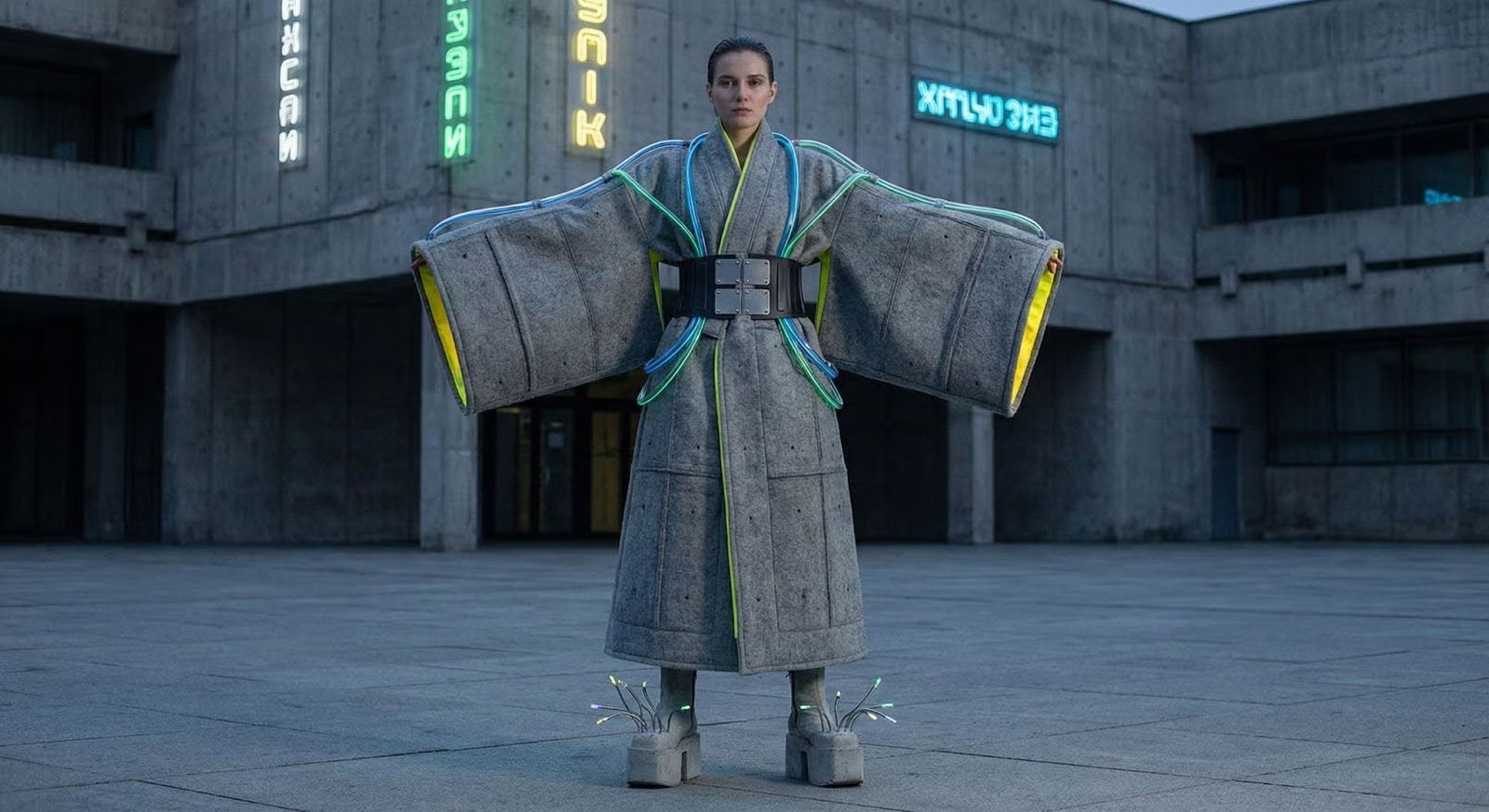
It is good to define what creativity and originality actually mean. One approach is Margaret Boden’s concept, which distinguishes three types of creativity. Combinatorial: creating new combinations of existing ideas, which is where AI excels. For example, when a designer enters “kimono cut + brutalist architecture + neon colors”, AI is able to generate hundreds of variants, from which the designer chooses and curates. Then there is exploratory creativity: systematic exploration and search for new concepts within existing fields and rules. Transformational creativity is essential, when the rules of the game themselves change and significant shifts and changes occur within the entire industry. This is a domain where AI is still fundamentally lagging behind.Current systems are indeed based on learned patterns and tend to generate outputs that are statistically close to the average. However, we have also encountered completely unexpectedly creative outputs in history. An example is the AlphaGO model, which in 2016 played a move against Lee Sedol in the game of Go that seemed completely illogical to everyone involved, but ultimately proved to be victorious. This has often been referred to as an “inhuman” way of playing. What does this mean for the question of originality? Generative AI primarily operates at the level of combinational and exploratory creativity, and most often it really recombines patterns from training data. However, the question is whether our creativity works fundamentally differently. Perhaps the role of humans will be to push the established order in a completely new direction.
Should artificial intelligence enter creative activities, and if so, to what extent?
It is crucial to distinguish between two approaches, namely augmentative and substitutive authorship. Augmentative authorship means that AI extends the creator’s capabilities. It offers variants, speeds up iteration, but the designer remains the bearer of the intention. In the substitutive method, on the other hand, AI generates output with minimal human input and creative control disappears. However, the boundaries are not fixed. This is a spectrum of creative control and we should try to delegate tasks to AI that do not distract us from the final work.
Do you consider the work of a designer or a designer using generative AI to be original?
In my view, anyone who uses AI tools with vision and creative control can be original. Generative AI tools themselves actually create original outputs by their very nature. They don’t search for and copy things from training data. They do tend to gravitate towards mediocrity, but we can largely influence that with the right prompting.
What boundaries would you set for the use of AI in creative fields, specifically in the field of fashion design?
I would say that the role of designers is gradually changing. It will no longer be so much about craftsmanship, but about more complex work – empathy, strategy, orchestration of tools. So it is about complex design thinking. The ability to identify a problem, empathetically evaluate a solution based on the target group, critically evaluate it, then implement it and again modify and optimize it. AI in this context moves the role of people from culturally creative professions to a new, more strategic level. I am not saying that craftsmanship will not be important or will be completely transferred to machines. However, it will no longer be the main indicator of success.
Do you think it is important to address the ethical aspects of working with AI, such as the environmental burden in the form of high water consumption or, for example, who owns and finances the large technology corporations that develop the latest AI models?
The ecological footprint of AI is vast and indisputable. However, we must realize that the entire digital infrastructure has tangible impacts – watching a video on YouTube, sharing TikTok videos, making a Zoom call, watching Netflix, and listening to songs on Spotify. None of these activities are insignificant and have a real impact on the physical world we live in. At the same time, these facts should not paralyze us! The point is not to reject technology, but to understand its real costs and use them consciously. AI and digital tools can make work easier or more efficient in many situations, and it is crucial that their development is done transparently and with respect for people, their rights, and the environment.
How do you perceive another ethical aspect of AI, which is the concern that AI will replace human activity in the creative fields? What do you think is the future scenario for the creative fields with artificial intelligence?
I admit that I don’t know. I would say that in the short or medium term, AI will not replace creatives, but it will significantly change what is expected of them. It will involve a high level of empathy, design and strategic thinking about the world around us. There is also an optimistic parallel. Historically, the so-called Jevons paradox has been true. The point is that more efficient technology historically does not lead to lower consumption, but rather to higher consumption, because new applications are opened up. If AI speeds up and makes the creative process cheaper, this may not lead to a smaller volume of creative work, but rather to an explosion of demand, for example, for a completely personalized form of design with a high level of creative control by human creators.
What is your opinion on AI slop and how to combat this visual clutter of the online space?
AI slop is low-quality digital content produced using AI, and its presence is still growing. Can it be fought? Partially yes, through platforms that will introduce functions to limit AI content. In the future, applications for filtering digital content may also come, such as “spam filters” for the entire digital environment. However, this restrictive principle may be counterproductive and further deepen the process of closing oneself into hyper-personalized information bubbles. In my opinion, the most important weapons still remain media literacy and critical thinking. However, it is getting harder and harder.
When is AI a good helper and tool, and when are we already navigating the waters of the AI slop?
I would say that it depends a lot on the creative vision, taste and intention. We could see slop around us even before AI. It just democratized the approach to its creation. In the context of slop, I also notice a related phenomenon called drama farming. This is deliberately provocative content designed to evoke amazement, dramatic-looking situations or anger in order to maximize engagement. Unlike classic trolling, it is not about individual entertainment, but about systematic, economically motivated monetization of emotions. And generative AI tools dramatically reduce the cost of producing such content. Some networks of pages and profiles even first build their audience with AI slop content, then switch to political content before elections or try to monetize followers through the sale of goods.
In conclusion, Martin Richter points out an interesting thing that we should keep in mind: the highest quality, and therefore the most widely used, AI models are developed by a handful of research and development teams, mostly from the USA. In addition to the concentration of power, there can also be a homogenization of values and ideas about how AI models should work. If AI trained mainly on Western data generates creative designs, there can be a flattening of aesthetics and the marginalization of non-Western traditions and values. These prejudices and stereotypes (so-called biases) are represented in AI models and every author should be aware of them. And I can only think of one thing: whether in the end the most treacherous thing about artificial intelligence is the person behind it.