






|
Neubauer Artists LLC
Getting your Trinity Audio player ready...
|
On the occasion of the exhibition Marilyn Monroe: Hollywood Icon at the Academy Museum in Los Angeles, the legendary pink dress from “Diamonds Are a Girl’s Best Friend” returns to the public. A fragile object, hastily made in the panic of a studio that tried to control Monroe’s sexual image and ended up giving her one of her most immortal myths.
In the white conservation room of the Academy Museum of Motion Pictures in Los Angeles, Hollywood’s most famous pink dress lies upside down, open, almost vulnerable. It is not on Marilyn Monroe, nor on a red staircase, nor in the Technicolor light. It is not surrounded by men in suits, diamonds, gloves, choreographed desire. It lies under the hands of conservators, on paper, like a body on an operating table.
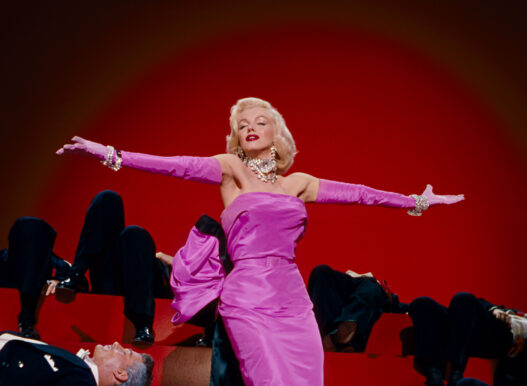
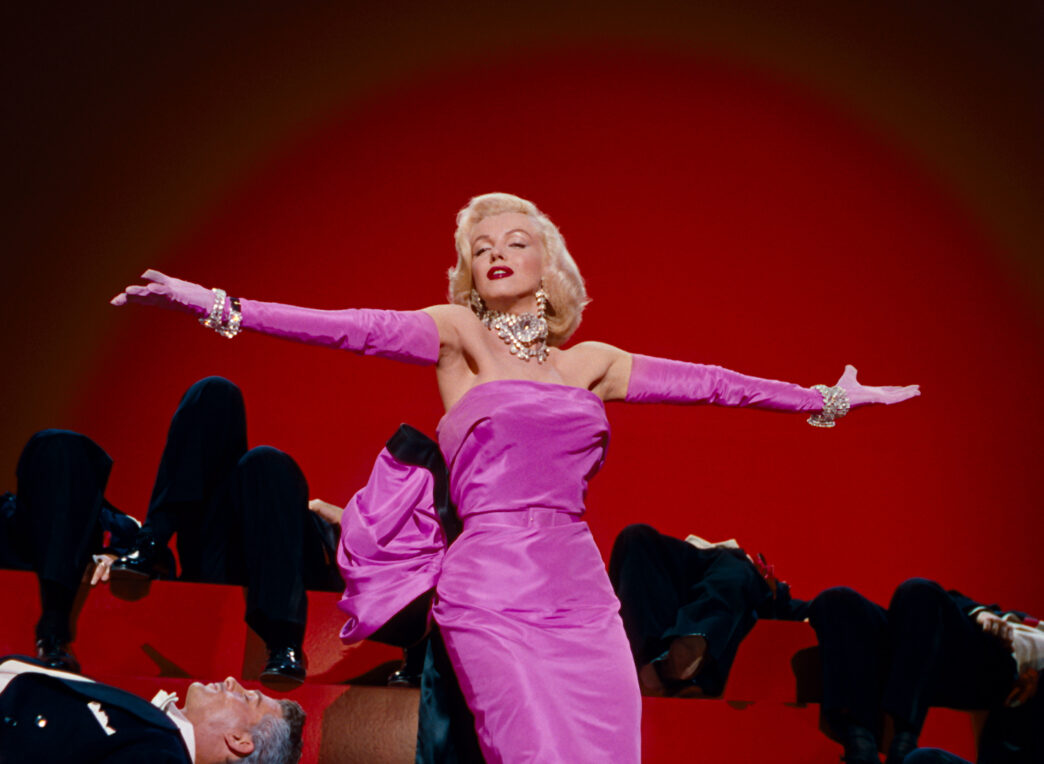
It’s the dress Monroe wore in 1953 in Gentlemen Prefer Blondes, in the number “Diamonds Are a Girl’s Best Friend.” The dress that became an icon before it even became an object. The dress copied by Madonna in “Material Girl,” has returned like a pop ghost in drag scenes, Halloween transformations, editorial photoshoots, Oscar tributes and countless fantasies surrounding Marilyn. A piece of pink satin that for seven decades has said, almost by itself: Marilyn.
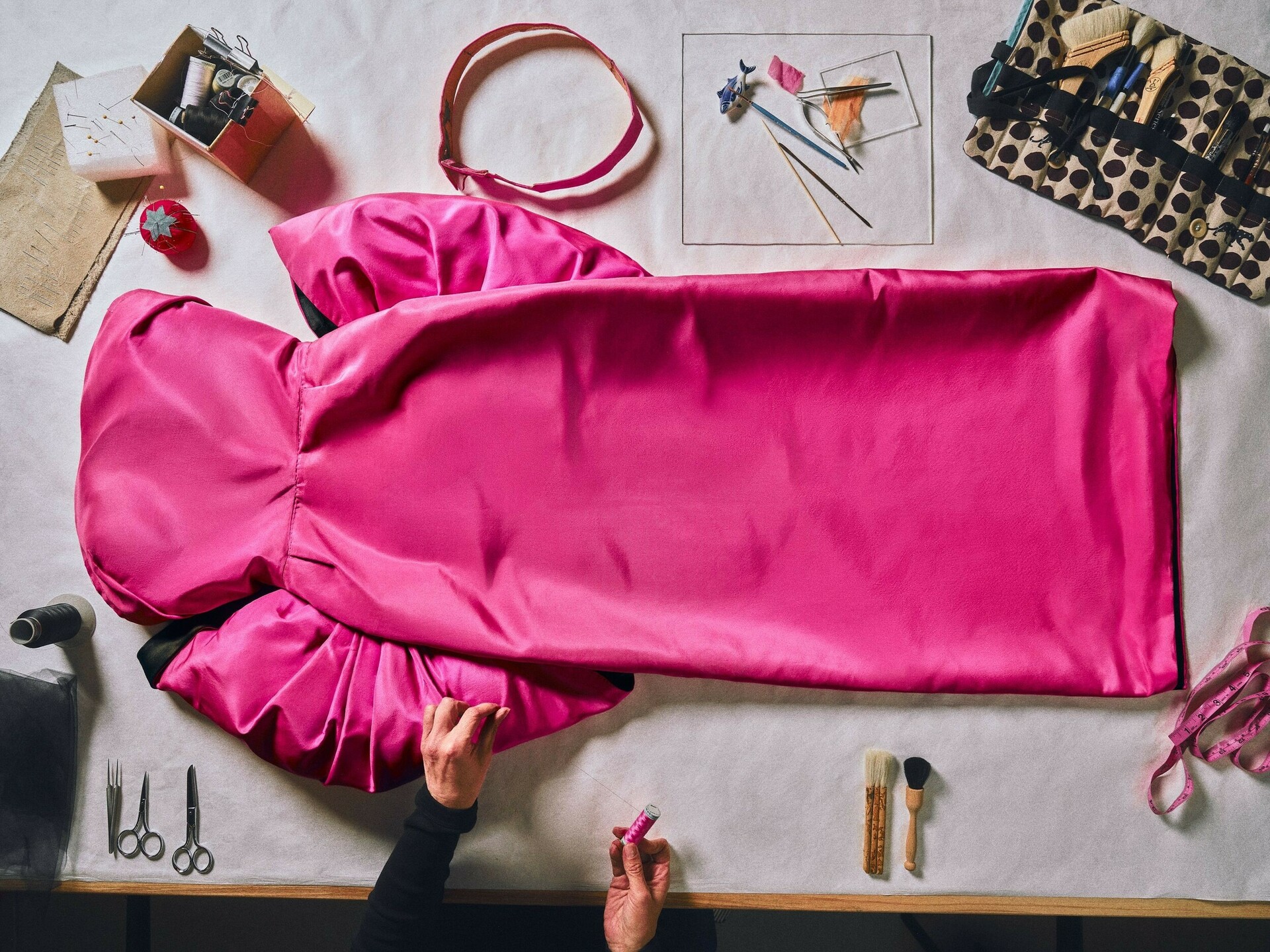
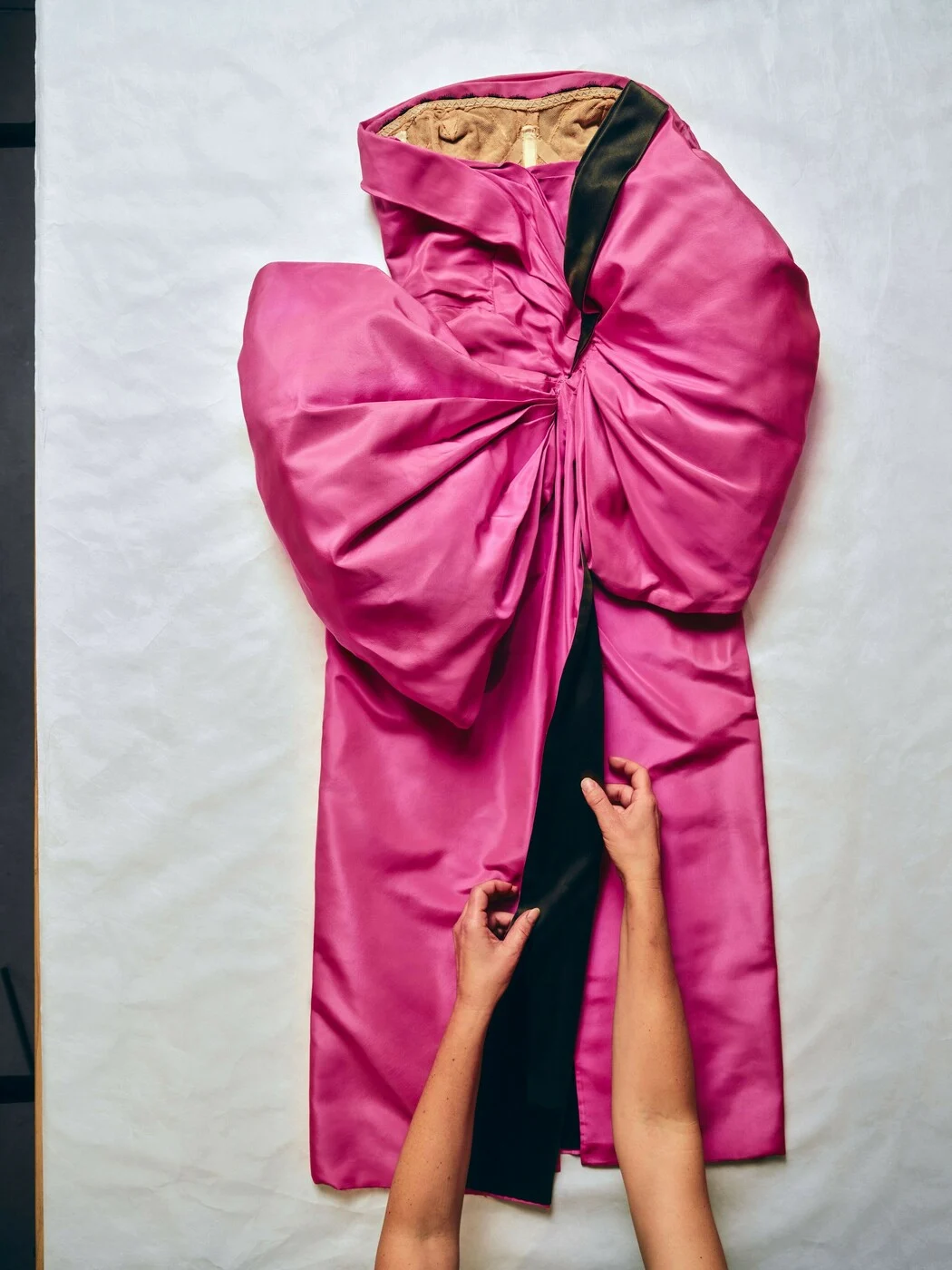
And yet, up close, the dress is not exactly what we remember. It is not just pink. Beneath the explosive surface of the silk there is a black strip that cuts the back, like a small noir shadow in all this sugary femininity. The large bow that on the screen seems almost self-evident is, in fact, a complex system of pleats, volumes, linings and corrections. From the inside, signs of wear are visible, traces of sweat, tension in the seams, small interventions made to enable the dress to withstand Monroe, the lights, the movement, the size.
This is the first, almost indecent lesson of the exhibition Marilyn Monroe: Hollywood Icon, which opens May 31 at the Academy Museum and runs through February 28, 2027, marking the 100th anniversary of Monroe’s birth. One of the most immortal dresses in film history was not made for eternity. It was made quickly, under pressure, as a last resort. It was, materially speaking, a temporary object. Mythology made it a monument.
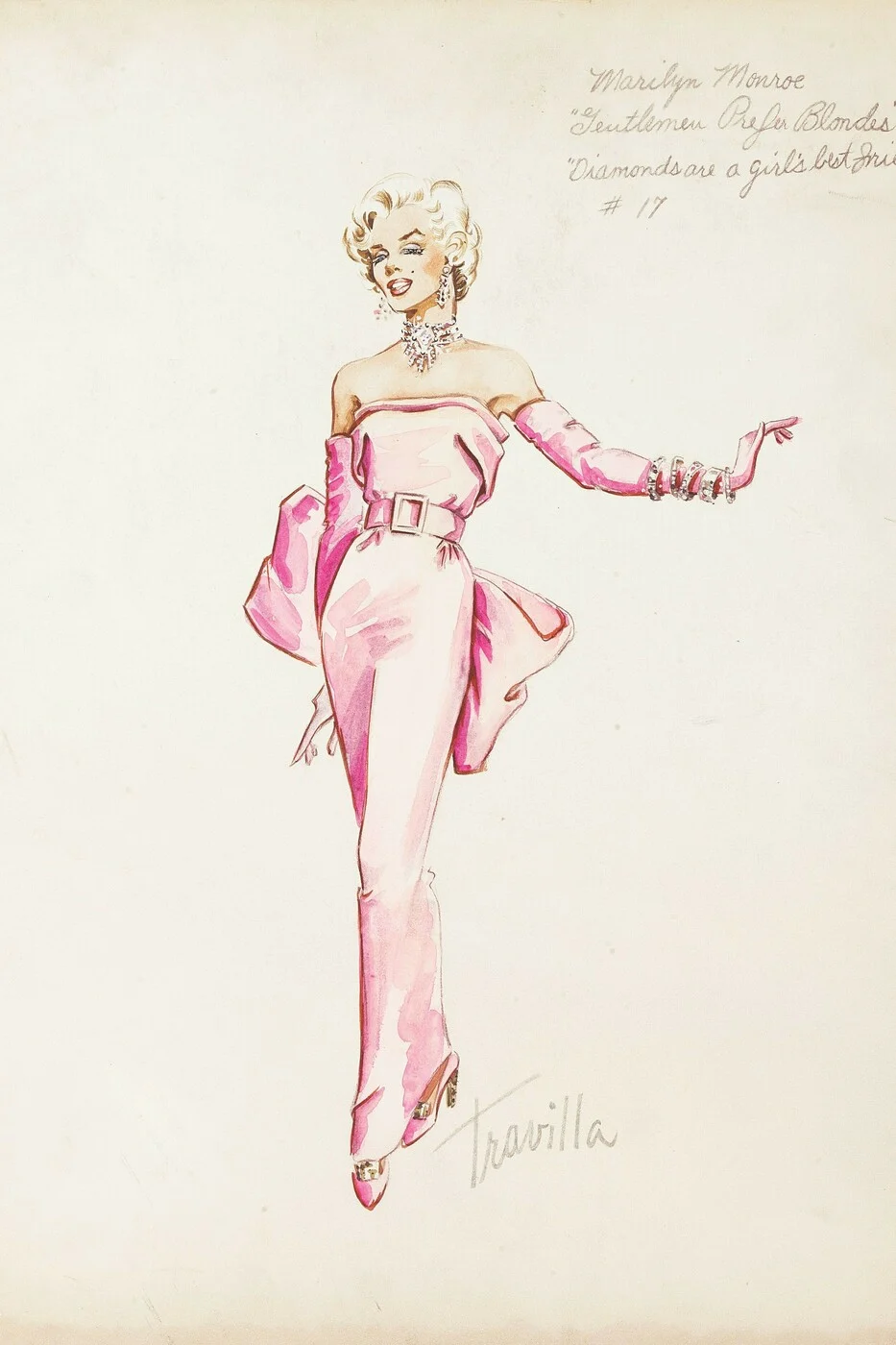
The story begins with a scandal that today seems almost prehistoric and at the same time completely modern. The original costume for “Diamonds Are a Girl’s Best Friend” was not the pink dress we know. William Travilla, the costume designer who dressed Monroe in some of her most recognizable moments, had designed something much more daring: an almost showgirl costume, black, revealing, full of glitter, fishnet and burlesque mood.
Then the nude calendar photos Monroe had taken years earlier as Norma Jeane, for a pittance because she needed to pay the rent, resurfaced. By the early 1950s, however, she was no longer an unknown young woman trying to survive. She was Fox’s new bet. She had already made All About Eve, The Asphalt Jungle, Monkey Business, and Niagara. The studio was investing in her. And the studio panicked.
Monroe’s reaction was unexpectedly modern. She didn’t deny the photos. She didn’t say they weren’t her. She didn’t try to erase the old Norma Jean to protect the new Marilyn. She told the truth. She had taken the photos because she needed the money. She had no reason to be ashamed. The studio, on the other hand, had every reason to try to rebuild her image. Quickly.
And so, in no time, the overtly sexy showgirl costume was replaced by the pink dress.
This is the paradox of the dress: it was created to “clean up” Monroe’s image, but it became one of the most charged erotic objects in cinema. It was designed to make her more acceptable, more polished, safer for the studio. It ended up doing something far more dangerous: condensing her very genius as a performer. Not naked, not exactly covered. Not innocent, not cheap. Not a victim of the gaze, but its absolute handler.
In “Diamonds Are a Girl’s Best Friend,” Lorelai Lee descends a red staircase into a world of men who exist almost exclusively to frame her. The scene is constructed as a fantasy of wealth, marriage, diamonds, spectacular femininity. But Monroe is not simply playing the “dumb blonde” chasing money. Lorelai knows. She knows the market, the gender, the desire, the exchange value of her beauty. She knows that the world sees her as an object, and she uses that assumption to organize her own spectacle.
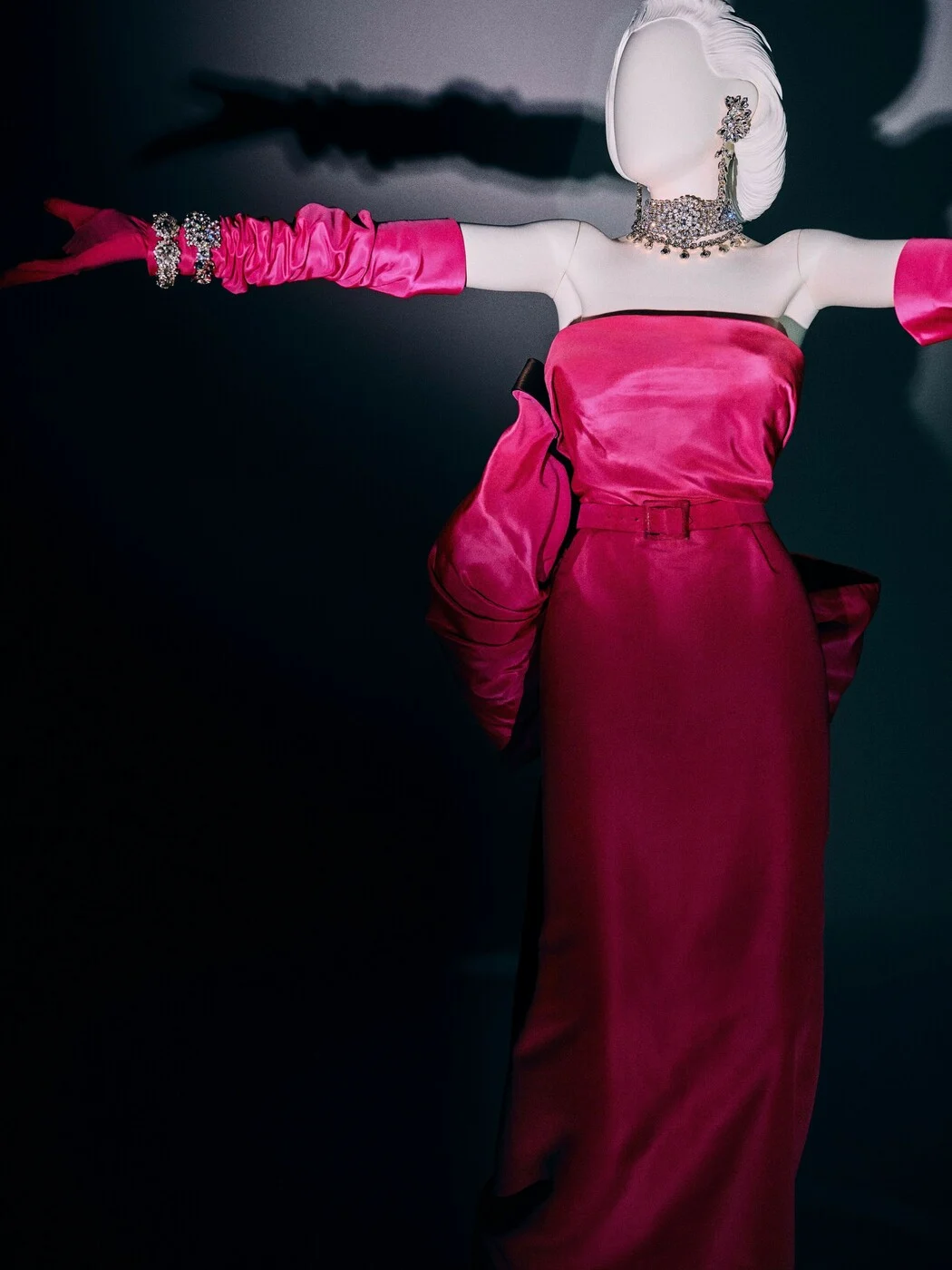
The dress is central to this organization. Its pink is not innocent. It is exaggerated, artificial, almost sugary. It is the color of manufactured femininity bordering on irony. Together with the long gloves, the jewelry, the bow and the column of the body, it creates an image so pure that it immediately becomes a myth. But this purity is the result of enormous work. There is nothing natural about Hollywood’s most famous “natural” sex symbol.
Monroe knew this better than anyone. The Academy Museum exhibition doesn’t just present her clothes as sacred objects of a star. It examines the ways in which she shaped, selected, controlled, and corrected her image inside and outside the studio system. Monroe studied photo contacts, selected shots, rejected negatives, cut out images she didn’t want to be released. What the world saw as mere glamour was often the result of meticulous self-direction.
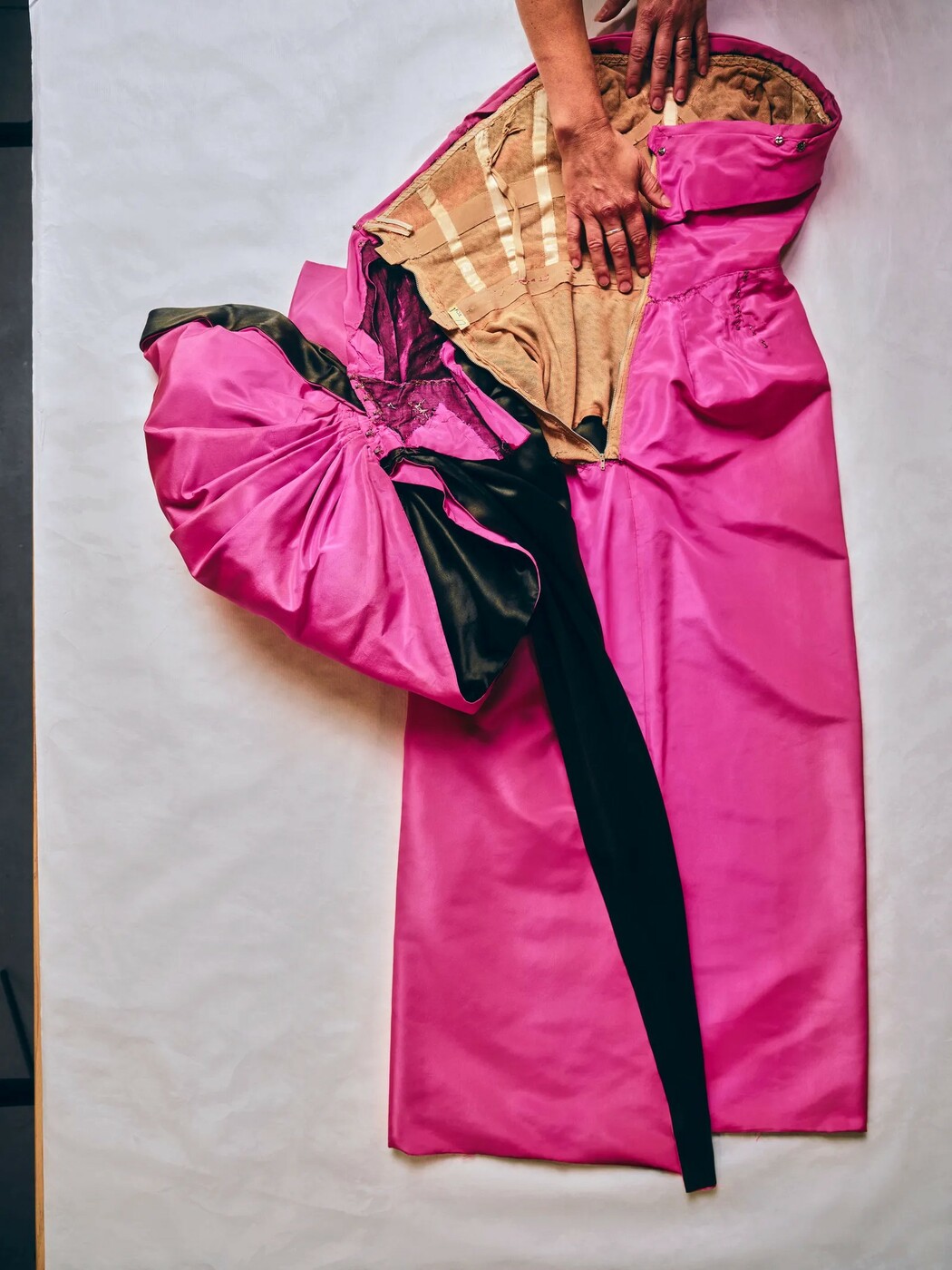
That’s why it’s important to see the dress not just as a fetish, but as a mechanism. This object is not just “Marilyn’s pink dress.” It’s the meeting point of a scandal, a studio in panic, a costume designer forced to improvise, a woman who refuses to be ashamed, an industry that sells desire while fearing women’s sexual pasts, and a performer who understands that the best defense against the gaze is to hypnotize it.
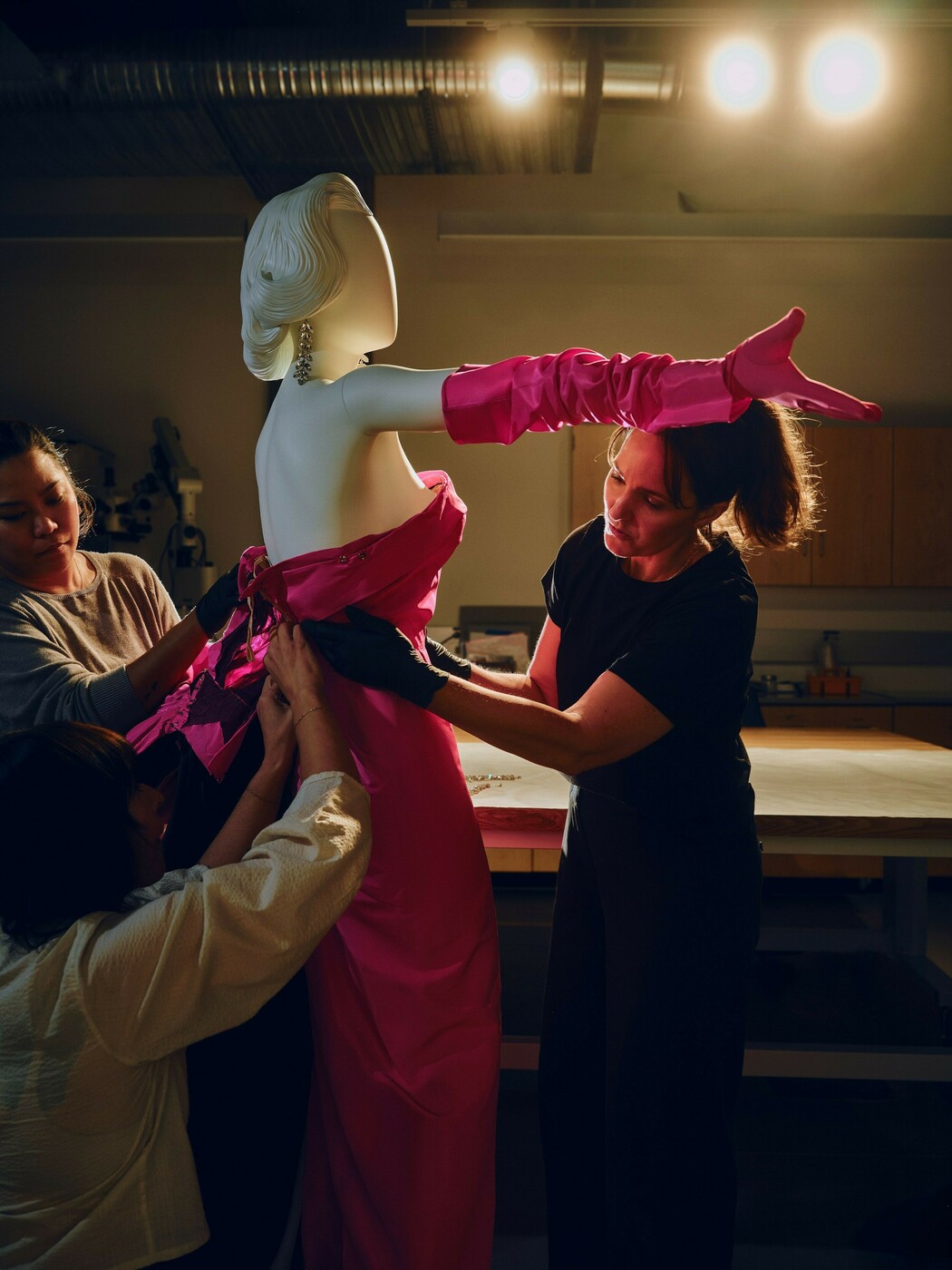
The preservation of the dress makes this engineering visible. From the inside, the object loses the self-evident perfection of the screen. The seams, the pressure points, the traces of heat, Travilla’s practical intelligence are visible. The dress had to be light enough to move, solid enough not to fall apart, spectacular enough to replace the discarded black suit, “clean” enough to reassure Fox, sexy enough not to betray Marilyn.
What on screen looks like a flawless pink idea was actually a constant compromise. And yet, that’s where its durability was born. The perfection of the dress didn’t lie in its perfection. It lay in its concealment of the pressure seams so effectively that the pressure became a glow.
If you look at it this way, the dress almost looks like Monroe herself. Made to last a while, doomed to last forever. Fragile, but immortal. Constructed, but true in effect. An object made of fabric, sweat, panic, studio, mistake, correction, and a woman who knew how to turn exposure into control.
The dress’s second life was almost as cinematic as its first. After it left Fox, it was purchased by Michael Shaw, the legendary Hollywood collector who once owned Dorothy’s red slippers from The Wizard of Oz. The price today seems almost comical: $12 for the dress, along with an extra outfit for another $2 — likely an alternate pink prototype from Travilla’s tests for the scene.
One of the most famous outfits in the history of cinema, cheaper than a meal today. But that’s often the case with objects of spectacle. Before they become sacred relics, they are production materials. Before they become myth, they are practical solutions. Before they enter the museum, they have survived warehouses, collectors, mistaken identifications, rumors, auctions, private homes, memory and luck.
For years, the dress almost disappeared into collector mythology. Rumors circulated that it had been lost, that it had been destroyed, that it had been confused with one of its many reproductions. Brian Jones, co-founder of the Icon Collection and its current owner, had been searching for evidence of its existence for years. He found it, almost like a cinematic find, in the depths of a documentary about Dorothy’s little red shoes: there, in footage from the 1970s, the pink dress was seen on a mannequin in a shop window. It was there. It had survived.
Then came a search of auction lists, transaction records, old records. In 2010, the dress appeared in a Profiles in History auction and was purchased anonymously for $310,000. Later, Jones tracked down the buyer’s family, who had since passed away. His son only remembered that his father had bought the dress for his wife. A few days later, they found it. And finally, they agreed to part with it.
This journey has something of the strange fate of Monroe herself: all too familiar as an image, but constantly lost as a reality. Everyone knows the dress. Few know the object. Everyone knows Marilyn shining on the staircase. Few know the woman who had to handle a studio, a scandal, an audience that wanted her available but not “guilty”, desirable but not self-willed.
The exhibition at the Academy Museum taps into this contradiction. It is not set up as a simple chronological biography. Rather than retelling Monroe’s life as a familiar drama—Norma Jean, studio, fame, pain, death—it examines the ways in which her public image was constructed and the ways in which she herself actively participated in that construction. The costumes, the contracts, the scripts with notes, the objects from her Brentwood home, the photographs, all act as evidence of a more complex Monroe: not only a product of the system, but also a reader of the system.
The space where the pink dress will be displayed will be set up as an intimate, almost magical room. The dress itself will be lit in two ways. From the front, its pink will be enhanced to resemble the glow of Technicolor. From the back, the visitor will see something closer to its actual material state. The museum, in other words, allows the dress to do what Marilyn always did: exist in two versions at once. The fantasy and the fact. The face and the construction. The pink light and the black stripe.
This double vision is perhaps the most appropriate way to talk about Monroe today. For decades, each new reading of her life has tried to “uncover” the woman behind the symbol, as if the image were fake and only the pain was real. But in Marilyn’s case, things are more complicated. The image was not just a prison. It was also a tool. It exploited her, limited her, consumed her, but it also gave her a field where she could exercise terrifying precision.
In “Diamonds Are a Girl’s Best Friend,” that precision is everywhere. In how she moves her hands. In how she tilts her head. In how she lingers over a word. In how she makes an innocent expression seem like a strategy. In how she plays the surface without fully believing it. Monroe doesn’t make fun of Lorelai. She takes her seriously. And that’s the secret of the scene. She doesn’t present a woman who knows nothing. She presents a woman who knows exactly how the room works.
That’s why the pink dress has survived so strongly. It’s not just pretty. It’s not just iconic. It’s a power suit disguised as candy. The bow, the gloves, the pink, the diamonds, the cartoonish femininity, everything seems to say, “Look at me.” But Monroe, in it all, seems to be saying something cooler and smarter: “I know you’re looking.”
The irony is that the dress was born out of an attempt at control. Fox wanted to protect its investment. It wanted to turn a scandal into a clean image. It wanted to limit Monroe’s sexual threat without losing her commercial power. That’s exactly what Hollywood did at the time with the women it sold: it wanted them dangerous enough to fill theaters, but controlled enough not to spoil the product.
Monroe, however, managed to stand inside this machine without completely getting lost in it. It doesn’t mean she defeated the system. The system corrupted her, used her, consumed her, often left her without any real protection. But moments like “Diamonds Are a Girl’s Best Friend” show that Monroe was never just the woman on whom the fantasy was projected.
She was a co-creator of the fantasy. Maybe that’s why she keeps coming back. Not because she was the most beautiful, the saddest, or the most wronged. But because within her very construction there is still a gaze that seems to know more than it is supposed to know.
The dress, opened today in the conservation room, is a reminder of just that. That every great image has seams. That every immortal object was once a hasty solution. That every fantasy has a flip side. That beneath the pink there is always a black line. And that Marilyn Monroe, perhaps more than any other star of the 20th century, managed to make even the seams of her mythology shine.
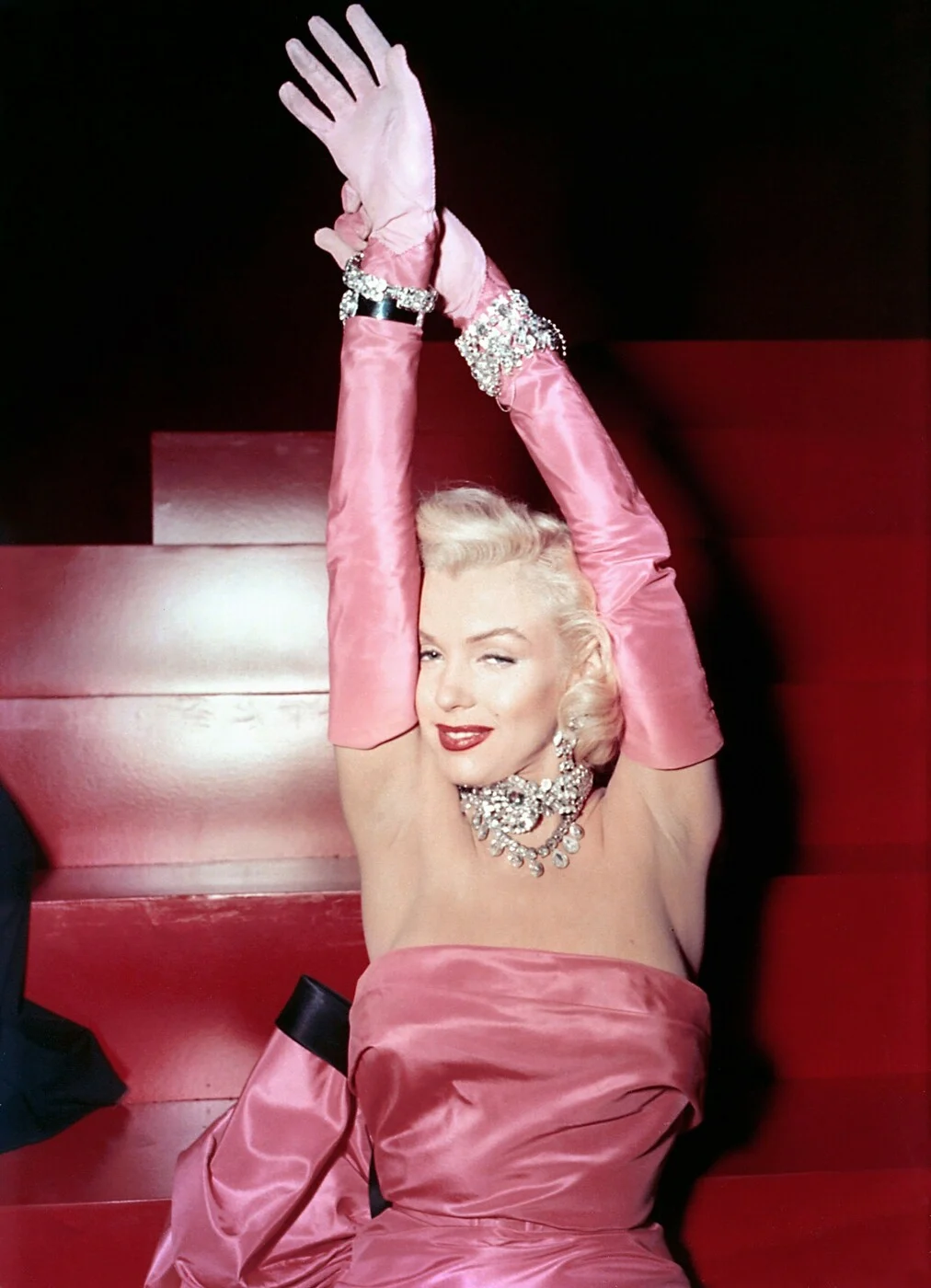
In the end, the most touching thing about the pink dress is not that it was saved. It’s that it was saved as something more fragile than its myth. Not as a flawless symbol, but as an object that carries the sweat, the pressure, the invention, the anxiety, and the terrible discipline of an image that was supposed to look easy.
Marilyn sang that diamonds are a woman’s best friend. The dress, seventy years later, says something more accurate: in Hollywood, a woman’s survival often depended on how well she could turn the control of others into her own stage.
And Marilyn, in that pink dress, didn’t just wear a legend. She directed it.
with elements from Vogue