


|
Neubauer Artists LLC
Getting your Trinity Audio player ready...
|
Chinese car brands are successfully penetrating the German luxury car market. They are exploiting the gap left by German automakers.
The Aachen-based car dealership group Jacobs is introducing the Denza brand to take advantage of the change.
But Chinese cars often lack a sense of quality, says one expert.
The days when affluent car buyers knew exactly what they wanted are over. “In the past, prospective buyers often came to us with a specific make and model in mind. Today, the vehicle size, intended use, and available budget are usually the first things determined,” reports Marijan Luckas. “The decision for a particular brand is often only made later in the consultation process.”
Luckas is the sales manager at the Aachen-based car dealership group Jacobs and is responsible for leveraging this change. Jacobs, primarily a dealer of VW Group vehicles, was the first dealer in Germany to add the Chinese brand Denza to its portfolio a few weeks ago.
With these cars, the Shenzhen-based BYD Group aims to break into the pride of domestic automakers: the luxury segment. There’s a good chance that this venture will succeed not only for BYD, but also for other manufacturers from the People’s Republic. Car dealerships like Luckas play a key role in this.
In China, not only Denza but also Xiaomi is putting pressure on its German competitor Porsche. The company, known for its mobile phones, is now also planning to launch its SU7 sports car in Germany. This is expected to happen next year. Chery is positioning the Freelander brand, acquired from Land Rover, as a new international premium brand, and competitor Geely has entered the important German company car market with its luxury brand Zeekr. VW partner Xpeng also intends to significantly increase its deliveries in Europe.
“The significant price changes of recent years have led many people to compare offers more closely. This also gives brands a chance that previously weren’t part of their personal selection process,” says Sales Manager Luckas in Aachen. In other words: Chinese luxury cars are entering a gap that German manufacturers themselves created when they increasingly shifted their models into the luxury segment.
German car manufacturers are becoming increasingly expensive – thus leaving a gap
This pushed the German luxury car segment out of the financial reach of traditional middle management executives. In 1990, a BMW 5 Series cost just under €40,000 in today’s purchasing power; by 2000, it was a good €50,000. Today, the list price is €60,000. The trend is similar for the Audi A6. The price of the Mercedes S-Class, adjusted for inflation, has almost doubled since 1990 – to €120,000.
“Denza benefits from being part of the BYD Group. Many customers already associate BYD with expertise in battery and electric mobility technology,” says Marijan Luckas. “What matters is not the origin of a brand, but whether the product, technology, quality, price, and service are convincing.” For example, the Denza Z9 GT electric sports car costs around €120,000, roughly the same as the Porsche Taycan 4S Sport Turismo, but with 1,156 hp, it boasts twice the power on paper.
Christoph Burmann, a marketing professor at the University of Bremen with a teaching position in China, believes that such an advantage puts the Chinese in a better starting position than the luxury offshoots of Japanese and Korean car manufacturers like Lexus and Genesis, which find hardly any buyers in Germany.
While these brands have only partially succeeded in reaching the technical level of German manufacturers, the Chinese have overtaken the Europeans across the board in electric cars. This opens up the possibility of presenting the new models to the target group as a more innovative choice – and thus also convincing performance-oriented target groups such as managers.
Europe is of interest to Chinese car manufacturers
For Chinese luxury car manufacturers, the European market is highly attractive because prices are significantly higher than in their home country. While a Xiaomi costs only a fifth of a Porsche Taycan in China, Burmann explains that in Europe it makes sense to limit the price discount to between ten and 25 percent. A price that is too low could even signal a lack of quality. This way, the Chinese could earn many times the profit per car in Europe compared to their domestic market.
German luxury car manufacturers are only cautiously preparing for the onslaught. “We haven’t yet noticed any impact on our sales figures in Europe. But we’re continuing to monitor the situation,” said BMW CEO Milan Nedeljkovic in the mid-year call. Mercedes CEO Ola Källenius expressed a similar sentiment. According to official statistics, registration figures for luxury brands are still in the low hundreds or low thousands. But the competition’s offensive is only just beginning – and the Chinese have learned their lessons from the initially bumpy, then rapid launch of their mass-market brands in Europe .
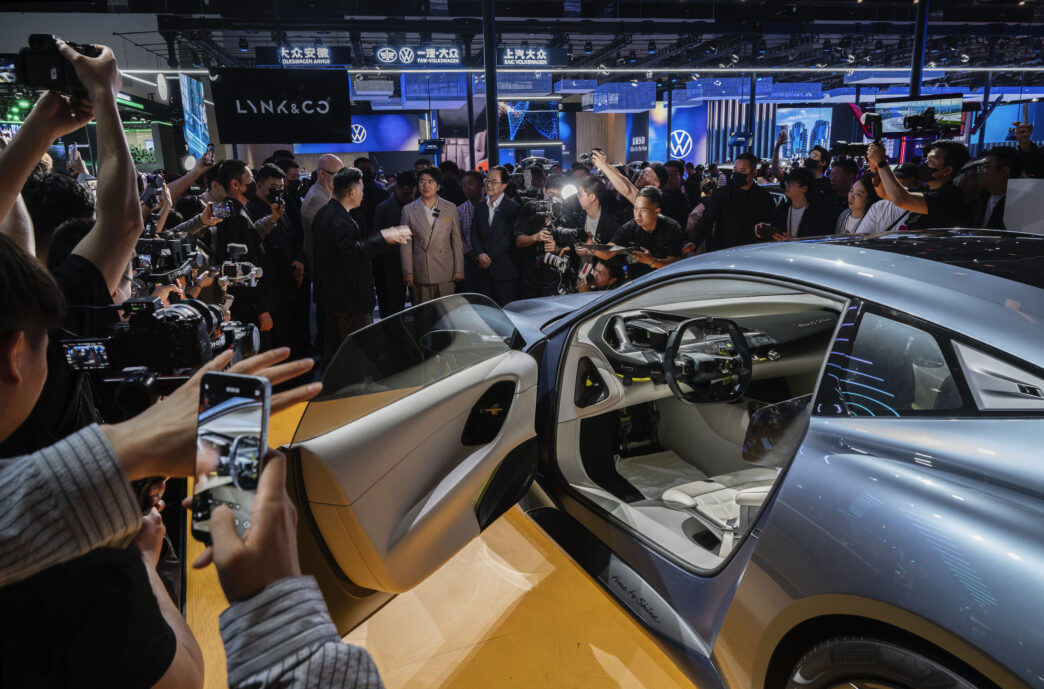
Christian Treitz knows this learning process firsthand. He’s tasked with making the Lynk & Co. brand a success for the Geely automotive group. At its launch, the mid-range brand served as an experimental platform for a new sales model: the cars were to be offered through company-owned dealerships, known as clubs, via subscription, or as car-sharing vehicles. However, the venture failed to achieve success. In all of 2025, only 703 Lynk & Co. cars were registered in Germany. The conclusion drawn from the experiment: “An automotive group needs dealers. They are the face of the brand,” says Treitz.
The head of the German branch is winding down the company’s own showrooms and is now cooperating with 23 established dealerships that already offer the sister brand Volvo. They are expected to leverage their existing customer relationships and local trust to establish the still relatively unknown brand. Instead of large national advertising campaigns, they are focusing on regional initiatives. “The classic marketing approach is making a comeback,” explains Treitz.
This experience has taught Geely lessons that it will continue to learn for its upcoming premium models. For example, the company postponed the launch of its Zeekr brand until the end of 2025 – until a network of service centers is established. Here, too, Geely is moving away from its own dealerships and seeking to partner with corporate clients. Zeekr aims to score points with a similar formula to Lynk & Co: For the base price of a German competitor, it should offer a full range of features.
Aachen-based car dealer Luckas confirms that this formula works: “Often, many features are already included in the standard equipment that other manufacturers require as additional packages. This makes the vehicle easier to compare for customers and the final price more transparent.”
Chinese car brands do not advertise
As strategic as the Chinese approach their market entry, unlike the Japanese or Koreans of previous decades, they don’t rely on a masterful brand presence. In 1996, for example, the red lips of the Korean car brand Daewoo were impossible to miss. The company blanketed Germany with advertising across all available channels at the time: television, billboards, radio, and print ads. The mouth displayed the correct pronunciation, “Dee-Juu.” Daewoo spent 50 million marks on the campaign for its market launch in Germany—equivalent to roughly 43 million euros in today’s purchasing power.
Now, with the arrival of the Chinese, there is no campaign on a scale comparable to the one that launched the Daewoo car brand – which failed during the Asian financial crisis over two decades ago. This is not only because internet advertising and influencer marketing have become more important.
Experts see a fundamental weakness in the marketing of newcomers: “Chinese manufacturers lack a coherent brand strategy with which they could achieve their ambitious goals in the premium segment,” criticizes Beatrix Keim, director of the CAR Institute in Bochum. She adds that they lack knowledge of the European market. “There’s an assumption that it’s enough to simply enter the market and thereby generate media coverage. But that’s not enough for people to understand what’s behind it.”
Professor Burmann suspects a different motive behind the comparatively quiet appearance: As long as the EU is discussing defensive measures against Chinese car manufacturers, the Chinese do not want to add fuel to the fire and become too visible.
Car dealers remain important
Either way, the Chinese still have gaps in the details of their brand presentation. When Lars Bialkowski, head of Denza Germany, opened the first Denza showroom in a prime location in downtown Hamburg this summer, the brand logo was only a simple sticker on the wall. Meanwhile, competitor Zeekr’s website displays an error message specifically for its core business offerings.
Christoph Burmann identifies similar oversights in cars: the feel of the materials and the smell of new cars often fail to convey the desired sense of quality, he criticizes. The professor doesn’t write off German manufacturers entirely, however. But he cautions that they must make an effort to catch up technologically. And they should leverage their established customer relationships to better meet the needs of Europeans.
However, the expert doubts that customers are currently a top priority for corporate executives. The heads of Audi, Porsche, BMW, and Mercedes are preoccupied with something else: they are struggling with their employees over ever-new cost-cutting programs. Meanwhile, the Chinese are hiring new staff in Europe.