

|
Neubauer Artists LLC
Getting your Trinity Audio player ready...
|
- A federal judge in Miami denied Tesla’s bid to overturn a $243 million jury verdict in a lawsuit over a fatal Autopilot crash.
- The suit focused on a 2019 collision that killed a 22-year-old woman, Naibel Benavides, and severely injured her boyfriend, Dillon Angulo.
- In her order published Friday, U.S. District Court Judge Beth Bloom wrote that “evidence admitted at trial more than supports the jury verdict,” and there was no justification for a new trial.
A federal judge in Miami denied Tesla’s bid to toss out a $243 million verdict in a lawsuit that requires the automaker to compensate the family of a 2019 fatal Autopilot crash victim as well as a survivor.
The collision, which occurred in Key Largo, Florida, killed 22-year-old Naibel Benavides and severely injured her boyfriend, Dillon Angulo. Tesla owner George McGee was driving his Model S sedan while using the company’s Enhanced Autopilot, a partially automated driving system. During the trial, McGee said that when he dropped his phone while driving and scrambled to pick it up, he thought the system would brake if an obstacle was in the way.
McGee’s car instead accelerated through an intersection at just over 60 mph, hitting a nearby empty parked car as well as Angulo and Benavides, who were standing on the other side of their vehicle.
A jury determined last year that Tesla should be held partially responsible for the fatal crash. Tesla filed to appeal the suit, seeking to have the verdict tossed or to proceed with a new trial.
In her order out Friday, U.S. District Court Judge Beth Bloom wrote that “evidence admitted at trial more than supports the jury verdict,” and there was no error previously, or additional argument introduced justifying a new trial or change to the earlier verdict.
“We are of course pleased, but also completely unsurprised that the honorable Judge Bloom upheld the jury’s verdict finding Tesla liable for the integral role Autopilot and the company’s misrepresentations of its capabilities played in the crash that killed Naibel and permanently injured Dillon,” Brett Schreiber, lead trial counsel for the plaintiffs in the case, said in a statement.
Attorneys for Tesla didn’t immediately respond to a request for comment.
The ruling marks the latest setback for Elon Musk’s automaker as the company tries to play catch-up in the nascent robotaxi market. Tesla is way behind Alphabet’s Waymo in the U.S. and Baidu’s Apollo Go in China, as both companies offer commercial ride-hailing services. Musk said last month that Tesla will have a “widespread” network of driverless robotaxis in the U.S. by the end of 2026, but the company doesn’t yet offer driverless ride-hailing services widely and only operates a handful of robotaxis in Austin, Texas.
Gibson Dunn, which represented Tesla, had argued that compensatory damages in the Florida case should be steeply reduced from $129 million to no more than $69 million, which would have resulted in Tesla having to pay a $23 million award. The firm also said punitive damages should be eliminated or reduced to, at most, three times compensatory damages due to a statutory cap in the state of Florida.
NTSB: Tesla’s Autopilot steered Model X into highway median, causing fatal crash
Two-year federal investigation also lays blame on lax regulations, driver distraction, damaged highway safety device
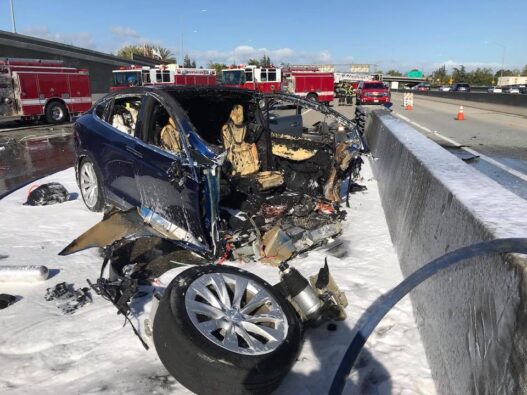
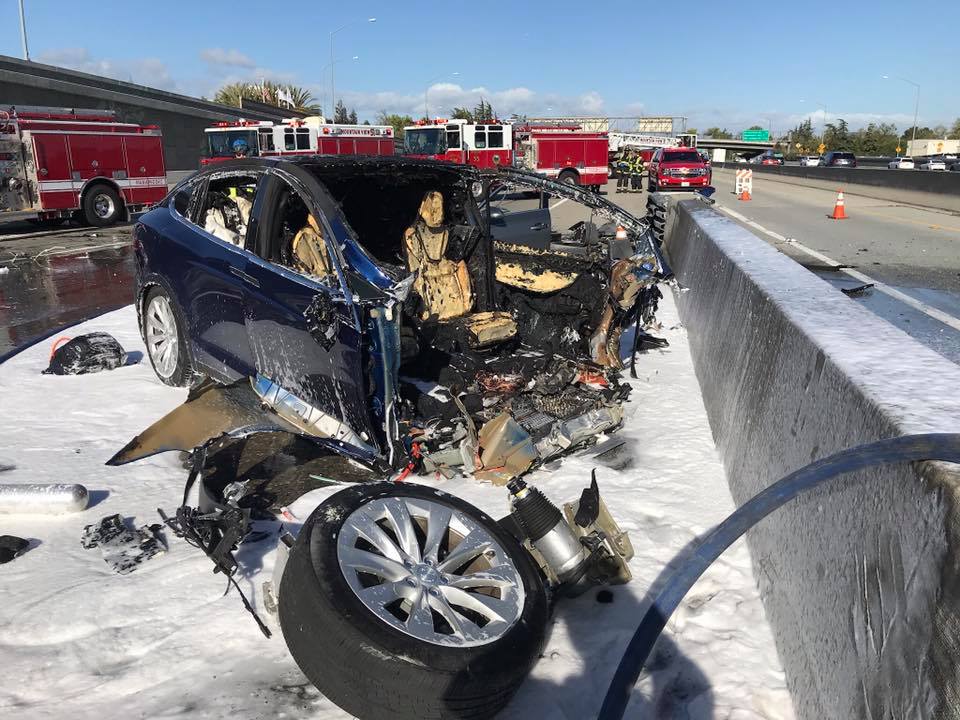
A 38-year-old Apple engineer died from a high-speed crash because his Tesla Model X’s Autopilot driving system steered the car into a median on Highway 101 in Mountain View in 2018, federal officials concluded Tuesday, following a two-year inquiry.
The probable cause of the crash, approved by the National Transportation Safety Board (NTSB) at the Feb. 25 meeting, lays significant blame on Tesla for shortcomings in the electric car company’s partially autonomous driving system. But it also points to driver complacency as a significant factor in the crash — he was likely playing a video game at the time — along with larger concerns that car manufacturers are marketing and selling autonomous features without adequate testing and clear disclosure of the limitations.