





|
Neubauer Artists LLC
Getting your Trinity Audio player ready...
|
hen you talk to people about Coco Mellors’ books, their eyes tend to either go very wide or very bright, or both at the same time. It’s the effect of falling deeply in love with one or several of the writer’s characters across her two hit books Cleopatra and Frankenstein and Blue Sisters.
Mellors, whose books have spent weeks in the best-selling lists, knows how to create characters and dialogue so real, intriguing and sparky that they jump off the page and stay with you long after finishing her books. She presents the messiness of life with a luster that draws you in.
And now she’s back in true form with a third novel, Grenade. Out on 8 April 2027, the book tells the story of filmmaker Zuzu who goes to Paris to present her first feature. She only has a short time there before she needs to go back to LA and try, once more, for a baby. At 34, Zuzu has suffered from multiple miscarriages and is determined to conceive. But Paris, in the midst of a heatwave, has different ideas for her. As other characters – friends and previous lovers – come back into her life, Zuzu is pulled off course and the existence she so meticulously built is thrown into question.
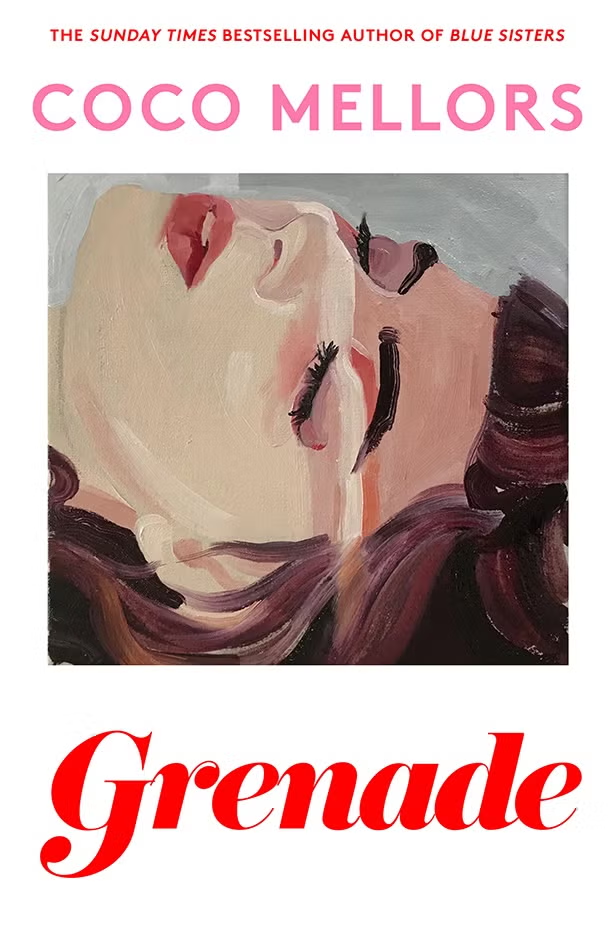
At the heart of the book is a contradiction that many women will know well: the longing for motherhood and stability, and the urge to run wild, creative and free. It’s this tension, which Mellors says a lot of women don’t talk about, that propels the storyline.
Mellors tells George V Magazine that the idea for the book came from her own trip to Paris. ‘My husband and I were trying to have a baby, but he was already back in the US. I realised if we wanted to try that month, I would need to fly home even though I desperately wanted to stay in Paris and write.’ The situation sparked an intense shift for the author. ‘That was when I realised my life, and my sense of freedom, had already seismically changed the moment I decided I wanted to be a mother – not when the baby arrived, as I had assumed. It was a drastic inner change, but no one but me could see it.’
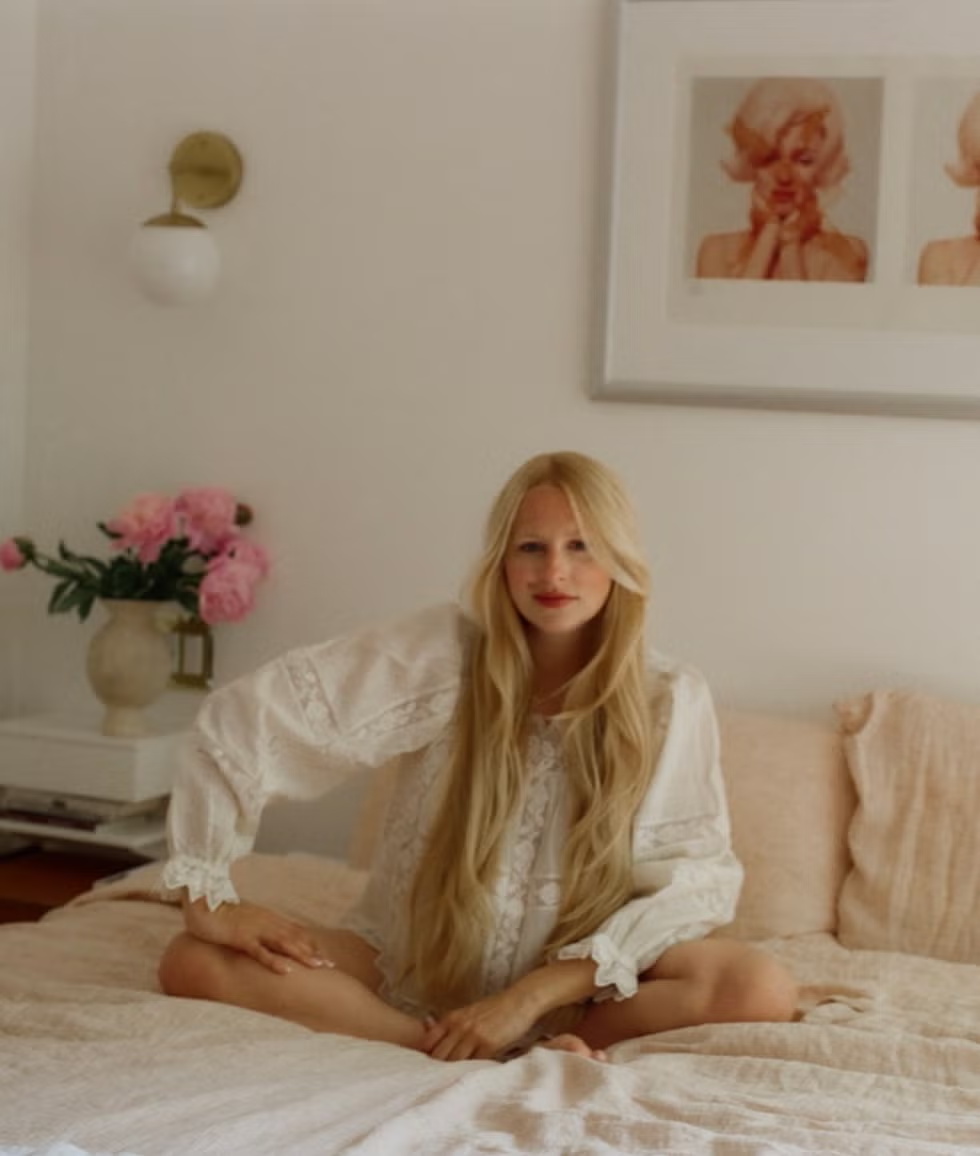
Some of the book was written during deeply personal and painful moments for Mellors, when the words seemed to flow even more. ‘There is an internal monologue in the second half of the book in which the narrator lists everything women go through physically — from period pains to pregnancy loss to birth trauma to menopause — that is rarely acknowledged in society. I wrote it in the wake of my second miscarriage, and it just poured out of me.’
While Mellors would normally join writing groups, she worked on Grenade in total privacy for over two years without showing it to anyone else. ‘Even though Zuzu and I are very different, I find writing in first person incredibly vulnerable, so I had to go somewhere very private inside of myself to write her the way I needed to. Even now, my mum, sister and husband are the only people in my life who have read the book outside of my publishers.’
And now the book is starting to make its way into the public? ‘I’m both desperate for other people to read it and a little terrified,’ says Mellors. And when they do, the author wants readers to come away with one lasting feeling: ‘Hope. Always and forever hope.’
Read an exclusive extract from Grenade by Coco Mellors:
Paris, Day One
I walk out of the airport into a cloud of cigarette smoke. It’s disgusting. It’s delicious. Three years since I quit and I still feel like a smoker. I should have gotten hypnotized, like all the actors do, but I wanted to do it the traditional way, through suffering and pride. The last cigarette I smoked, I stubbed out on my inner thigh. I still carry the pale circle left by the ember, several shades lighter than the rest of my skin, a moon barely visible in a daylit sky. I don’t notice it often, but when I do, I’m always surprised by the person I used to be. It’s a relief to feel that I’m not her anymore, though I’ve never lost the fear that I could be again.
If I was to rewrite Dante’s Inferno, one of the circles of hell would be trying to find the car you ordered to collect you from the airport after a long flight. I search up and down the road at the arrivals level, maneuvering past harried families with their mountains of luggage and clusters of old men smoking while looking existentially pained, then realize I’m apparently on the wrong floor and stagger down to departures, arriving at the next level just in time for my driver to cancel and leave. By the time I manage to book and locate the next car, I feel as though the journey here has somehow doubled in length. As I tumble into the back seat, the driver looks at my name in his phone and starts to laugh.
“Zuzu?” he says. “C’est vous?”
“C’est moi!” I say gamely, already meeting the limits of my French. The driver only laughs and shakes his head, as if he feels sorry for me.
I was named after George Bailey’s daughter in It’s a Wonderful Life, my father’s favourite movie. Zuzu Bailey utters the most famous line in the film: Every time a bell rings an angel gets his wings. She doesn’t figure in the movie in any other meaningful way. Her role is to make George recognise the miracle of his life. She is not the miracle.
Everyone thinks they’re original when they ask if Zuzu is my real name, as if incredulity is the same as wit. I’ll never understand it. A green anaconda can swallow a grown man whole. One teaspoon of a neutron star weighs the same as the entire human population. The world is surprising, strange, and infinitely unfamiliar. A name that sounds like someone sneezing twice in close succession should be the least of our daily astonishments!
As we drive into the city, I stare out the window and wait for Paris to reveal itself. I’m still disoriented from lack of sleep, existing both within my body and hovering slightly above it. My fingers have swollen from the heat and the air pressure, so one by one I pry my rings, including my wedding band, off my fingers and slip them into my wallet with a feeling of relief. Here is what I know: It is the middle of July. It is the hottest summer in Paris’s history. Tomorrow, I will show my first movie to the world at the Passage Film Festival. It’s the only festival my film got into, and I have been given two screening times instead of the usual four. I mind, of course I mind, but I also have other things going on.
In three days, I must return to L.A., not for work or an appointment, but because this is when I will ovulate. Inside me, a clutch of follicles is gathering until one will split open to offer a single, radiant egg. If my life had turned out differently, I would be having a baby this week. I hoped I would be pregnant by now, but instead I’m here. Even though it’s only one month, one cycle, I cannot bear the thought of another egg escaping me like a pearl slipped from its oyster, lost to the sea.
Ahead of us a bumper sticker on a truck warns ATTENTION! ANGLES MORTS. This, I feel, accurately sums up the difference between the Americans and the French. We have blind spots. They have angles of death.
We arrive and I fumble through a stilted thank-you in French, then retrieve my bag from the trunk, reminding myself that it is probably unfeminist to expect the driver to help me while quietly judging him for not doing so. I’m staying with the lead actress of my film, Anouk, at her mother’s apartment in the eleventh arrondissement. It’s on a little square protected from cars, surrounded by a handful of bright restaurants and bars. Outside, clusters of people sit in groups talking with their heads bowed together like wildflowers. There are wrought iron benches lining the pavements and a dog park dappled in light. A fluffy white poodle runs free of the loop of its owner’s leash, as a puff of smoke escapes from a mouth.
It is so lovely here, it is hard to imagine that this street, bustling yet somehow preserving an air of peace, exists all the time, even when I am six thousand miles away in Los Angeles, sitting in traffic on the 405 and watching a man in a trucker hat shoot phlegm out the window while leaning on his horn. Is it possible that there are always people here sitting outside of cafés, and children bouncing balls off a little stone fountain in the park? That Paris is here, all the time, and we all just have to go about life not living in it?
Excerpted from Grenade by Coco Mellors. Copyright © 2027 by Coco Mellors. All rights reserved. No part of this excerpt may be reproduced or reprinted without permission in writing from the publisher. Pre-order your copy of ‘Grenade‘.