

|
Neubauer Artists LLC
Getting your Trinity Audio player ready...
|
This article will have to forgo the taxi driver quote so common in journalistic reports. The journey to the newly opened Lucas Museum of Narrative Art in Los Angeles is in a Waymo, one of those self-driving taxis so common in the West Coast metropolis. On the way from West Hollywood to the south side of the city, palm trees of every imaginable size and shape glide past the car windows, and Randy Newman’s iconic line “Look at those trees!” from his hit “I Love LA” involuntarily comes to mind.
Los Angeles is not just the city of film (Warner Bros., Paramount, Universal, and numerous other film studios are based here). It is also the city of the future, where even trees look like futuristic design objects, where baristas no longer simply ask for oat or soy milk, but rather for creatine, collagen, or MCT oil in their coffee, and where box-like robots deliver calorie- and protein-counted food orders to your door. Furthermore, it is the city of museums (from classic ones like the Getty Center to film-related ones like the Academy Museum, to unusual ones like the Museum of Failure).
Futuristic design
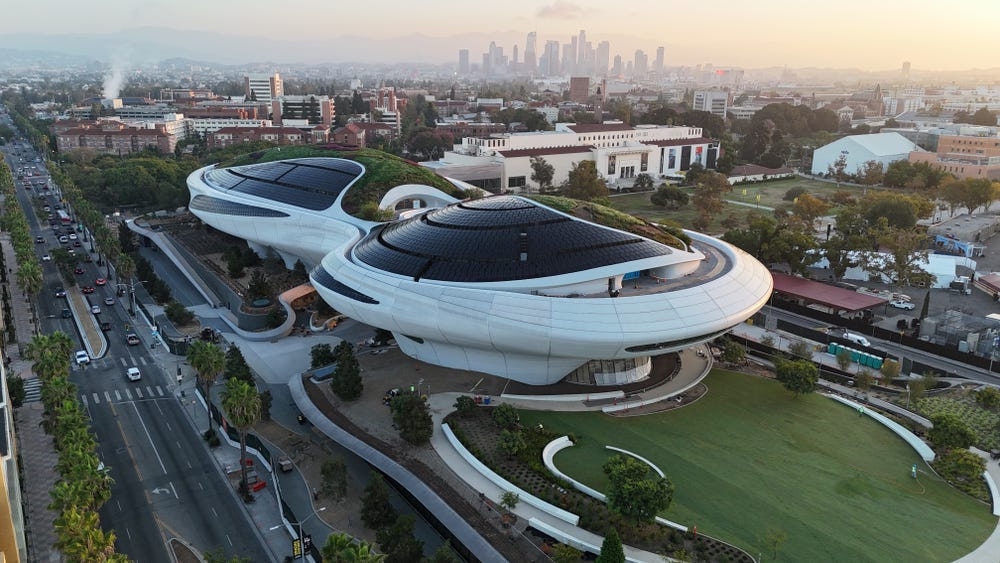
All of this is now combined by “Star Wars” creator George Lucas in a gigantic spaceship that, from the outside, looks as if it has landed from the future for a brief stopover and is about to take off again. Inside, it looks as if an 82-year-old art enthusiast had considered what he could assemble on a roughly 28,000-square-meter, five-story space—works ranging from Banksy and Frida Kahlo to Norman Rockwell and Jessie Willcox Smith, and from Artemisia Gentileschi to Vincent van Gogh—to make it clear to extraterrestrials what a human being is.
The underlying premise, inherent in the name “Museum of Narrative Art,” is this: Humans are the storytelling animals. And how do humans tell stories? Through paintings, comics, photography, murals, graffiti, and films.

What’s striking is that the exhibition completely forgoes explanatory texts. “Have fun and explore!” the museum staff call out at the elevators. “Start wherever you like, left or right, just let yourself drift!” The museum dispenses with art historical guidance and relies entirely on the direct encounter with the works. The absence of academic framework will likely be met with skepticism by some, while others will celebrate it as the long-awaited liberation from intellectual baggage.
With few exceptions, the exhibits are arranged not by artist or era, but by theme. Many are dedicated to aspects of life such as “Childhood,” “Adventure,” “History,” “Motherhood,” “Play,” “School,” “Love,” and “Sports,” while others focus on genres like “Western” and “Science Fiction,” and still others on art forms such as “Comics,” “Photography,” “Film,” and “Architecture.” The works span time, continents, and art forms.

The Museum of Narrative Arts is many things—wondrous, extraordinary, breathtaking—but the last adjective that would come to mind to describe it would be “pretentious.” Lucas shows no fear of engaging with either high or popular culture. He pays homage to the origins of narrative with reproductions of Michelangelo’s David, cave paintings from around 35,000 BC, Aztec stone sculptures, and frescoes from the Sistine Chapel. And then, Pikachu, Pinocchio, Snoopy, and, of course, props from “Star Wars” keep smiling back at you from serious self-portraits and depictions of everyday life.
Although the museum’s motto is “Experience rather than understand,” it pleasantly distances itself from the Instagram-ready immersion trend currently practiced to exhaustion in other L.A. museums. One is relieved to realize at some point that one has already walked through a dozen rooms without once being asked to sit at the Godfather’s table or on the broomstick from “Harry Potter” for a photo. In this sense, “Star Wars” director Lucas thankfully remains true to the classic tradition of contemplative viewing.
The UFO-shaped building in the heart of Los Angeles was designed by the renowned Chinese architect Ma Yansong and his firm MAD. George Lucas and his wife, businesswoman Mellody Hobson, spent approximately one billion dollars to realize this dream. The construction of this cathedral for story lovers was entirely privately financed. Initially, Lucas wanted to locate his project in San Francisco. When that plan failed, he tried Chicago.

Both architectural designs are on display at the Lucas Museum in Los Angeles (the Chicago design looks like a bowl of jelly spilled on a lawn), where the project was eventually realized – directly across the street from the University of Southern California campus, where Lucas studied film. Lucas began acquiring works of art as a college student. Over the decades, he amassed 40,000 pieces without selling a single one.
In addition to its extensive gallery, the museum also houses two cinemas that continuously screen films: one experimental films, the other documentaries. Currently showing is “Who Are You Charlie Brown?”, a documentary about Charles M. Schulz, the creator of “Peanuts”. The building also includes a freely accessible library.
The best museum in the world?
An acquaintance of mine, who, like me, has been living in Los Angeles for a few weeks, raved after her visit that the Lucas Museum was “the best museum.” “Wow, the best museum you’ve visited in LA so far?” I asked. “No, the best museum ever,” she replied. It’s no surprise that the building inspires such superlatives.
Just as it is hardly surprising that the most striking images in the exhibition depict children (Jessie Willcox Smith’s snowball fights, story time, and bedtime story scenes, as well as Mary Cassatt’s children playing with a cat, Florence Kroger’s toddler slumbering with a teddy bear, George Hughes’s returning family, or Norman Rockwell’s girl among four deputy marshals). For it is childhood, childlike wonder, curiosity, and enthusiasm to which Lucas pays tribute, as he always has. In his cabinet-of-curiosities-like collection, Lucas characterizes humankind not only as storytellers but also as playful, learning, and experimenting.
In the foreword to the program booklet, the founder makes a case for myths. Myths, he argues, help us understand things that are incomprehensible. Myths are stories that make emotional sense, even if they aren’t true. In the second foreword, written by Guillermo del Toro, the filmmaker writes that Lucas’s museum will undoubtedly leave just as big an impression as Lucas’s films. Both describe entering the museum almost as a religious awakening. And perhaps that’s exactly what it is. Perhaps in a few years, people will say, “‘Star Wars’? That’s the film by the founder of the Lucas Museum!”