







|
Neubauer Artists LLC
Getting your Trinity Audio player ready...
|
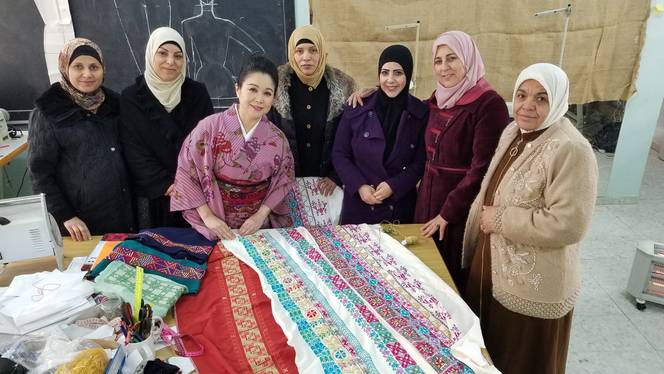
For the last decade, Maki Yamamoto has been merging the unique Palestinian cross-stitch technique into kimono sashes, known as obis, unfolding a seamless union between two distinct cultures.
The Tokyo native had found herself smitten by the beauty of Palestinian tatreez from the very first time she laid eyes on them.
As a researcher for a cosmetics company some 20 years ago, she began volunteering at various cultural events by foreign embassies in Japan, including Palestine’s, and struck up a longstanding friendship with the Palestinian ambassador to Japan’s wife, Maali Siam.
Yamamoto would admire the intricate patterns on thobes that her Palestinian friend would don, as well as on textiles such as table runners and pillow covers on display at events.
As their friendship grew, so did her interest in Palestine. She visited the occupied West Bank for the first time in 2013, and returned with the idea of incorporating Palestinian tatreez into kimonos, or more specifically, the belt-like sash that wraps around the waist of the Japanese traditional garment, known as obi.
ガザ出身マーリ夫人、昭和初期のお振袖に、ラマラ農村女性による一番星、星のかけら、鳥の羽文様のパレスチナ刺繍帯の装い
— 山本(荒川)真希 Maki YAMAMOTO-ARAKAWA (@maki_ya0521) April 1, 2024
????????????????????
Mme Maali with vintage kimono and Palestinian embroidery obi stitched by farmer woman in rural Ramallah. pic.twitter.com/8K93UpxJzi
“For me and those who know the history of kimonos, it’s a very natural pairing because the kimono has been influenced by neighbouring countries by the way of the Silk Road – China, Korea, Persia, Syria and many other cultures,” Yamamoto shares.
“For example, there is the Arabesque pattern,” which typically features recurring geometric and nature-esque motifs, “that is very popular for kimonos and other Japanese traditional crafts.”
On top of that, she adds, “When I see the table runners [with Palestinian tatreez] being almost the same size as the obi, it is very easy to imagine that I can make an obi with this embroidery.”
Yamamoto tells TRT World that during her visit , she “saw the reality of the people [when it came to] the conflict, and the occupation under Israelis.”
“At the time,” she says, moved by the Palestinian people’s steadfast preservation of their vibrant culture and way of life in the grim face of it all, “I also experienced many rich, cultural moments with Palestinian people, like their dance, the food, and of course, the beautiful embroidery on beautiful Palestinian traditional dresses.”

The Palestinian Embroidery Obi Project
At a crossroads with her career, Yamamoto was already contemplating on leaving her decade-long job in cosmetics research, and upon returning from the occupied West Bank, ventured on her own business dedicated to cultural exchange, including the design, production, and sale of Palestinian tatreez.
“So I decided that I will work on Palestinian embroidery to make obi,” says Yamamoto, who is currently also researching Palestinian embroidery and the economic independence of women as part of her PhD course at Tokyo University of Agriculture and Technology.
The Palestinian Embroidery Obi Project was thus born in 2014, a sort of social enterprise that sees the founder collaborate with women mostly in the Amari refugee camp in Ramallah. She also began working with embroiderers in Gaza.
Due to Israeli attacks on the besieged enclave, Yamamoto says she has “temporarily stopped making obi with women in Gaza, because, of course, the situation is terrible.” She has lost contact with them since the war began and doesn’t know whether they are safe.
“I hope that they are alive but many of the people [have already] been killed.

“I still produce obi together with the women in the West Bank,” Yamamoto states, noting that tatreez is a meticulous craft, meaning each obi is embroidered by hand, and can take up to five to six months to complete.
Besides the more time-consuming needlework involved with making the kimono’s obi, the Japanese researcher says Palestinian embroiderers also make handmade crafts like purses and other small textiles, allowing them to earn extra income while keeping up with the skill.
“For example, one of the women earned enough money through embroidery and enrolled her kid in university.”
A form of resilience
In 2021, the United Nations’ cultural agency (UNESCO) classified the art of Palestinian tatreez, which is the Arabic word for embroidery, as an Intangible Cultural Heritage of Humanity.
The designs and motifs of tatreez in traditional Palestinian costumes reflect the rich tapestry of life in local villages and towns, with each region showcasing its individual style. Often passed down through the family, these traditional garments serve as powerful symbols of Palestine’s identity and enduring legacy.
Conceived by the Institute for Palestine Studies as part of a joint project with the Palestinian Museum, The Interactive Encyclopedia of the Palestine Question states: “The earliest extant examples of Palestinian embroidery can be found on dresses dating back to the 1840s; cross stitch (quṭbah fallāḥiyyah) is the stitch most commonly and strongly associated with Palestine and seems to have become ubiquitous by the end of the nineteenth century.”
This is "Intifada Obi" inspired by Intifada dress, Palestinian dress embroidered with ????????flags worn at protests. obi is belt for Japanese kimono. this obi was embroidered by 6 refugee women in Gaza. We don't even know if they are alive.
— 山本(荒川)真希 Maki YAMAMOTO-ARAKAWA (@maki_ya0521) November 12, 2023
STOP THE WAR IMMEDIATELY https://t.co/NcpagXSRe8
With a rich history dating 3,000 years, tatreez is said to be a symbol of resistance and resilience of Palestinians in the face of forced mass displacement following the Nakba in 1948, during which an estimated 700,000 people were expelled from their homelands.
“Tatreez is an indigenous embroidery practice and cultural art form that illustrates Palestinian land and life: the tradition of reading the bottom of the coffee cup embodied as a brown octagon, a diagonal culmination of lines depicting wheat, or an endless squiggle impersonating a row of snails,” writes writer and artist Reem Farah.
According to Yamamoto, there are many striking patterns of tatreez. They can depict animals and plants like Jaffa’s orange trees to household items like kohl holders. “There are also Cypress trees — this pattern is originally from Gaza, and I apply it on the obi, which is very popular now for Japanese women.”
So far, Yamamoto has visited Palestine more than 15 times, but hasn’t been back since the Covid-19 pandemic. She learned how to stitch Palestinian tatreez from women in the occupied West Bank during her second visit there in the summer of 2014. And in 2022, Yamamoto published a paper on the history of Palestinian embroidery, roughly two years after she started her PhD in 2020.
“The women who do the embroidery want to know how their [handicraft] is being used, so I brought the obi and showed them how to wear it,” she adds, saying that during her visits, she would “sometimes organise kimono shows in the West Bank.”
Through the Palestinian Embroidery Obi Project, Yamamoto hosts exhibitions and pop-up events selling handmade Palestinian embroidered crafts, as well as guided workshops where participants get to try their hands at stitching tatreez.

Since October 7, she has organised more than half a dozen workshops in Tokyo, called Stitch for Palestine, to raise funds for civilians trapped in Gaza.
“People who do not know a lot about Palestine come into the workshop — and this might be their first time getting to know Palestinian culture — because I also talk about the history of Palestinian embroidery to the participants, so we don’t only work on the embroidery,” Yamamoto says.
As more news from Gaza appears in Japanese headlines, “I want to share the history of beautiful Palestinian culture, not only conflict, so this is what I do now,” she adds, emphasising that a lot of the thanks goes towards “all the women in Palestine for producing and protecting this beautiful embroidery.”
“I want to show my respect for this beautiful culture,” Yamamoto says. “War destroys culture, so I want to protect this beautiful culture from the war through what I can do.”