



|
Neubauer Artists LLC
Getting your Trinity Audio player ready...
|
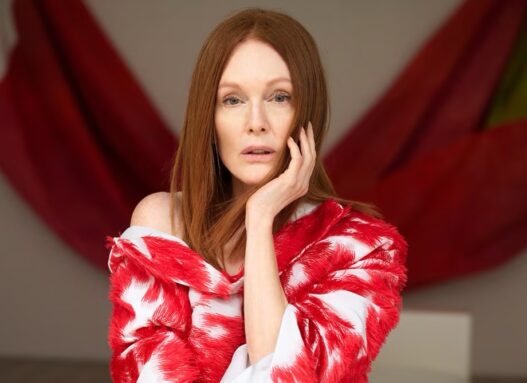
Between New York, her family, and the filmmakers who continue to vie for her attention, the American actress navigates time with sovereign elegance. An interview with our May 2026 cover girl.
Julianne Moore appears on screen, her face radiant and makeup-free, her hair hastily tied back with an elastic band, simply dressed in a slate-colored tracksuit jacket, and immediately apologizes for being a few minutes late. “I’m so sorry, ”she says with a dazzling smile, “ my son Caleb came over. I’m always so excited talking to him that I lost track of time.” The actress returned to New York the day before, after two weeks in Europe and a final stop in Rome where she filmed a cameo in Cry to Heaven, Tom Ford ’s upcoming film based on a novel by Anne Rice, a sweeping romance set in 18th-century Venice, which also stars Aaron Taylor-Johnson, Nicholas Hoult, and the singer Adele.
“I really have a very small role,” she is quick to point out, “ but I can’t say no to Tom. We met when my son was two months old. Twenty-eight years ago. Tom designed a breathtaking dress for me for the Oscars, a little sheer, and since I had just given birth, I didn’t dare wear it. But that’s how our friendship began. I remember running into him years later at a party in Hollywood when he was working on the script for his first film, A Single Man. I approached him to ask how his project was progressing. He took a step back, looked me in the eyes, and said, ‘Can I send it to you?’” I replied “okay” with the apprehension one might have about reading a script from someone who isn’t a director. I read it, found the role of Charley fantastic, and immediately emailed him to tell him how much I loved it. He offered to come to my place to explain in more detail what he had in mind, to show me all his inspiration notebooks, his mood boards, which were impressively precise. I replied, “Tom, of course, come over, I’d love that, but it’s done, it’s a wrap, I’m making the film!” It’s a joy to work with him.”

Julianne Moore’s last appearance on the big screen was in The Room Next Door, Pedro Almodóvar’s first American film, which won the Golden Lion at Venice in 2024. In this powerful and luminous tearless melodrama, imbued with the ultra-polished aesthetic codes, the symmetry of lines and primary colors with which the Spanish filmmaker juggles wonderfully, the actress embodies with astonishing depth Ingrid, a successful novelist who agrees to put her life on hold to accompany a close friend suffering from incurable cancer in death. “When I received Pedro’s offer, I literally had to pinch myself ,” she said.“ There isn’t an actress in the world who doesn’t dream of working with him. I discovered ‘Women on the Verge of a Nervous Breakdown,’ especially the scene where Carmen Maura cries in a taxi, when I was a young actress. I was stunned by this emotional mix of humor and sophisticated, uninhibited drama. I had never seen anything like it! And then, for someone like me who had never set foot in Spain, Pedro’s vibrant colors and Movida folklore represented my idea of the country. When I went there for the first time, I understood that it was, in fact, Pedro’s poetry.” For his part, the director, who loves actresses, confided that as soon as his script was finished, Julianne Moore’s name was a no-brainer: “She’s one of the greatest.”
Many leading filmmakers share this sentiment, from Todd Haynes to Paul Thomas Anderson, including the Coen brothers, David Cronenberg, James Ivory, Ridley Scott, Steven Spielberg, Gus Van Sant, Alfonso Cuarón … All have sought to capture the luminous mystery of this chameleon with her rosy complexion and vibrant zest for life, gifted like no other at embodying the fault lines of the human condition and fading magnificently into roles such as a neglected wife, an academic with Alzheimer’s, a porn star on the verge of collapse, or a capricious actress terrified of losing her fame.

For nearly forty years, often masterful in roles of neurotic characters, Julianne Moore has skillfully navigated between demanding independent cinema and flamboyant blockbusters (Jurassic Park, The Hunger Games) and established herself as a unique figure in Hollywood, as discreet and elusive as she is indispensable . An artistic feat that has earned her a place in the very exclusive club of actors to have won acting awards at Cannes, Berlin, and Venice, and to have also taken home an Oscar, several Golden Globes, and a BAFTA. This recognition has left her “in shock.” “My ambition was never to be a star, ” she insists. “ Even at the beginning, I didn’t imagine having a career. When I started acting in the evenings after school, I had no awareness of this world, no connections, no cultural background. I didn’t even know you could make a living from it until my teacher told me it was possible. I just knew that I loved words, immersing myself in stories, and, above all, acting. I was eager to learn.” While she had initially planned to pursue a traditional academic path, the young woman convinced her parents to let her try her luck at the entrance exam for a drama school , promising them that if she failed, she would return to a regular university program, studying law or medicine. “I was accepted. And six months after arriving in New York, I was working, ” she recounts. “ I was determined. A few plays, a few odd jobs until I was cast in ‘As the World Turns,’ a very popular American soap opera. I wasn’t getting ahead of myself; I was taking it one step at a time, project after project, enjoying it immensely. As I often tell my children, it’s important to have achievable ambitions.” She is currently playing Uncle VanyaOn stage, in an ambitious experimental project spanning five years under the direction of André Gregory—from which Louis Malle made a film, Vanya, 42nd Street, using footage of the rehearsals— she was spotted by Robert Altman, who brought her into the Short Cuts adventure. “How lucky I am that he saw me on stage,” she says, adjusting the elastic band around her auburn hair. “ He’s my cinematic hero, the one who opened my eyes . Years earlier, watching ‘Three Women’ with Sissy Spacek, Shelley Duvall, and Janice Rule, I was struck by what he made them do, by his camera movements. It woke me up. And it was also the first time I understood what a vision, a point of view, was. It was definitely the kind of film I wanted to make. Fate granted my wish.”
Like a domino effect, it was seeing her in Short Cuts that captivated Todd Haynes. Safe , with her role as a bourgeois Californian woman burdened by phobias, acted as a catalyst in her career, forging an off-screen friendship reminiscent of Hanna Schygulla and Rainer Werner Fassbinder, and creating a golden partnership in the world of cinema. To date, one of the greatest portrayers of women in contemporary film has offered his “Sirkian” muse five roles as heroines with troubled emotions and vertiginous inner turmoil: Safe, of course, but also Far From Heaven, I’m Not There, Wonderstruck , and finally May December, in which she radiates a touching and stoic authority.

“Todd is like a brother to me,” says Julianne Moore. “We understand each other so well. I think it’s partly due to our many similarities. We’re the same age and had similar upbringings; our parents married very young, around 20; we’re the eldest of three siblings; we’re passionate about human relationships, our connection to the world, and the question of identity. As a result, I understand what he writes; it’s very easy for me to connect with his imagination. We talk a lot about the character before a film; I do a lot of preparation beforehand, I delve into every detail, which allows me to be completely free once I’m in front of his camera, to be sufficiently immersed in my character to let go, to let myself go. I feel so supported when I work with him that it allows me to dare to do extravagant things. He’s the only director I could follow on a project without hesitation. He’s a genius .”
Since we are talking about relationships with directors, trust and well-being on set, it is impossible not to ask her about what she feels when she works with Bart Freundlich, a director she met on the set of Back Home in 1996, with whom she has shared her life for thirty years (they married in 2003) and with whom she has two children. “It’s a double-edged sword, ” she acknowledges. “ On the one hand, it’s wonderful because we have a lot of time, especially in private, to explore and develop a project. It leads to many discussions and a fantastic creative partnership. On the other hand, I’m aware of his needs, his ambition, the pressure he’s under, and as a result, I’m perhaps a little less inclined to let go. That said, when we filmed ‘Trust the Man’ together, our two children made an appearance. I must say it was a joy to be reunited, all four of us, on an artistic project.”
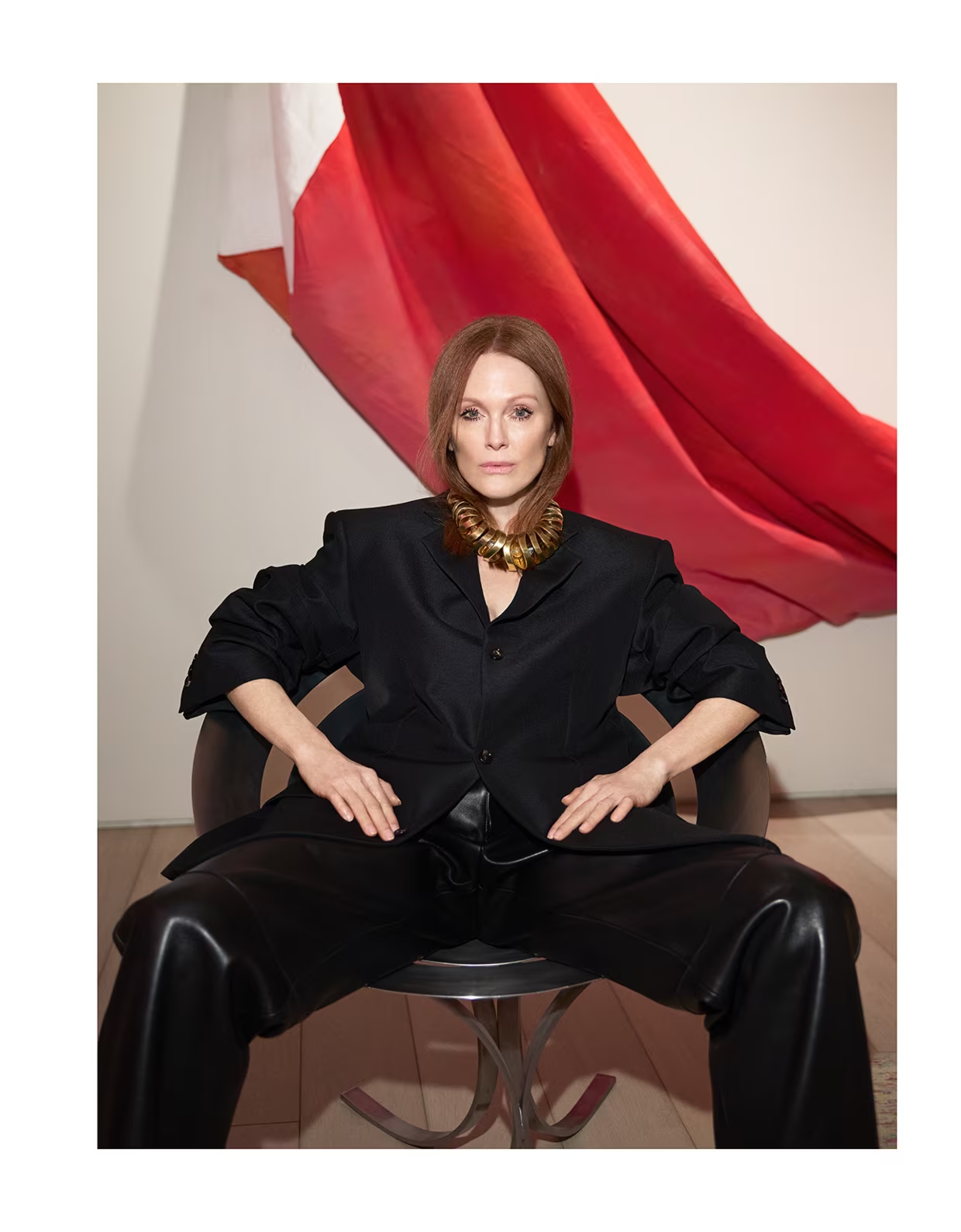
By nature, I am not someone who seeks attention; I try rather to integrate.
Although she is very private about her personal life, family and home are the backbone of Julianne Moore’s life, and she makes no secret of the happiness she feels every time she returns to her elegant townhouse in Manhattan’s West Village, far from Hollywood, the center of her career. Without resorting to armchair psychology, it’s a safe bet that her childhood and adolescence, marked by a series of moves due to her military father’s postings—from Texas to Alabama, from Virginia to Nebraska, and finally to Frankfurt, Germany—play a significant role in this attachment to her home. “You don’t come away from such a nomadic life unscathed,” she confides. “It made me adaptable. By nature, I’m not someone who seeks attention; I try to fit in. Thanks to this nomadic lifestyle, I’ve become an excellent observer of social rules, hierarchy , and how people interact, able to grasp in a flash how to behave, speak, and move depending on the context. It also opened my eyes to all the places to explore and ignited my curiosity. The downside is that while I adapt very quickly, it takes me a long time to feel comfortable, or at least at ease.”
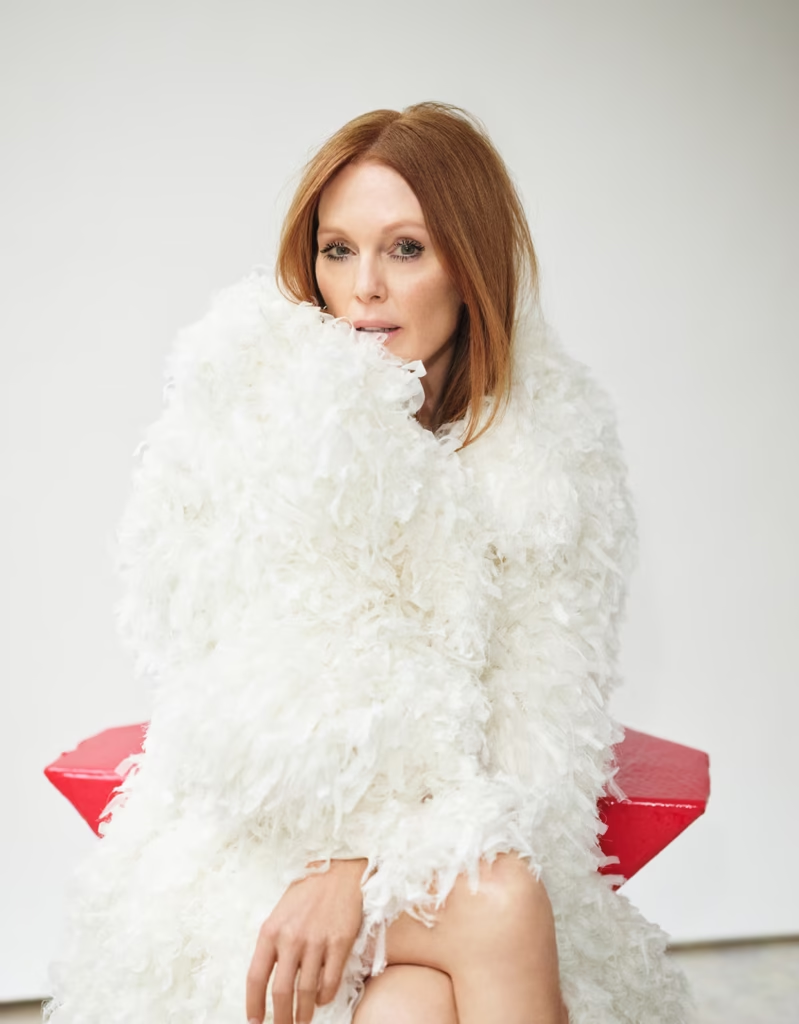
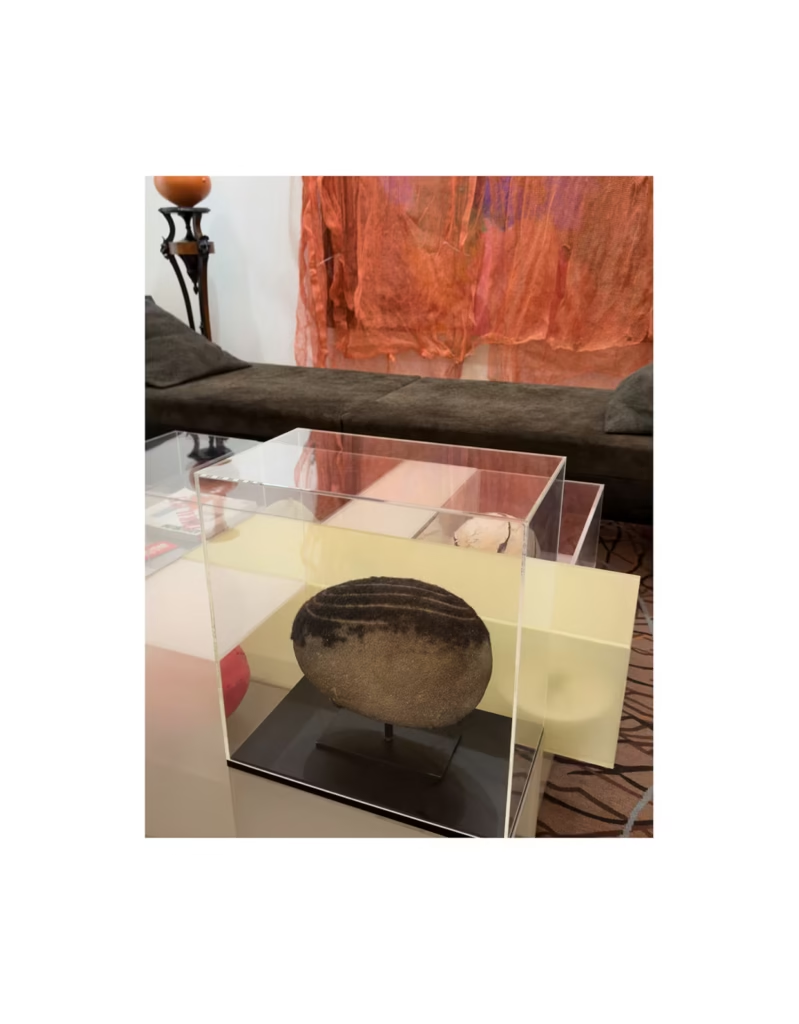
Everything suggests that in the refined and hushed New York setting of this “design junkie ,” unbeatable at finding a Pierre Jeanneret desk, a Charlotte Perriand table, a Pierre Chapo chair, a Charles Pfister sofa for Knoll, or lamps by Isamu Noguchi or Paavo Tynell, everything is designed to enhance the feeling of comfort and timelessness. “I love light and being surrounded by beautiful objects,” she explains. “I’m crazy about design, the French modernists, craftsmanship, handmade items, the feel of materials , whether it’s ceramics or fabrics. In my living room, I have a George Nakashima coffee table that I bought for myself more than twenty years ago. Every time I look at it, I’m amazed. Design exudes a physicality that, in turn, makes me feel good.” And what are Julianne Moore’s days like within these walls when the camera isn’t calling her name? “I wake up quite early,” she confides. “ I like to sit on my sofa with my coffee, read the New York Times, check my emails, and do my yoga. Then I go out, to the corner store, the dry cleaners, and sometimes I have lunch with a friend. In the afternoon, I wander around town, or I might come home to read scripts or a good book to clear my head. I’m currently devouring ‘The Safekeep’ by Yael van der Wouden. And to end the day perfectly, there’s nothing like a romantic dinner with my husband.”
A magnificent, seamless career, a seemingly peaceful and perfectly ordered private life: reality is almost too good to be true, the alignment of the stars virtually unique in the star system, and it’s indeed difficult to imagine Julianne Moore ever experiencing regrets. “I don’t really have any,” she says. “Oh yes, maybe one. I sometimes wonder what my path would have been if I had stayed in Europe.

I loved life in Germany, and I wonder how things would have turned out if I had made that choice. It would have been courageous. I was a student when we lived there, and I never once thought that staying would have been an option. And at the same time, I don’t dwell on it for long because I’m fulfilled by my life and, above all, by the family I’ve created.” She is told that if she had made that choice, she would undoubtedly have been a serious challenger to Isabelle Huppert, her European counterpart. “I adore her, ” she exclaims! “ She’s my French sister. I can spend hours watching her on screen; she’s fascinating. I’m not sure anyone could overshadow her.”
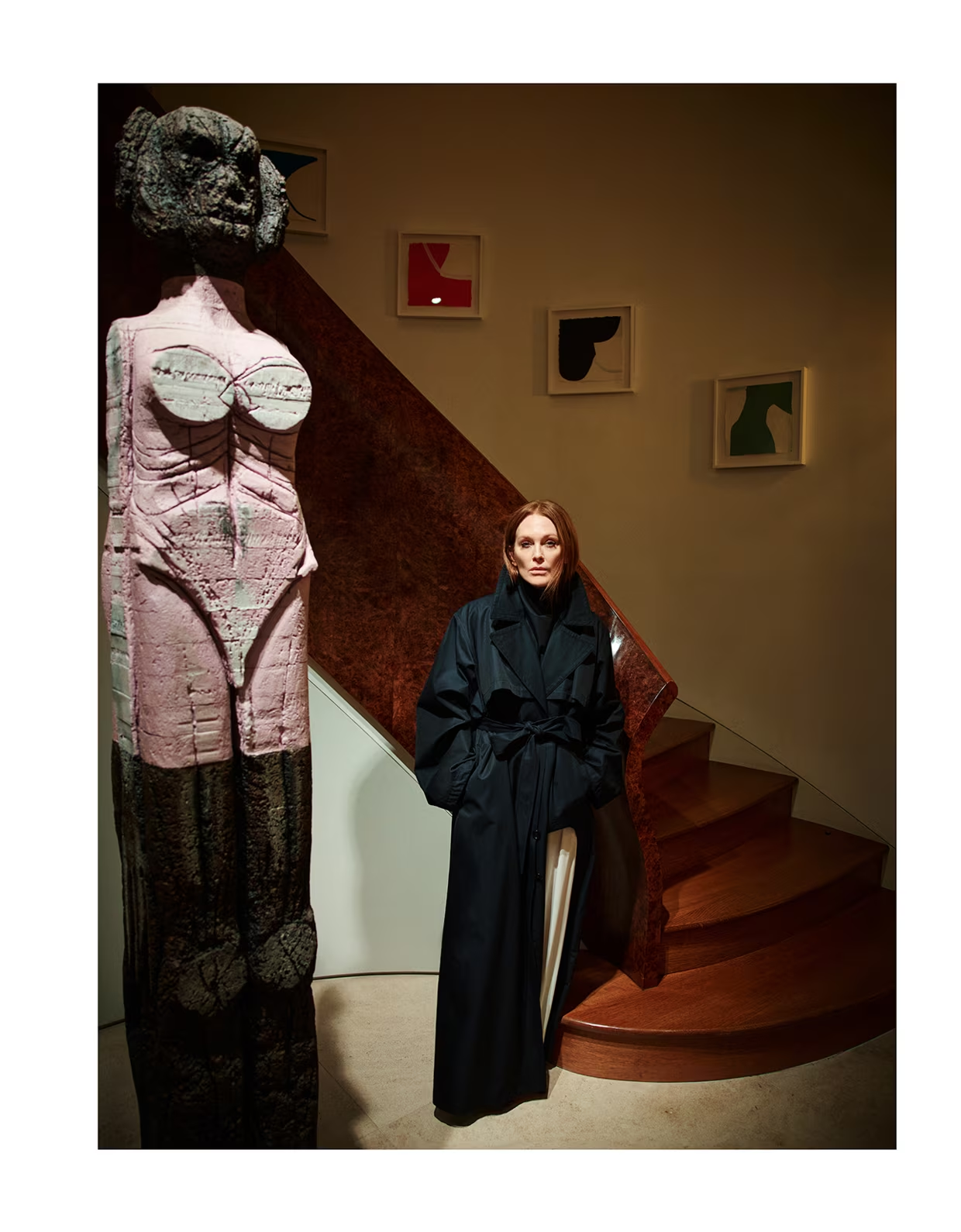
On the set of Cry to Heaven, Julianne Moore had a long phone conversation with her daughter Liv, intrigued by her mother’s career and who, even as a little girl, had remarked, “Mom, on screen, it’s always the same thing: either you get divorced or you die!” “She was curious to know if my job still brought me joy. If I felt as energized on set,” Julianne Moore recounts. ” I told her that not only was my enthusiasm intact, but that the pleasure of acting was an end in itself for me.” And what if the phone stopped ringing, if the directors’ desire faded? “Ouch,” she says with a burst of laughter. “ What a question! I don’t even want to think about it. I feel so at home here. I don’t have a narcissistic relationship with cinema; I don’t like watching myself. On the other hand, I love the emotional experience it represents, the teamwork, the creation of illusion. I think it would be a life without any flavor. And I don’t want to experience that.”