



|
Neubauer Artists LLC
Getting your Trinity Audio player ready...
|
And although my current home — the top floor of an 1800s-era brownstone — has a bathtub, it’s extremely short (if very deep) so my 5”9 frame can’t exactly lounge comfortably. So when the opportunity arose to visit Budapest, Hungary and the surrounding countryside in order to try out a few of the legendary thermal baths, I quite literally squealed in anticipation.
I’ve dabbled in bath houses in and around New York City, at the old school Russian & Turkish Baths in the East Village to the trendy Bathhouse in Williamsburg and the dark and glamorous Aire Ancient Baths in TriBeCa. While these all offer a welcome reprieve from the city’s frenetic energy, Americans have not exactly embraced bathing culture on a larger scale. Hungary, on the other hand, has centuries of history and tradition surrounding bathing, as well as the geographical advantage of its mineral-rich thermal waters.
She adds that the thermal waters of Hungary were first discovered in 100 AD, when Romans built the city’s first thermal bath at Aquincum. During the Middle Ages, the Knights Templar built hospices on these springs to treat leprosy, while the Ottomans saw the rise of hammams — thermal baths with glass ceilings to allow in the sunlight — which enhanced the tradition of therapeutic bathing.

Budapest is also something of a geological curiosity, an area wherein tectonic plates collided millions of years ago, resulting in waters that are rich with nourishing minerals like calcium, zinc, copper, and magnesium. De Heinrich de Omorovicza explains that today, Budapest’s mineral-charged waters are renowned for their skin benefits, like improving general elasticity, barrier function, and repair. “The Hungarian government even subsidizes healthcare treatments at these baths,” she adds, a modality known as balneotherapy, a type of hydrotherapy that incorporates bathing in water, mineral-rich or otherwise.
Comparatively, I’ve yet to have a dermatologist prescribe me a trip to the bath house to address my eczema flairs or soothe my chronically dry skin. Clearly, the only logical thing to do was visit as many Hungarian thermal baths as I could during my four-day trip to experience these purported benefits for myself.
Keep reading for four of the best Hungarian thermal baths to visit if you’re hoping to experience some balneotherapy.
Lake Hévíz

Although there are plenty of bath house options in Budapest itself, the prospect of exploring the largest swimmable thermal lake in the world was too tempting to not visit first. Located just two hours away by car, Lake Hévíz has been open to the public for the last 220 years (they have plenty of incredible photographs of bathers showcased around the property). Sprawling and primarily open air, I was delighted to see Hungarian locals and tourists like me lounging on chairs in the sun and floating on inner-tubes in the lightly smoking water. Everyone looked relaxed and unbothered, exactly how I wanted to feel after the two flights it took me to reach Hungary the day prior.
Once I changed into my swimsuit, I finally took to the 80ish degree waters and gleefully sank in (which only has the faintest trace of sulfur scent). Although I intended to spend only 20 minutes in the lake, the next time I checked my watch an hour had passed. Such was the level of my blissful tranquility.
As de Heinrich de Omorovicza reminds me, “For centuries, balneotherapy has been esteemed for its ability to promote both physical and mental wellness, offering relief from ailments such as chronic pain, inflammation, and stress.” Indeed, by the time I exited the waters for my 45-minute mud wrap treatment (using mineral charged mud pulled from the lake just a few yards away) my inbox and to-do list felt very far away. Not to mention my parched skin felt more hydrated than it had in months, a major plus following a long travel day.
Gellért Thermal Bath


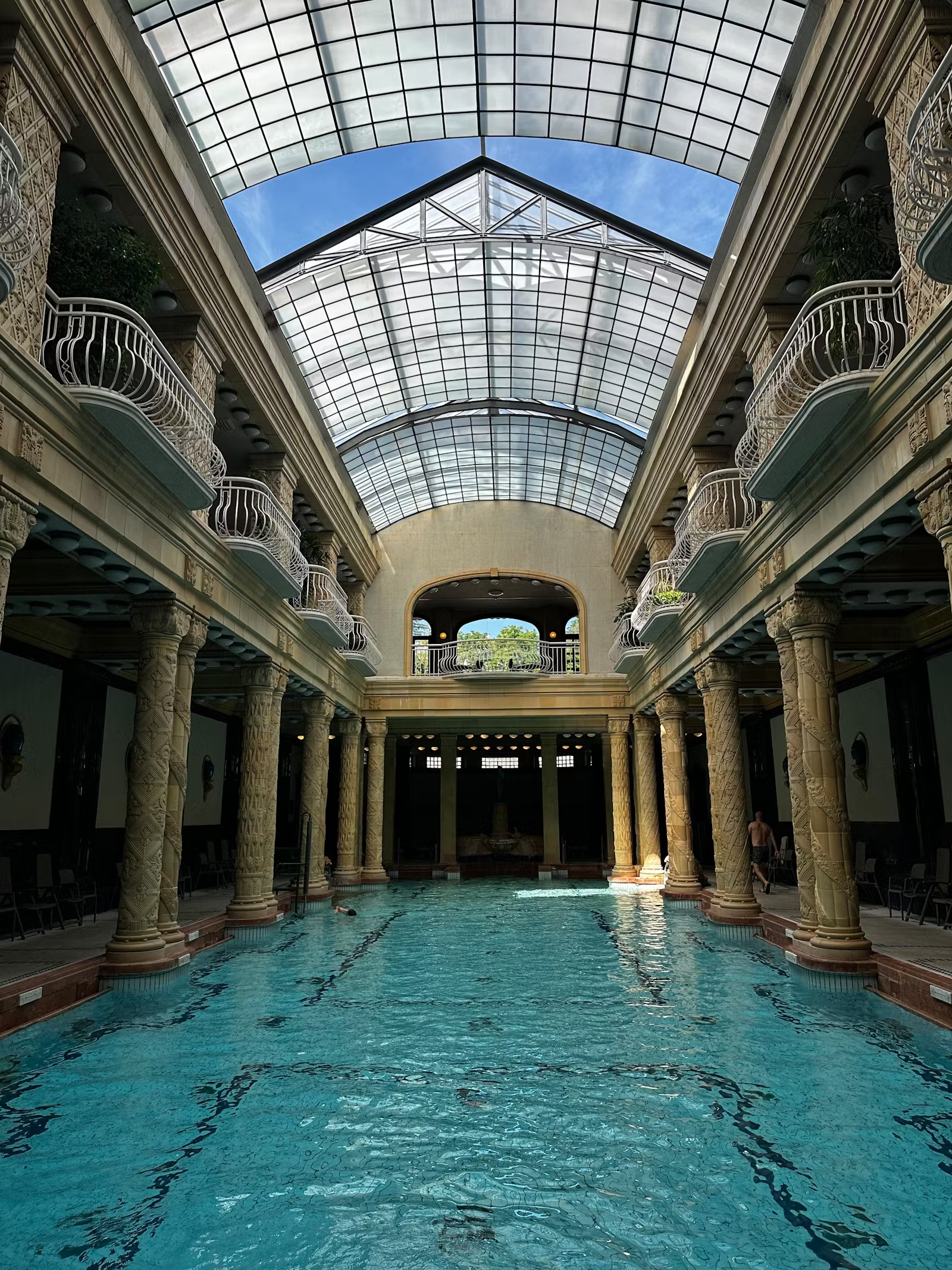
The next morning back in Budapest, I headed over to the Gellért Thermal Bath, a jaw-dropping Art Nouveau style structure with multiple indoor and outdoor pools at a range of temperatures. As I cycled through the hot and warm baths in a few different rooms, I couldn’t stop staring at the gorgeous architecture and stained glass ceilings (though some of the fountain designs weren’t exactly PG-rated, if you know what I mean). Bathers ranged in age and gender, with solo and groups equally popular. It was this community aspect that struck me the most about my day at the baths — although I couldn’t understand the majority of the soft conversations around me (Hungarian is not a language I’ve managed to learn), we were all happy to share the space for the sake of our mental and physical health. Most surprisingly, by the time I toweled off for the day, my skin didn’t immediately cry out for a layer of moisturizer. The minerals from the thermal water had done their job well. Even the recurring eczema on my palms (which always flares when I travel) calmed down — no itchy red patches in sight.
Lukács Baths

By day three I had finally learned how to take the Budapest metro (always a goal wherever I travel) so I ventured across the Danube river to the Lukács Baths. The multiple indoor and outdoor baths felt a bit more lively than the Gellért location, and I also decided to pre-book a massage to enhance my wellness experience. While there’s definitely a difference between my typically deep tissue massage at The Well in NYC and a 6”4 Hungarian man kneading my shoulders for an hour, overall the afternoon was chill and comfortable. I was starting to feel like a local since I knew to bring my own towel as well as a pair of flip flops — or in my case, waterproof Birkenstocks. Again, I didn’t even need to apply a body lotion after leaving the baths. My skin already felt adequately nourished by the thermal waters. I even nixed my exfoliating toner at night because my complexion was particularly glowy after three days of visiting bath houses.
Szechenyi Beer Spa

Once I toweled off and changed to head back to my hotel, I struggled to remember the last time I had felt so relaxed — or was able to completely skip body moisturizer. Sure, two pints of Hungarian Ale might have contributed to my carefree mindset, but after four days of thermal bath bliss, I was thoroughly convinced that everyone deserves a dose of balneotherapy for the good of their skin and mental health. And for someone who never goes anywhere without a full-sized moisturizer in my bag, it was thrilling to know that my skin wouldn’t need any extra hydration after I visited the baths— the waters were just that nourishing.
More importantly, both the Hungarian mud and thermal waters now top my list of must-have skincare ingredients, especially if you struggle with dry or dull skin. They’re gentle enough to use everyday for brightening and extra moisture, and they leave your skin looking impossibly glowy from morning to night. In case a trip to Budapest isn’t in the budget, you can still add a few products that utilize the healing benefits of Hungarian thermal water and mud minerals into your skin care routine. Prepare for supple, radiant skin.