



|
Neubauer Artists LLC
Getting your Trinity Audio player ready...
|
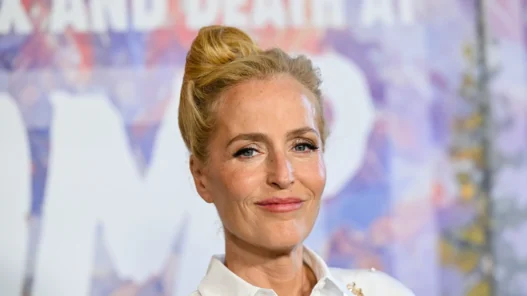
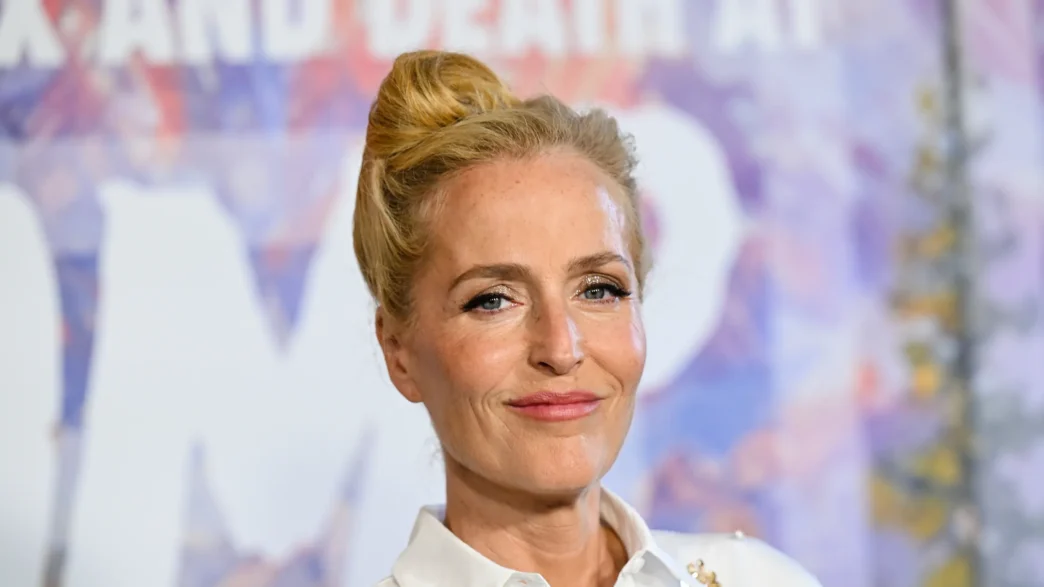
To mark the release in cinemas today, for one day only, of her new film Teenage Sex And Death At Camp Miasma, Queer Palm at Cannes this year, we met Gillian Anderson and spoke with her about the film, sex and her projects, including the sequel to her book Nos désirs, which should be released soon in France.
hen we met, Gillian Anderson was in Los Angeles to promote her new film, the surprising Teenage Sex and Death at Camp Miasma by Jane Schoenbrun (whose previous film, I Saw the TV Glow, had already garnered considerable attention). The film is released in French theaters today for a single day before heading to streaming platforms. She plays Billy, the final girl of a former Friday the13th -style slasher franchise , a reclusive and mysterious actress whom a young director, played by Hannah Einbinder , brings back into the spotlight. The actress immediately warned us: “I can’t tell you much more, but the film follows the same path as my books: creating spaces where people can be themselves. Another step towards ending shame.” She was, however, quite forthcoming about her publishing work. But first, let’s go back a few years.
“My vagina is a flower, an eccentric tulip, with a deep, sharp heart, a delicate fragrance, and soft but resilient petals,” Gillian declared to a packed audience at London ’s Old Vic Theatre on Valentine’s Day 1999. The actress, who had become a television phenomenon thanks to her role in The X-Files, had agreed to perform several excerpts from The Vagina Monologues , the play by activist Eve Ensler, at a special performance. Around twenty celebrities joined her, including actresses Melanie Griffith, Kate Winslet, Cate Blanchett, and Thandiwe Newton, to raise awareness and funds for the fight against violence against women. At the height of the third-wave feminist movement, this evening marked Gillian’s public debut as an activist for women’s sexual rights. “My intention was to help and I found the experience very interesting, but I felt that this world was not quite mine,” she recalls today from her hotel in Los Angeles.
Twenty-seven years later, she no longer feels at all like an outsider in this world; quite the contrary, she has fully embraced the movement. More, the second volume of Our Desires: 174 Women Reveal Their Most Secret Fantasies (Denoël, 2024), a collection of letters in which women of different nationalities, ages, faiths, marital statuses, ethnicities, and sexual orientations anonymously confided their fantasies to her, has just been released in the United States and the United Kingdom. Through these pages, the actress seeks to create “a community in which women can feel supported,” by giving a platform to female desire. And she doesn’t just collect their stories. The actress also dares to question the labels that have followed her over the years (“actress, mother, partner, activist, and American/British”) and slips in her own letter. Unsigned, of course.
How did female sexuality come to occupy such a central place in her discourse? Largely thanks to her acting career. After becoming one of the most recognizable faces on 1990s television with the role of Dana Scully over the course of eleven seasons of The X-Files , she wanted to find characters capable of distancing herself from this image and allowing her to explore, through acting, “different ways of being a woman.” She did so in film with The House of Mirth (2000), on television with roles in The Fall (2013), Bleak House (2005), and Hannibal (2013), but also on British stages when, in 2014, she took on one of the great challenges of her career: playing Blanche DuBois in A Streetcar Named Desire at the Young Vic Theatre, a character she had dreamed of portraying “since adolescence,” she confides.
“Women have been unjustly reduced to simple little things. As if we were simple beings, destined to serve. It astounds me that there are still people surprised to discover that we contain multitudes. That we have complex desires, needs, and emotions.”
In 2017, she took a break from acting to explore the world of non-fiction. Gillian co-authored *WE: Nine Principles for a Meaningful Life* (HarperCollins, 2018) with journalist Jennifer Nadel, a book that, drawing on their own experiences and those of other women, examines female identity. In 2019, her work took a new turn, fully engaging with female sexuality through the character of Jean F. Milburn, a sex therapist and mother of the teenage protagonist in *Sex Education*, a Netflix series that garnered over 40 million views in its first month: “Unlike other roles, Jean approached me. At first, I refused, then I changed my mind. I think some of the activism I was doing at the time was already part of a similar conversation.”
During the filming of the first season, the actress tried an experiment on Instagram: posting photos of phallic-shaped objects from the set under the hashtag #penisoftheday. The reaction from her followers was massive, and Gillian quickly turned the experiment into a ritual. The images soon expanded to include everyday objects and elements of nature whose shapes evoked penises, vaginas, or breasts. “It was a way of reclaiming the narrative, of connecting with the subject in a more personal way,” she explains. It was then that she rediscovered *My Secret Garden: An Anthology of Female Sexual Fantasies* by Nancy Friday (Balland, 1976), the book that would ultimately inspire *Our Desires *. Originally published in 1973, it compiled about a hundred real and anonymous sexual fantasies of American women collected by the journalist. A pioneer in its genre alongside Shere Hite‘s Hite Report (Robert Laffont, 1977), the book revolutionized the debate around female identity in the United States by putting into words something that was still difficult to state: yes, women possess a sexuality of their own, independent of that of men.
“Historically, we have been unfairly reduced and simplified. Our brains have been considered smaller, less active, less interesting, less efficient, or less intelligent. Women have been reduced to simple little things, beings made to serve. It astounds me that there are still people surprised to discover that we contain multitudes,” she says. The phrase is, of course, borrowed from “ Song of Myself ,” the poem by Walt Whitman, whom she later admits to admiring. This idea that each individual can contain multiple identities, contradictions, and experiences resonates with her. “For me, sex is about connection, pleasure, intimacy—even if that isn’t always essential—exploration, and conversation,” she summarizes.
Fifty years after the publication of Friday’s book, Gillian Anderson wondered how much our sexual and social relationships had changed: “I was curious to see how the fantasies of a diverse group of women today resembled mine, or not.” In 2023, she decided the time was right to gather these accounts to create a contemporary version of My Secret Garden, this time as editor. In collaboration with Bloomsbury, she launched Dear Gillian, a digital mailbox where any woman could send her sexual fantasy. The thousands of submissions received covered the entire spectrum of desire and imagination: a woman fantasizes about being penetrated by an octopus; a heterosexual woman feels attracted to a colleague; an older woman masturbates while imagining losing her virginity; a trans woman dreams of becoming pregnant by her cisgender girlfriend; another simply desires tender lovemaking from her partner. One woman even claims that, in her lucid dreams, her bed partner is none other than Pedro Pascal. A few months before the book’s release, Gillian attended the Golden Globes in a Gabriela Hearst dress embroidered with vulvas. Upon its publication in September 2024, its success exceeded expectations: Our Desires reached number one in the Sunday Times bestseller list, number eight on the New York Times bestseller list , and remained in the top 10 best-selling paperbacks in the UK for over twenty weeks.
Anderson explains that the second volume, More , “is a consequence of the success of the first.” It was an opportunity to reach even more women. “We destroyed the letters that couldn’t be included in the first book, even though they would have been enough to fill several more, and we wanted to start from scratch.” A new feature: the authors’ ages are now included. “With this edition, we realized it was important to have this information. It’s important to remember that passion is alive and legitimate at any age.” The book again brings together certain fantasies that might be uncomfortable or difficult to interpret, particularly those in which women imagine themselves being assaulted or harassed by their fictional lovers. “They seemed legitimate to us because we don’t know where these thoughts come from: they can express hidden feelings, fears, or be a way of processing certain experiences. And unlike what happens in reality, here there is consent, since the person is in control of the situation in their own mind.” Perhaps this power allows us to feel less vulnerable, since we are the ones in control.
Gillian Anderson knows perfectly well what it means to find herself on the other side of the fantasy. In 1996, FHM magazine named her the sexiest woman in the world. A mother of three (Piper Maru, born in 1994 from her marriage to art director Clyde Klotz; Oscar, born in 2006; and Felix, born in 2009, both from her relationship with businessman Mark Griffiths), and currently in a relationship with British screenwriter Peter Morgan , creator of The Crown, she has lived for decades with the tension between the woman she is and the image others have created of her. “That title didn’t seem real to me. It meant nothing to me; I didn’t feel sexy, I didn’t think that image represented me. When I first became a mother, I was very disconnected from my own sensuality and sexuality.” “So I felt like they weren’t talking about me, but about an idea of me constructed from the desire or perception of others,” she sighed, staring into space. “It’s a bit like those pornographic images where they paste a celebrity’s head onto someone else’s naked body: you recognize something that seems to be me, but which, in reality, doesn’t represent me at all.”
Is it flattering nonetheless?
“It could be, since it’s presented as something positive. But it’s also strange to accept recognition for something that isn’t real and contributes to the objectification of women.” This observation leads us to reflect on the increasing exposure of sexuality on the internet, particularly on platforms like OnlyFans, which generated approximately $720 million in operating profit in 2025. “It’s understandable that some people want to consume this kind of content. But they don’t reap the benefits of a real relationship: they don’t learn how to communicate or connect sexually with another person. Sometimes, it all comes down to consumption, and we stop building real connections. That’s the whole problem.”
Styling: Martha Ward. Makeup: Amanda Grossman. Hair: Sandra Hahnel. Manicure: Chiara Ballisal.