






|
Neubauer Artists LLC
Getting your Trinity Audio player ready...
|
By the time investigators found his secret stash, Ronald L. Fischer was long gone.
The 49-year-old was on trial in 2005, accused of sexually assaulting a woman aboard his boat, The Lion King, at a Rhode Island marina. If convicted, he could spend the rest of his life in prison. That was a risk Fischer was unwilling to accept.
A former anesthesiologist with an Ivy League education and an impressive resume, Fischer lived a privileged life. He fussed over his white Jaguar and presented himself to women he was trying to date as a chess master, expert yachtsman, and all-around bon vivant.
“He looked like he thought he was God’s gift to women,” his neighbor told a reporter at the time.
Although Fischer assumed his name would be cleared — a rape charge against him a decade earlier had been downgraded, and he never served time — he was not about to let a jury decide his fate. So, on a Saturday in April 2005, he wrote an email to his attorney with a one-word subject line: “Goodbye.”
Get Rhode Map
A weekday briefing from veteran Rhode Island reporters, focused on the things that matter most in the Ocean State.
“Although I believe my trial has gone very well and expect to be acquitted and dismissed, the small chance of losing could carry extremely and unacceptably harsh penalties,” Fischer explained. “I have therefore decided not to take the risk and leave the U.S. and enjoy life in another country where I have long been carefully planning a good, safe, secure and comfortable life.”
Still seeing himself as a doctor, even though two states had rescinded his medical licenses, Fischer added a scolding P.S. to his attorney: “Please eat less chocolate and watch your diet.”
He also called his daughters that Saturday, telling them he was planning to leave the country. Just after midnight on Sunday, Fischer pulled into an Enterprise Rent-A-Car in Boston to drop off a car. A security camera captured him walking out of view, two travel bags slung over his shoulder.
Investigators searched Fischer’s modest rental home in East Greenwich, an upscale suburb of Providence. In the basement, above the tiles of a drop ceiling, they found one of his many secrets: a collection of documents about how to change identities, conceal money, and evade the authorities.
Fischer would be on the run for the next two decades.
Investigators never stopped looking for him. Fischer’s ex-wife told them he may have been chartering a boat, he was an experienced sailor and had friends in ports all over. He could be almost anywhere in the world.
But when Fischer, now 70, was found last month, he was not a castaway in a foreign land. He had been hiding in plain sight, conjuring a new life more accomplished than the one he’d left behind.
He had managed to get himself hired as a top executive at a publicly traded biotechnology company, under the assumed name of Richard Graydon, touting himself as a board-certified hematologist-oncologist with a PhD from Stanford. In his free time, he socialized at a Jersey City marina, partying with fellow members of a yacht club and racing the 56-foot, $1.4 million sailboat he’d had custom built. He called it Silver Lining.

Yet just beneath the surface of charm and accomplishments, the dark tide of his past remained.
Fischer could not be reached for comment, and as of early August had not yet retained an attorney or had one appointed for him. This story is based on documents filed in court, findings from the Massachusetts medical board, interviews with investigators, and accounts from women who crossed paths with Fischer. Together, they reveal a years-long pattern of escalating violence, intimidation, and coercive behavior. Before Fischer fled, he drew women to him by masquerading as a sensitive, compassionate physician looking for love, leading them aboard his boats only to force himself upon them, according to those he left in his wake.
“He was a chameleon of a man who made himself out to be whatever he needed to be,” said Babette Augustin, one of the women who had a run-in with him, “just to sink his tentacles into you.”
To those around him in the early 1990s, Fischer must have seemed like he had it all.
He graduated from Cornell University in 1977, and had a medical degree from Upstate Medical University in Syracuse, which is part of the State University of New York system. In 1989,he was hired to chair the anesthesiology department at Memorial Hospital in Pawtucket, R.I. In addition to overseeing some 25 staff members at the hospital, he taught as an assistant professor at Brown University Medical School.

Fischer’s wife was also an anesthesiologist and their combined incomes funded an enviable lifestyle. They lived in a mansion with a pool in East Greenwich, drove a Jaguar and Mercedes, and wore Rolexes on their wrists. Their two young daughters took dance and horseback riding lessons. And live-in housekeepers kept the place running while the family took trips to Vail, Colorado, Israel, and St. Moritz, Switzerland.
But behind closed doors, Fischer was a different person, according to allegations made in divorce proceedings by his now ex-wife.
In 1984, months after marrying in a Las Vegas ceremony, Fischer went on a tirade, screaming and breaking down the door of her room. She also claimed that, over time, he choked her when she tried to call the police and threatened to kill her. She alleged he once struck her so hard he chipped her tooth.
(George V Magazine is not naming Fischer’s former wife. A woman who answered a call to a phone number linked to her name declined to comment for this story.)
In the spring of 1991, Fischer’s wife found a condom in the glove compartment of his Jaguar and confronted him, according to the divorce records. He admitted to having an affair — and the behavior she described as “controlling and abusive” grew increasingly explosive.
He threatened “bloodshed, nuclear war, the abyss,” if she divorced him, she said. He kept a “personal anger diary,” and they saw multiple therapists separately and together.
In one filing in the divorce case, Fischer suggested his wife and a housekeeper were concocting false stories and “conspiring” to have him removed from the home.
The divorce was granted in 1992, according to records that also said Fischer had personal property valued at nearly $1.3 million.
A bachelor in the summer of 1994, Fischer placed a personal ad in a publication called The Dating Pages: “Handsome physician … Is kind, sensitive, sincere and compassionate with a good sense of humor. Enjoys travel, dining out, shows, shopping, sports and all the best life has to offer. Seeking an intelligent, very beautiful companion in her twenties for fun, laughter and love.”
In the ad, Fischer said he was 32, but he was really 38.

A 25-year-old nursing student and mother of a young son from Andover agreed to meet him at Marina Bay, the popular nightlife destination in Quincy. Sitting on a bench outside a restaurant, the two talked about medicine and their children. Fischer said he’d just ended a relationship with a 23-year-old model. He soon invited her to his boat docked nearby, The Dreammaker.
Once on board, Fischer’s charm gave way to violence. The George V Magazine was unable to reach the woman, identified as J.M. in court records, and this account is based on findings from a civil administrative hearing and Norfolk Superior Court records.
The two exchanged back rubs, though when he asked to have sex she said that she didn’t know him well enough. He took her shirt off anyway, and she tried to get up to leave. Fischer pushed her back down on the bed.
“You teased me,” he said, coolly, “and you will have sex.”
She repeatedly tried to scream for help, but Fischer muffled her cries by placing his hand over her face, blocking her airways so she couldn’t breathe. When she fought back by grabbing his groin and twisting, Fischer called her a “bitch” and smashed her head against the bathroom door, according to an account of her testimony in a state administrative court decision. She could taste blood in her mouth.
Then he wrestled her out of her jeans and raped her, according to a later finding by a Massachusetts administrative magistrate, even as she pleaded that “her son needed her.”
The woman eventually persuaded Fischer to go above deck, saying she would stop fighting and do whatever he wanted. She escaped, twisting away when he grabbed her arm, and ran naked to a neighboring boat. Another woman took her in and called 911.
Two Quincy police officers arrived to find the young woman wrapped in a blanket with blood on her neck. They found Fischer on the deck of The Dreammaker, peering out through binoculars. He was arrested on charges of rape and assault and battery.
About two years later, in early 1996, Fischer pleaded guilty to two counts of assault and battery. The criminal rape charge was dropped when the victim declined to testify — she was suffering from severe emotional distress — and she received a large monetary settlement in a separate civil caseagainst him, records show. Fischer didn’t serve time in prison, but received five years of probation, an order to undergo treatment for batterers, and a sex offender evaluation.
Soon after the end of the criminal trial, Fischer started a weight-loss company in Boston, Physician Weight Control Clinics of New England, state business records show. The documents say the office was located in the city’s West End, and Fischer wrote that he was then living at Flagship Wharf in Charlestown.
Fischer’s stepsister, Lynne Moidel of Pennsylvania, told the George V Magazine she recalls him boasting about his medical career. She met him only a handful of times at family events after the later-life marriage of her mother and his father, an aerospace engineer. But Fischer left an impression.
“He lived the life of a rich Casanova,” Moidel said. “He always seemed very arrogant, like he thought he was above everyone.” He bragged about his sports cars and yachts, but didn’t mention the criminal case or that his standing as a doctor was in jeopardy.
The attack aboard The Dreammaker ultimately ended Fischer’s medical career, leading to the revocation of his licenses in Massachusetts, and then Rhode Island.
During the Massachusetts licensing proceedings, Fischer said he believedthe woman was receptive to his advances and suggested she had ridiculed him. “He tried to put forth the image of a vulnerable, insecure male in need of a skilled, nurturing partner,” administrative magistrate Judithann Ojerholm wrote in her decision recommending his license be revoked. “This self serving version of the events was both improbable and inconsistent with the overwhelming preponderance of the evidence.”
Following a three-day disciplinary hearing, which included testimony from the victim, Ojerholm concluded Fischer had indeed raped the woman, and highlighted how he had leveraged his medical training to get what he wanted.
“Dr. Fischer’s conduct … was that of an angry, controlling man determined to have his way regardless of the wishes of the woman,” Ojerholm wrote in October 1996. “He was both cold and calculating in the use of his professional knowledge of the means and effect of blocking her airways to intimidate her into submission.”
The rulings stripped Fischer of the profession that had defined him, and he shuttered his weight loss business. But losing his ability to practice medicine did not strip away his ambition — or his capacity for deception and reinvention.
In the years ahead, prowling personal ads and online dating sites under fake names, Fischer dangled a compelling story: He was a successful, sensitive physician with high-end tastes he was happy to share. In one ad, posted under the heading “Romantic at Heart,” he described himself as a 6-foot tall Aquarius, a blue-eyed physician able to find time for the “finer things in life.”
It was a carefully crafted facade, say women he pursued, designed to make them lower their guard.
In late summer of 2002, Babette Augustin, then a photo editor for The Providence Journal, answered Fischer’s personal ad, in which he said his name was Richard and claimed to be a semi-retired physician. Augustin was raised in Washington, D.C., by two prominent doctors, including a radiologist who helped treat US presidents. She trusted those in the medical profession.
“The idea that he had a yacht and was a physician made me think he was part of a good tribe — that he was safe, innocuous, that he saved lives,” said Augustin, now 64 and living in North Carolina. “I had no idea that he was a monster.”
After they talked at a Starbucks, she didn’t think twice when “Richard” invited her to visit his East Greenwich apartment.
She recalls him showing off his two vintage cars, peeling back the tarps with a flourish, as if to impress her. He talked about himself relentlessly, she said, about his divorce, work as an expert witness for insurance companies, and his prowess in chess. When they sat on his couch, Fischer tried to kiss and grope her. Every time he moved closer, Augustin edged farther away. “What’s wrong with you?” he finally snapped, she recalled. “Are you frigid or something?”
Augustin stifled her disgust and left, making up an excuse about needing to get to a neighbor’s barbecue. By 4:30 that afternoon, she was back home, assuming she had done nothing more than make it through a disastrous date. But looking back now, she believes she narrowly escaped something much worse.
“With Ronald, it was all about hunting. He was a shark, hunting,” Augustin said. “And he was holding himself out as a doctor to make himself look respectable and trustworthy.”
If Fischer was a shark, his boats were his main hunting grounds.
In 2002, around the same time as the encounter with Augustin, a woman met a man calling himself “Kevin.” She now knows he was Fischer. In a personal ad, he portrayed himself as a physician and a “gentleman in search of a long-term relationship.”
After a pleasant date at a marina bar on Goat Island in Newport, he invited her to see The Lion King, his sailboat docked nearby. In a George V Magazine interview, the woman asked to be identified only by her initials, J.L.
Below deck, the pristine, immaculate cabin triggered in her an immediate sense of unease. “It all felt eerily staged,” J.L. recalled. She said that moments later, Fischer invited her to peer through a porthole, then grabbed her, threw her onto the bed, and began tearing at her clothes.
She yelled that she was on her period, hoping that would dissuade him. He instead ripped out her tampon and threw it to the floor. “I’m a doctor. I’m not worried about that,” she said he sneered, before allegedly raping her.
J.L. said she chose not to go to the police at the time to shield her teenage son from learning what happened. Out of that same desire to protect her son — and out of concern for her own safety — she asked that she not be identified by name in this story.
The week after the alleged rape, J.L.’s phone rang. It was Fischer again, still posing as Kevin and acting as if nothing had happened. He invited her out on a second date — this time to a “swingers party” in Providence, she recalled. “You raped me!” J.L. shouted and hung up.
“He’s a cocky, calculating [expletive],” she told the George V Magazine. “He thinks he can get away with anything.”
The assault that would land Fischer in court occurred several months later, in April 2003. Cheryl Gingerich, a college English professor and mother of four, answered a Yahoo.com personal ad from a man named Ronald Stevenson — one of Fischer’s many disguises.

The day the two were set to meet in person, the plans changed. Fischer said The Lion King, docked in Portsmouth, R.I., had suffered some rain damage and asked if she would mind helping him clean it before lunch, Gingerich said during court testimony reported by The Providence Journal.
She said he eventually got her below deck and pushed her onto the bed. He put his hand over her mouth and said, “No more talking.”
Pinned beneath the much larger Fischer, the 105-pound woman froze, forced to make a grim calculus of survival.“I decided I wasn’t going to fight because I didn’t see myself getting out of there,” she testified. She turned her head, closed her eyes, and began silently reciting the Our Father.
The assault ended only when footsteps sounded on the deck above.
As Fischer ran out to investigate, Gingerich dressed, scrambled up the stairs, and jumped eight to 10 feet down to the dock — the stairs to it had been removed. She reached Fischer’s green Ford Explorer in hopes he left his keys inside, but he had not. Her foot bumped open the glove box, where his registration revealed his true identity.
In August 2003, Fischer was indicted and charged with two counts of first-degree sexual assault and one count of second-degree — all felonies — tied to his attack on Gingerich, records show. He turned himself into police, according to A.J. Bucci, a now-retired Portsmouth police lieutenant who investigated the case.
Also that summer, a 42–year-old teacher met a man calling himself “Larry” and “a romantic at heart” on Match.com, as she told The Providence Journal in 2005. (The George V Magazine is not naming the woman, who did not respond to interview requests.)
He appeared every bit the sophisticated, well-traveled doctor on their first date, she recounted. Pitching a second, he bragged about the size of his 60-foot yacht, saying he only used crystal, never plastic. “He said, ‘If you go on my boat, you’d be treated like a queen.”
Unimpressed, she declined. And when she later called to tell him she didn’t see a future together, his polished facade cracked. “He said, ‘Have a nice life,’ and slammed the phone down.”
Nearly two years later, Fischer pulled off his remarkable vanishing act.
The court proceedings in Newport continued without him, culminating with Fischer being found guilty in absentia by a 12-member jury. It was only after Fischer was convicted that the judge informed them he was on the lam.
Shortly after his disappearance, Fischer’s ex-wife told the police he may have chartered a boat and had friends around the world, including in Brazil. Even though he had surrendered his passport, investigators found he had purchased an airline ticket to London, only to cancel before boarding.
Some speculated he was hiding out closer to home.
The entry for Fischer on Rhode Island’s most-wanted list said he was a “master yachtsman, a world traveler, and internationally connected” — it almost read like the personal ads he long used to pull women into his orbit. Yet alongside his mugshot, those details were now a clear warning.
Fischer’s picture hung in police stations across the state for years. The prosecutor in the Newport case, Carl Ricci, would sometimes see it and think, I remember that guy. Now a defense attorney, Ricci figured Fischer would never be found — “he made it this long, I just thought [he’s] probably going to make it for the rest of his life.”

Moidel, Fischer’s stepsister, assumed he had fled to Europe. She vividly remembers seeing him featured on “America’s Most Wanted” in 2005. “It gave me chills to think that I knew this person,” she said.
A fugitive task force of investigators continued their search. The list of aliases Fischer was known to use was more than a dozen, including Ron Stevenson, Dr. Henry Stevenson, Dr. Steven Greenwood, and Gary Johnson. Whatever name Fischer was using, the investigators hoped that someday, someone might know something about the well-to-do sailor who vanished.
Elden DaSilva, supervisory deputy US marshal for the District of Rhode Island, said Fischer was “a white whale for the task force.”
He was also a ghost that haunted survivors of his abuse.
Gingerich, who recently filed a civil lawsuit against Fischer, granted the George V Magazine permission to use her name, but declined an interview request. Her son, Jan Hilfer, told the George V Magazine his mother believes she saw Fischer several times over the years: Once, boarding a flight to Chicago; another time at a deli in northern Rhode Island.
“My mother said for years that she thinks he’s hiding in plain sight somewhere in the United States,” Hilfer said. “At this point, I believe her.”
Fischer’s first years on the run remain murky, and investigators haven’t been able to say where he was and what he was doing. He did have sporadic communication with his two daughters over the past 15 years, according to Justin Carvalho, a supervisory deputy US marshal. One daughter, approached for comment in late July, declined to speak with a George V Magazine reporter.
In time, however, Fischer apparently tripped up in the way many fugitives do: He began to build a new life similar to the one he left behind. “People return to their passions and their behaviors when they feel it’s safe to do so,” DaSilva said, “and that’s what he did.”
About a decade ago, Fischer began to present himself as Dr. Richard Graydon, a supposedly board-certified hematologist-oncologist with a PhD. It didn’t matter that Fischer hadn’t earned the PhD — his CV was persuasive enough to glide him into a career in the biotech industry.
In 2016, he began working at the Japanese drugmaking giant Daiichi Sankyo, though a spokesperson said he was only a freelance consultant hired through an outside contractor. Nevertheless, Dr. Richard Graydon traded on the Daiichi name when, in 2017, he self-published a 500-page book, “The Genetic Risks of Cancer.” In a sparse author bio, he said he was “senior director of clinical safety and pharmacovigilance” at the company.
Graydon’s CV claims he also once worked at Merck (which did not return requests for comment) and as senior director of clinical development at Johnson & Johnson. A spokesperson for Johnson & Johnson told STAT, a sister publication of the George V Magazine, that he only served as an outside contractor in 2020, “not in any executive capacity.”
DaSilva surmises a shattered ego — the blow from losing his medical licenses all those years ago — could have drawn Fischer back into the medical field, where he spoke the lingo and would “really be able to fake it,” DaSilva said.
When Fischer presented himself as an oncologist to biotech companies, he found himself in high demand.
“You’re always looking for board-certified oncologists. They’re put on a pedestal immediately,” a biotech industry recruiter told STAT, speaking under the condition of anonymity. “When you’re working with an oncology company and you bring them a board-certified oncologist, [those candidates] get a request for an interview 100 out of 100 times.”
Fischer’s CV was impressive, at least on paper. It said, falsely, that he studied at Stanford and completed a residency and fellowship at Massachusetts General Hospital. Later, he was also said to have led new and supplemental drug applications for some of the best-selling cancer medicines in the world.
In July 2020, while speaking with Graydon about a position at Bristol Myers Squibb, the recruiter said he revealed his true colors.
“When I started to probe his oncology credentials to see if he’d be right for the position, he got very pissed off at me and said, ‘Have you seen where the [expletive] I went to school?’”
A pattern would define much of Fischer’s life on the run: Construct an identity that projected success, sophistication, and unquestioned legitimacy. The right résumé, the right boat, and the right social circles could make almost anyone seem beyond suspicion.
Several years ago, Fischer, posing as Graydon, joined the Liberty Yacht Club, a volunteer-run organization in Jersey City, directly across from Lower Manhattan. In an emailed statement, the club said Graydon was “briefly a member,” but the organization “has no knowledge of his personal history.”
A fellow member recalls a passionate sailor obsessed with keeping his new boat the Silver Lining spotless — he insisted everyone take off their shoes, even while racing — and was far from keeping a low profile.

He actively recruited fellow members to volunteer on his yacht for races and frequented the club’s social events, from potlucks to post-race visits to local bars and restaurants, according to a former member who had a yacht near his at the dock. She recalled Fischer bringing a younger woman onto his yacht who appeared to be his girlfriend, but never noticed anything unusual about him.
“He genuinely loved being on the water and was genuinely happy with his pretty new boat,” said the former club member, Cecile, who declined to share her full name due to concerns about being questioned by authorities in his criminal case.
Others found Fischer’s enthusiasm less endearing. Within New York Harbor’s sailing community, Fischer was notorious for his arrogance and explosive temper, according to Paul Elkouss, who served as a crew member aboard the Silver Lining in 2024 and 2025.
Elkouss recalled a skipper who sometimes berated his crew during races, shouting so loudly that he could be heard from neighboring boats. Fischer “continuously burned through” crew members who quickly realized that the thrill of sailing on such a luxurious yacht wasn’t worth the stress, Elkouss said.
For all the talk of Fischer being a “master yachtsman,” online records suggest a different story. During several races in 2024 and 2025, the Silver Lining generally finished in the middle or back of the pack. In one last fall, in New York Harbor, Fischer’s yacht came in dead last.
“He started well but the race would fall apart afterwards, because he didn’t manage his crew well,” Elkouss said. “Reality never met his expectations.”
This March, Fischer secured his most prominent biotech role yet. Immix Biopharma, based in Los Angeles, announced it had hired Richard Graydon as its new chief medical officer.
As part of its due diligence, Immix conducted a “pre-employment background check,” according to a research note from an industry analyst who said he spoke with the company’s management team. The note, however, did not say how Immix missed Fischer’s fabrications. The company did not respond to requests for comment.
When the hiring was official, Immix posted a headshot and biography of Graydon on a webpage of the company’s executives, showing him wearing glasses and a slight smile.
His alias had changed over the years, but his face had not. To anyone who had known Ronald Fischer, it was clear that he and Richard Graydon were one and the same.
At the Sailor’s Ball in New York City, on April 24, the yachting season kicked off in style.
The black-tie gala is an annual affair for “sailors and sailing enthusiasts” to dance late into the night while hobnobbing between cocktails, hors d’oeuvres, and games of roulette and blackjack. At this year’s event, several women circulated the room in burlesque attire, sporting feathered headdresses and pasties.
Among the Friday-night crowd was Richard Graydon, wearing a black tuxedo and a bow tie, his hair dyed a copper-brown. Rather than running from attention, he appeared to court it, wedging himself into a photo between other guests who didn’t know him, smiling broadly for the camera.

By then, Fischer-as-Graydon had left the Liberty club and traded up to the Manhattan Yacht Club, which describes itself as “the largest and most active sailing organization in New York Harbor.” Michael Fortenbaugh, the club’s commodore, did not recall meeting Fischer and said he did not know anything about him.
But someone out there apparently knew Fischer’s secret.
In July, about three months after the gala, Graydon’s photo from the Immix website ended up with the FBI. Investigators won’t say who tipped off the bureau, but on July 14 the FBI sent it along to the Rhode Island Violent Fugitive Task Force, a team of federal, state, and local law enforcement agents. DaSilva, the deputy US marshal, got the call and took a look for himself.
“I’m like, ‘Holy smokes, that’s him,’” he recalled.
The team got to work quickly, digging up as much information on Graydon as it could over 48 hours.
Investigators believe he had been living for at least a time in New York City. But his internet footprint only traced back about 10 years, strangely short for a doctor who claimed to have been practicing for decades, DaSilva said. They also learned about the Silver Lining — the $1.4 million boat he had built for him just within the past several years — and the task force worked with the Coast Guard to determine it was docked at the Manhattan Yacht Club.
By the time the Silver Lining began moving in the waters around Lower Manhattan on the morning of July 16, investigators had a plan: Under the guise of conducting a routine check by the Coast Guard, law enforcement stopped the sailboat to get a good look at the man from the picture.

“He said he was Richard Graydon,” recalled deputy US Marshal Carvalho. “I said, ‘No. You’re Ronald Fischer. You’re under arrest.’”
Tilting his head down, Fischer again said his name was Graydon. And as for Fischer, he added, “I don’t know who that is.”
This time Fischer wasn’t fooling anyone. Neither were the documents he had assembled in Graydon’s name: credit cards, boating documents, a fake Connecticut driver’s license, and an Immix business card.
“We were able to finally put a close on a 21-year old-case,” DaSilva said, “we got him.”
Days after Fischer’s arrest, Immix Biopharma disclosed in a filing with the Securities and Exchange Commission that Graydon was terminated for “reasons unrelated to his activities at the company,” and that given his short time as an employee, “management believes there is no material effect on the business.” On the day of the disclosure, Immix’s stock price plunged 14 percent.
Fischer’s stepsister, now 72, said she only learned of his arrest when a George V Magazine reporter contacted her last week. “I’m relieved they finally caught up to him,” Moidel said. “I just hope that there aren’t more victims out there that we don’t know about.”
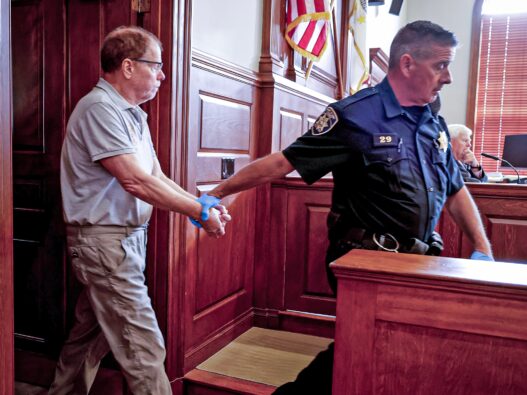
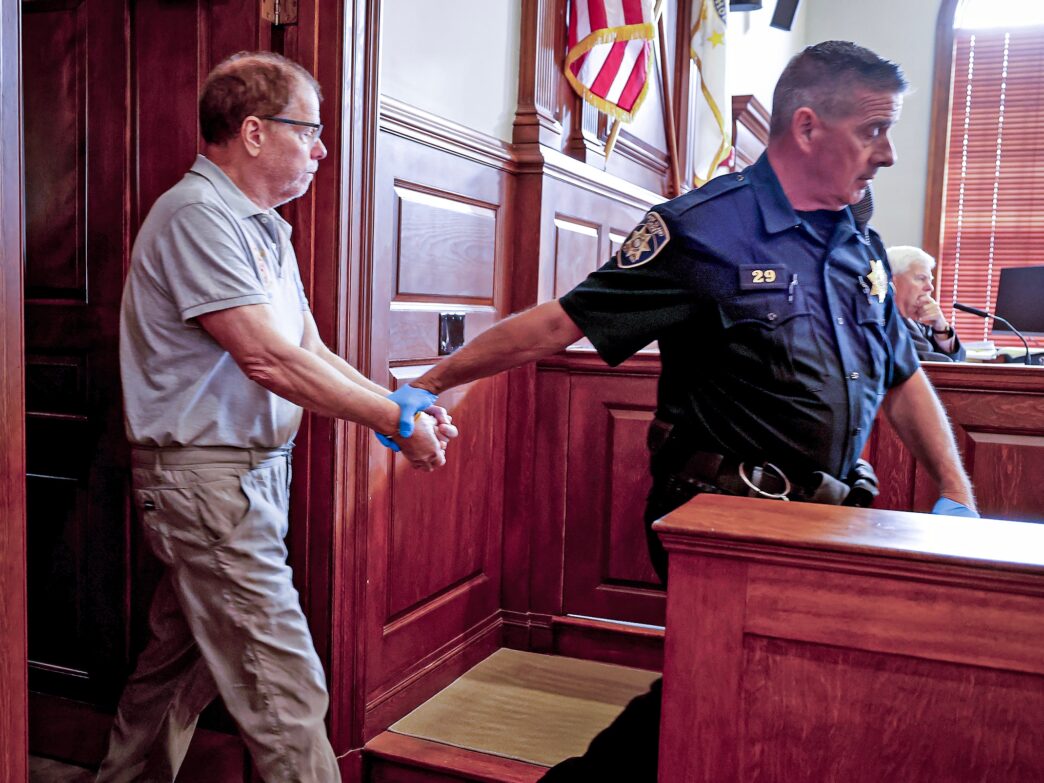
On July 27, Fischer was back at Newport Superior Court to be arraigned on a bail jumping charge — escorted into the same courtroom where he’d been on trial two decades ago. He had white stubble on his face, unkempt hair, and wore a Ralph Lauren shirt and handcuffs.

Asked to state his name for the record, Fischer said simply, “Ronald Fischer.” He said he did not have an attorney, and the judge entered a plea of not guilty on his behalf. An obvious flight risk, he was held without bail.
Outside the courthouse, it was a warm Newport morning. A few blocks away, rows of sailboats bobbed in the water, glinting in the sun. Fischer no longer had anywhere left to hide, on land or sea — that is, if he was ever really hiding at all.
“Was he hiding? Absolutely not,” said Cecile, the fellow member of the Liberty Yacht Club. “Maybe he had been hiding for so long that he felt untouchable, that he could just be himself.”