




|
Neubauer Artists LLC
Getting your Trinity Audio player ready...
|
Emily Barnett’s latest novel, “Standing Like a Queen,” is available from Gallimard. This short story is loosely based on Loana’s participation in Jean Paul Gaultier’s Spring/Summer 2002 fashion show.
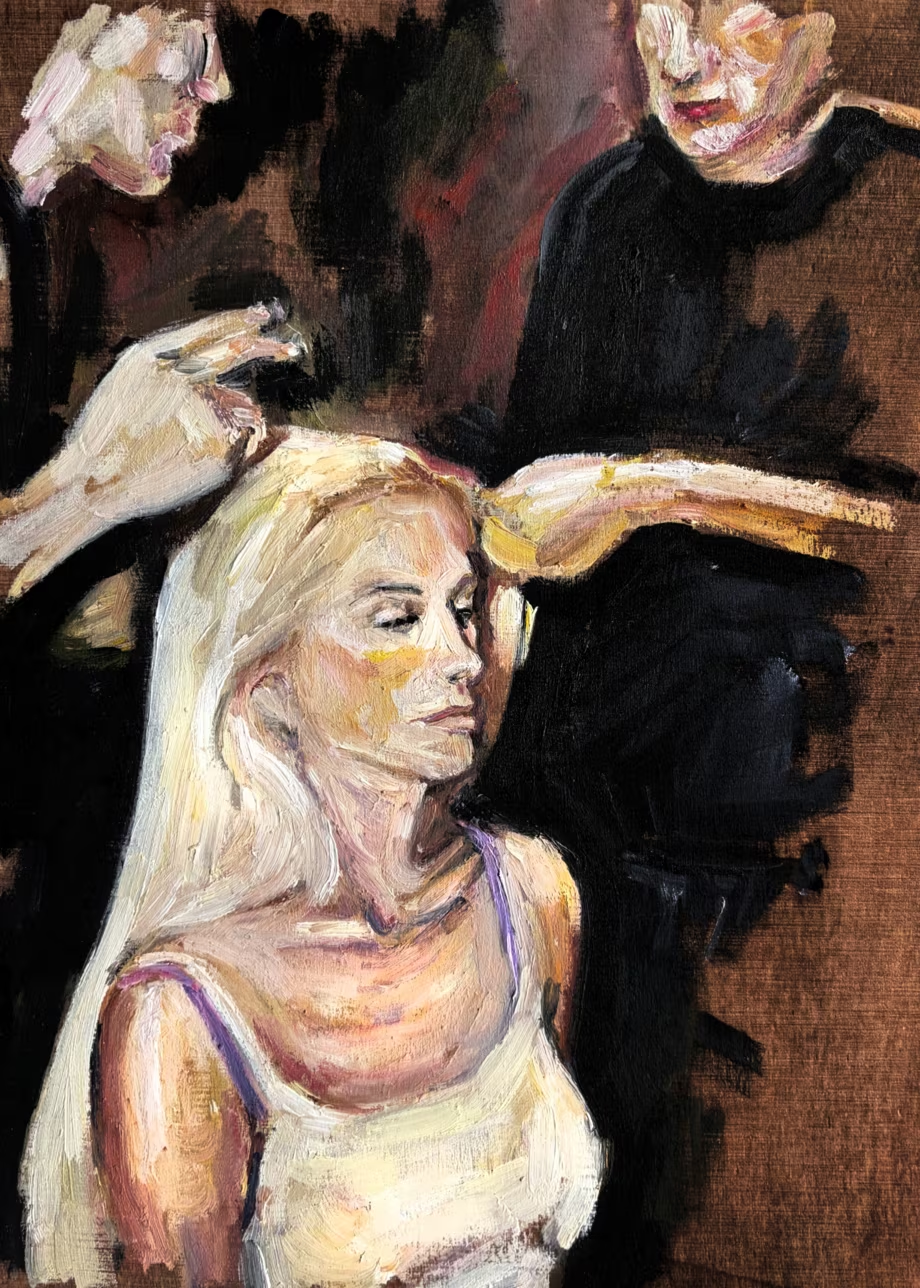
L. stays in the shadows, as much as possible, in the heart of the Carrousel. Soon she’ll have to plunge into the cylinder, burning like a sunset. But for now, she’s clinging to a few more minutes of anonymity. Unknown once again, she is amidst all these models. These celestial beauties who float more than they walk, in their clothes so fluid, so transparent they look like wings. L. isn’t used to this. Before Loft Story, she loved—still loves—flashy clothes, the pink knit mini-top and the low-rise jeans that literally catch the eye! She loves feeling her wasp waist sway in the breeze. Otherwise, what would have been the point of gyrating in a bar in front of all those men, working out her abs for months, when she was still “just” herself – just L. – a slender blonde with “big” breasts – she wanted them, she got them, no shame in that – in the Loft, nobody knew except Steevy, her soul brother, her annoying friend too, always talking louder than her! But she likes him, she adores him, is happy to be living this new adventure by his side – walking the runway for a major designer! “Pinch me, I must be dreaming!” he told her, and they laughed like monkeys, like excited kids. But that was earlier, in the electrifying chaos backstage, when they were getting their hair and makeup done – for her, a black headband plastered across her long blonde hair; for S., a white headband and a thin braid inspired by a hairstyle from China or Japan. Yet S. looks neither like a warrior nor a sumo wrestler in her flimsy, fringed top—tulle, like the dancers’. And what is she wearing? She doesn’t even know anymore, shrouded as she is in the darkness—after the commotion of the fittings, the show has finally begun, and the music, incantatory, ethereal, as if in a vast church, a cathedral, has replaced the real sounds of the world. Captivated by this melody, by the glow of the illuminated catwalk, L. retreated to a shadowy corner, like a night bird, a bat frightened by these unfamiliar presences. She suddenly became aware of the crowd, of all the people present who had come to attend the show of the “star designer of Fashion Week, “ the enfant terrible of fashion”, and she panicked when she heard the distant buzzing of this crowd gathered around the stage, waiting to admire the “great trends of spring-summer 2002”, this Parisian elite that she venerates as much as she fears – she, the little adopted Niçoise.
Since leaving Loft Story, she has invented a fairy tale for herself: she was a Cinderella and reality TV was her “magic wand”. From a lame duck, she became a princess.
Suddenly, she tells herself that she—Loana—has no right to be there. Her journey is an accident, her rise to “scandalous reality TV figure” a sham, a heist; a joke. Of course, she has no right to be there, standing at 1.73 meters tall when all the others—the real top models—dominate her in experience and height. How could she! She, the “go-go dancer,” the abused, beaten child, a poor “crumb” (she just wrote a book about it), subjected to every kind of violence, not even worthy of the gentleness of childhood; how could she, once confined with her mother in a 15-square-meter apartment, two chickens in a cage, possibly presume to walk the runway for the most innovative of young French designers? She, the “bad mother” of 17, entrusting her little girl to social services—her heartbreaking, shameful secret—for lack of money to raise her; Is she still the “slut” fooling around with the guy who broke her heart in a swimming pool? Since leaving Loft Story, she’s invented a fairy tale for herself: she was Cinderella, and reality TV was her “magic wand.” From a nobody, she became a princess. This narrative suited her well. It flattered her childhood imagination. But here, amidst the glitz of Fashion Week, this temple of elegance, this springboard of beauty, L. sees herself only as the awkward, clumsy girl she’s always been, uncomfortable around others, always speaking too fast, slurring her words for fear of not being able to finish her sentences, so gnawing is her shyness… The old fear of getting hit for a word out of place? Outside the circle of red and gold light, she feels nothing but her anonymous body, once planted on platform shoes to mask the true reason for her unsteady gait, this way of moving like a tightrope walker through life—always ready to fall, to disappear. So she clung to the eyes of others—those of men—as if to holds on a climbing wall to keep from falling. Their gazes—lustful, embarrassed, or condescending, there is never any in-between—saved her, despite everything.
Tonight, those looks will save her again. That’s what L. tells herself, feeling somewhat rejuvenated, invigorated—a smile in the darkness. The audience will breathe life back into her ego, rebuilding stone by stone the crumbling wall of her self. She will cast her invisible nets over the audience to draw from them the riches she needs to survive, the jewels of affection, the treasures of tenderness, with which the press has already showered her since her release from their gilded cage three months ago—it was July 5th, and now it’s October—an eternity ago… “Loana, why we love her” on the cover of a major women’s magazine… The outpourings of love she received from the very first night, getting out of the car, sitting by the window, on the Avenue de la Grande-Armée… The most beautiful moment of her life… How happy she was… What revenge, what a resurrection…! Had she died before? Or had life never even begun?
A member of the staff signals to her; it will soon be her turn to step into the spotlight… to enter the golden circle. She watches the models leave and reappear in their flowing, light, golden tunics—pure, monastic, nonchalant beauties, some bare-chested like Madonnas, others tattooed, shaved, and pierced like Buddhist monks who’ve gone bad. Jean-Paul G. has dressed her all in black. Another Madonna? Like Mondino, who photographed her a few months ago, he told her: “You are a queen, a warrior.” For her, it will be a top in light black fabric, a long, semi-transparent black skirt, hidden high heels—a sober, “total black look” that breaks with her image, she supposes, of a flashy TV bimbo. A woman-child. L. no longer feels like an alien hiding under her tight-fitting “I LOVE IBIZA” T-shirts (she was still wearing them this morning, nostalgic for her reunion with Jean-Édouard this summer, driven by a tenacious, voracious, and desperate desire for him), hiding, therefore, so that no one would see her, so that she would be forgotten. Hidden, too, behind her breasts, her supposedly sculpted physique. Jean-Paul G. erased all that to tell another story: another mythology of her body in the most beautiful museum in the world. Loana is perfectly aware that here, in this place, she is another woman: a queen, an empress—nothing less!—with a “little bit of Brigitte Bardot ,” she was told, in Contempt. So she’s going to have fun being this haughty presence she’s never dared to be in real life, because tonight, clothes make the woman.
The ethereal chants mingle with the sound of trip-pop—it’s her turn! The plunge, the leap; before L., the cone of light widens. The space opens up, abyssal. A single turn and she begins her ascent onto the catwalk—a white ribbon that gently slopes toward the crowd. At first, her body seems stiff, she sways a little, then she finds her rhythm, her movements become fluid, precise, refined. Jean-Paul G. told her not to stop smiling. She’s a guest star—not a professional model—so she has to enjoy herself, “have fun,” he whispered to her, before she took flight. Seeing her, the invited crowd lets out a murmur of surprise—”Loana, here?”—they laugh, they encourage her kindly—perhaps out of admiration for the piece she’s wearing. Then everything changes: her frozen smile, her fear of being judged and tripping over her skirt; she suddenly feels proud and burns like the sun. Reaching the end of the catwalk, she pauses—that famous moment, the climax of the garment, of this strange parade, before heading back in the opposite direction—and, while savoring her happiness and triumph, she can’t help but, in a surge, an impulse, bow, curtsy before this Parisian crowd which, in her eyes, is the true queen of the evening. The one by whom Loana dreams of being knighted.
But then, to her horror, she hears a man shout, “She’s found a job!” Or perhaps—even worse, it sends a chill of shame down her spine—“There’s still work to be done!” L.’s back is turned now, she’s heading backstage, but she can hear the bursts of laughter this sarcasm has provoked from some in the audience. With her discreet curtsy, the young woman wanted to reveal a moment of humility, seeing in it a politeness that some mistook for weakness. A man rushed into this opening. The light in Loana’s head went out. Old wounds were reopened. But she won’t let this laughter ruin everything. A few minutes later, she accompanies Jean-Paul G. and Steevy to greet the crowd. The designer gives her a little kiss. Thankfully, angels do exist, sometimes standing up to the easy arrogance of vultures.