



|
Neubauer Artists LLC
Getting your Trinity Audio player ready...
|
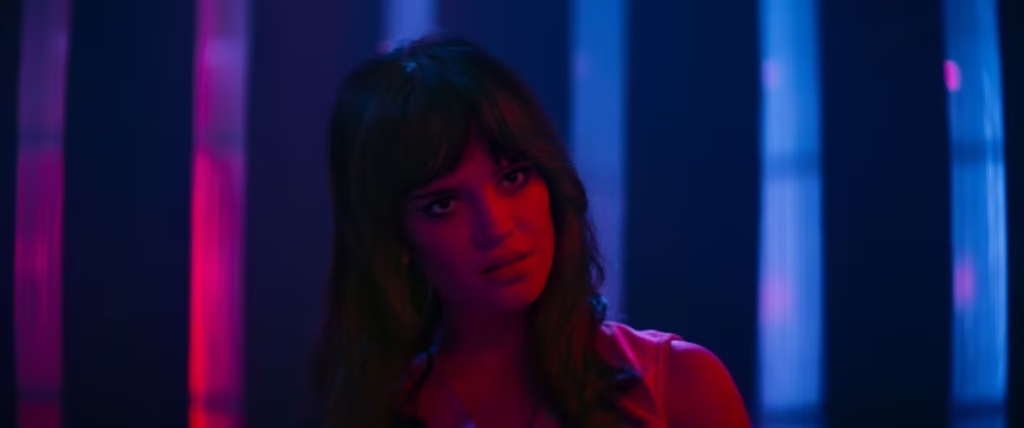
She is the hallucinatory heroine of “Her Private Hell,” Nicolas Winding Refn’s new monster of a film, presented Out of Competition at the 79th Cannes Film Festival. A meeting with this demented actress on the Croisette.
Sophie Thatcher: Haha, that’s so Nick. But no, he didn’t sell me the project like that at all. He hardly told me anything about the script, actually. He mostly talked about his personal story: after a health problem, he was clinically dead for about twenty minutes, and his only thought at that moment was to find his daughter. He told me this during our first meeting, and it was one of the strangest I’ve ever had with anyone. We ended up talking about films we both like. We have very similar tastes; we’re both drawn to the weirdest and most unusual things.
GVM: Which films, for example?
ST: We talked about Nekromantik (a 1987 German gore film) and other European B-movies, as well as Kenneth Anger ( Scorpio Rising ). And at our second meeting, I figured I had to win her over somehow. So I brought her my rare Cannibal Holocaust vinyl record , which costs a fortune, as a gift. It was my way of saying, “Hire me!”
GHV: How did you prepare for such an abstract scenario?
ST: We had a lot of conversations, a lot of preparation time. We were trying to unravel the symbolism together, because not everything was written down. As for the tone, it was very difficult for me to find my footing, because it’s such a strange, dreamlike world. And then at a certain point, I let go. I stopped intellectualizing, I stopped analyzing, and I simply started to trust Nick and his vision. That’s when I was able to blossom in the character. For this type of film, I understood that you shouldn’t be too cerebral. It was almost an out-of-body experience. Something meditative.
I want to explore facets of myself that I don’t yet know.
GHV: How did he direct you on set?
ST: In an… atmospheric way. A lot thanks to the music. We exchanged playlists every day. On set, he was playing Pino Donaggio (the legendary composer of Brian De Palma’s work and Italian giallos in the 1970s and 80s), even before we knew he was going to do the soundtrack. I’d prepared a playlist inspired by his scores, with a touch of dream pop: Sonic Boom, Spiritualized, My Bloody Valentine… For the scene where I have my meltdown, I played him Suicide’s “Frankie Teardrop” on repeat. I was jumping around right before we started shooting. It was one of the most exhilarating experiences I’ve ever had on a film set.
GHV: Did the fact that you are also a musician play a role in Refn wanting to hire you?
ST: I think so. Music is also her way of communicating; it was an immediate connection between us. And beyond that, having a rich artistic life outside of acting, I think that’s very important. My music is my own thing. I compose it alone in my room, in the dark; I don’t do press, I don’t try to please anyone… But it helps me enormously with my acting.
GVH: How exactly?
ST: When I write music, I enter a state close to a trance. It’s meditative, it’s improvised, it flows naturally. Being able to draw from this type of artistic state, not having everything fixed in advance… it helps me a lot.
GVH: I read that you wanted to “be as strange as possible” in your roles. Were you strange enough in this one?
ST: I could have gone even further into the bizarre! I have another film coming out soon, Peaches , in which I do a lot of physical comedy, a very clownish thing. I want to explore facets of myself that I don’t yet know. That’s what’s wonderful about this profession: being able to let go emotionally and go home relieved. Doing things you can’t do in real life. And when you commit to it seriously, it’s hypnotic.
GVH: Do you have role models in the industry, actresses who inspire you?
ST: Gena Rowlands. Absolutely. If we’re talking about immersion, she’s the queen. She inhabits her characters so deeply that you never question anything. Juliette Binoche, also a queen of immersion. I really like character actors in general, and I want to move more in that direction. I feel I have the ability to shift into very different mental states. But I’m still very early in my career. For now, I’m playing characters who are versions of myself, or versions of what people imagine me to be. It’s something that’s tricky to overcome.
GVH: Many people seem to see you as a “scream queen”.
ST: That’s what everyone says in every interview… Look, what I really need is to collaborate with directors. I need someone who pushes me to my limits.
GVH: Who would you dream of working with?
ST: Wim Wenders. John Cassavetes, if he were still alive. Sean Baker. There are many others, but these are the first names that come to mind.
GVH: How did you get into music? And what instrument do you play?
ST: I sing and play synthesizer—an Ableton. I grew up playing piano, my mother’s piano. I sang classically, started in musical theatre, and received a fairly thorough musical education. But I had to “unravel” myself to find my voice. Artists like Sparklehorse have influenced me a lot. Animal Collective too. Cindy Lee fascinates me.
GVH: And you have an Elliott Smith tattoo?
ST: I’d forgotten I said that in an interview—now everyone’s going to ask me! Actually, it’s just “ES,” the initials. Elliott Smith was my childhood. He helped me through so much. I’m listening to him a little less these days—I go through phases—but I’m looking forward to rediscovering him with fresh eyes, with more life experience. When I was 14, I felt it was deeper than I could understand. I was eager to live to understand those emotions, however sad they might be. It’s part of the human experience.