






|
Neubauer Artists LLC
Getting your Trinity Audio player ready...
|
Three stories about the United States economy converged in mid-August. In decreasing order of importance: The official federal debt hit $40 trillion. Primary voters chose candidates for a slew of political contests that look sure to center on questions of “affordability.” And fans and critics of Vice President JD Vance debated his views about the global status of the dollar. These developments, usually considered in isolation, illustrate that voters and politicians alike want things that are incompatible with one another but refuse to acknowledge the trade-offs.
The dollar controversy began when a Vance critic circulated a 2023 clip of the then-senator. The dollar is the world’s reserve currency, used by governments and firms to conduct transactions, settle accounts and hold as savings. Vance has repeatedly expressed the concern that this foreign demand for dollars distorts the U.S. economy. It reduces borrowing costs and encourages an unhealthy level of debt. It strengthens the currency relative to others, making imports to the U.S. cheaper for American consumers and exports from the U.S. more expensive for foreign consumers. The dollar’s dominance, the thinking goes, thus contributes to larger trade deficits and suppresses manufacturing output and employment.
Most economists don’t see it this way. Maurice Obstfeld, a professor of economics emeritus at the University of California at Berkeley, points out that the trade deficit expanded even as the dollar weakened between 2002 and 2006, and that Britain ran trade surpluses in the era of pound supremacy. He concludes that the U.S. trade deficit is mostly homegrown, a consequence of an economy with less savings than investment. Others have noted that manufacturing employment has been shrinking around the world, in countries with trade deficits and countries with trade surpluses.
President Donald Trump has sometimes said he wants a weaker dollar, in line with Vance’s comments, but he’s emphatically defended its reserve status, too. “You know, if we lost that, that would be like losing a world war,” he said in July 2025. But even a somewhat weaker dollar comes with costs. To favor one is to want Americans’ paychecks to be able to purchase fewer foreign goods than they can now. Americans would produce morefor the rest of the world and get less in return. Whatever other benefits that would bring, it would mean less affordability.
Viewing the dollar’s high status as a “curse,” as Vance has suggested, raises an additional question: How should the U.S. get rid of it? The dollar became the reserve currency less because of policies deliberately designed to achieve that than because of America’s prosperity and military power, the attractiveness of its capital markets, and confidence in its adherence to the rule of law.
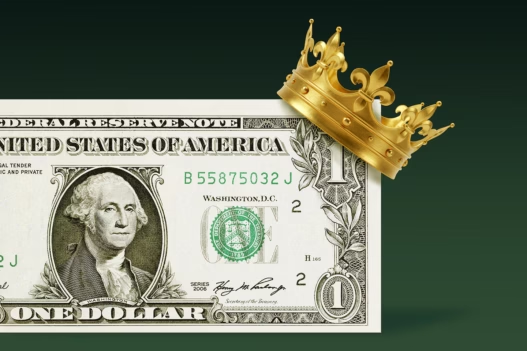
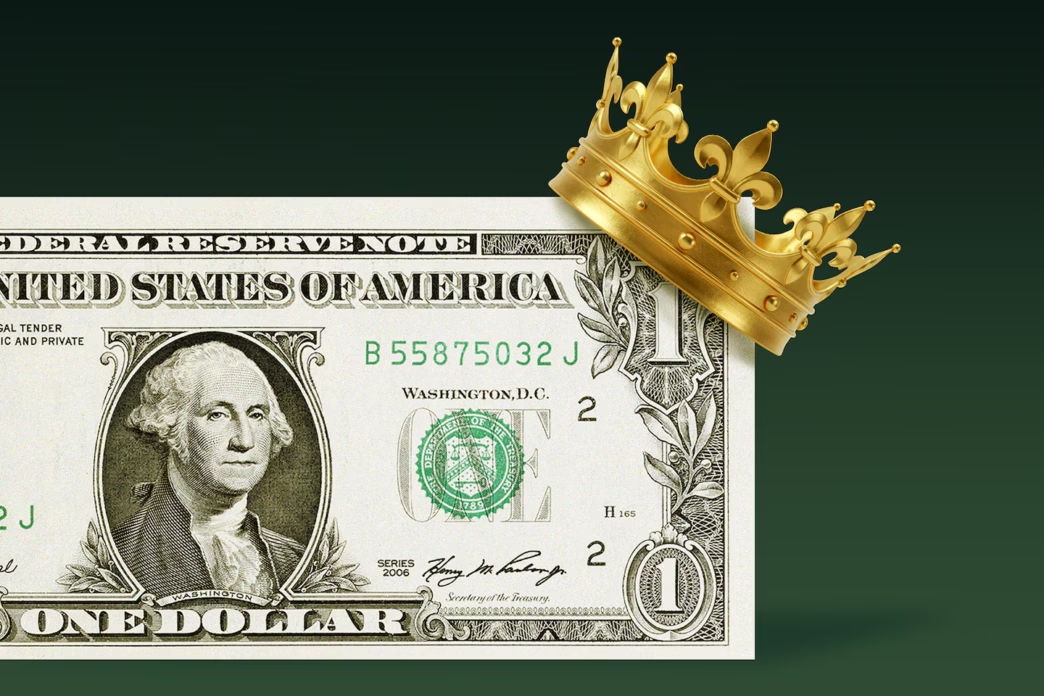
Jamie Dimon, the CEO of JPMorgan Chase, recently remarked that “if we’re not the strongest military in 25 years and the strongest economy, we won’t be the reserve currency either.” That’s presumably not the way most Americans would want to escape the disadvantages of King Dollar.
Some Trump administration officials, such as former economic adviser Stephen Miran, have suggested that the U.S. “impose a user fee on foreign official holders of Treasury securities.” That might drive the dollar down. But since U.S. citizens would need to buy more Treasurys, they would lend less to the private sector. Investment would suffer.
Federal borrowing costs would also increase. That’s a good thing, if you believe dollar dominance is a curse: The theory goes that the federal government has gone so deeply into debt because it has been easy. Make it more expensive for the government to borrow and Washington will have to do less of it.
Yet interest costs, now the third-largest item in the federal budget, have been mounting for years without inducing greater fiscal discipline. Dethroning the dollar is more likely to lead to bigger deficits by raising interest payments than it is to cause a nationwide outbreak of responsibility.
Many economists think that the currency-curse theory gets the link between budget and trade deficits backward: Cut the budget deficit, and the dollar will depreciate and the trade deficit shrink. Yet the options for reducing the deficit remain as unattractive as ever. The tax increases that would raise the most revenue are unpopular. So are cuts to Medicare and Social Security, the biggest items in the federal budget. Downsizing the fourth-biggest item, the Pentagon, would endanger national security. That’s why the deficit persists.
Lower budget and trade deficits, lower taxes, more manufacturing jobs, cheaper goods and services: These are all appealing but can’t be had simultaneously. That won’t stop us from continuing to try, though, which is why our policies are frequently incoherent and our debates often inane.
Article written by Ramesh Ponnuru
Source: Washington Post