

|
Neubauer Artists LLC
Getting your Trinity Audio player ready...
|
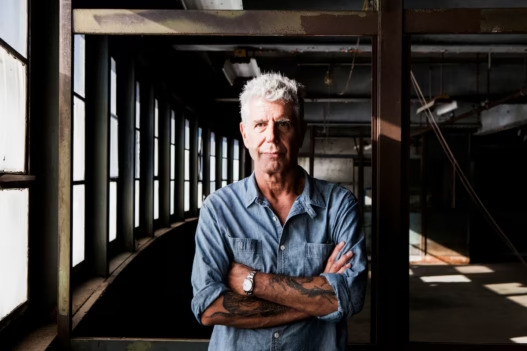
With the new biopic “Tony” now in theaters, I, like many fans of the late chef and author, can’t help but reflect on the legacy and lasting impact of Anthony Bourdain on how we eat, travel, and look at the world.
The first time I remember watching Bourdain on television, he was drinking snake wine and slurping up a beating cobra heart in Ho Chi Minh City for an episode of “A Cook’s Tour.” As an impressionable middle schooler in the early 2000s, I had never seen anything on TV as, frankly, badass before, and him throwing back that snake heart like a shot of Jack Daniel’s is forever seared into my brain (it tasted like chicken, I recall him telling me during my first interview with him in 2016).
That wild, rock star-like image of Bourdain — the tall, slender guy usually wearing a leather jacket and shades, smoking a cigarette before enjoying a rare local delicacy in some remote part of the globe — is what first got me hooked on his work. His penning “Kitchen Confidential” made him a world-renowned culinary star, with his rugged persona attracting legions of fans, reinforced by his early travelogue programs “A Cook’s Tour” and “No Reservations,” shows I religiously watched reruns of after school in my youth.
But the more I read and watched Bourdain, who tragically died in 2018 at the age of 61, the more I came to appreciate his creative genius and masterful storytelling, the empathy and honesty he showed to everyone he talked to or shared a meal with, and the strength of his convictions and moral compass.
Most of all, I appreciated how he showcased Vietnam, where my mom is from, across his different programs. Watching those episodes chronologically, from the more wild moments of that first “A Cook’s Tour” trip up through his famous 2016 episode of “Parts Unknown,” where he sat with President Obama in a Hanoi restaurant, I sensed his appreciation and understanding of the country had deepened over the years. He loved not only the food, but also the people and history of Vietnam, even embracing the chaos of its infamous motorbike culture.
When I got the chance to chat with Bourdain for Boston Magazine in a phone interview ahead of a 2016 appearance at Symphony Hall, he reflected on the surreal moment of dining at a “shabby, family-run restaurant” in Vietnam with the thenpresident.
“To see the president of the United States on a low plastic stool drinking Hanoi beer from the bottle and eating bún cha with chopsticks, as much fun as it was for me and my crew, the effect on ordinary Vietnamese from Hanoi the next day was absolutely electric,” Bourdain said. “People were coming up to me in the street literally crying with gratitude and surprise that the president of the free world had chosen to eat this specifically Hanoi dish.”
Bourdain’s repeated travels to Vietnam meant a lot to me as someone who grew up only hearing sad historical facts, or, the occasional derogatory statement said about the country from less open-minded classmates. These days, Vietnam is a sought after tourist destination, particularly beloved by influencers, who flock to popular spots across the country, seeking to experience the Cái Răng floating market and the beauty of Ha Long Bay. I credit a lot of this growth in popularity to Bourdain showcasing Vietnam in a respectful and open-minded way.
About a week before Thanksgiving in 2017, I interviewed Bourdain again, this time for Metro Boston while he was in Chestnut Hill for an event at the Showcase SuperLux theater. Long before the Tartan Army came to town, Bourdain had teamed up with Scotch whisky maker Balvenie for its web series “Raw Craft.” Bourdain screened an episode featuring Southbridge, where he visited a local drum maker along with Tré Cool of Green Day.
“I got to see Green Day. I’ve never seen Green Day before,” Bourdain told me over glasses of whisky after the screening. “I like any excuse to come to Massachusetts. I have a lot of history here. I just feel really comfortable in this state. I love it. I like coming to Boston.”
As a kindred spirit who also appreciates a good dive bar, hearing Bourdain opine about his love for the ones in South Boston was such an unforgettable treat.
“I like Southie,” he said, referencing the 2011 episode of “No Reservations” where he visited the Quencher Tavern, which has long since closed. “[The bar] was built into a row house in Southie. It was incredible.”
“A perfect bar is a rare and beautiful thing, and Boston has a good bunch of them, as well as a lot of really old school, dinosaur places that do old school [expletive] without any irony, which I like, too.”
What I’ll remember most from that evening, though, is seeing Bourdain’s eyes light up as we talked about, of all things, Brazilian Jiu-Jitsu. He had gotten into the sport thanks to his estranged wife, Ottavia Busia-Bourdain, and trained at the legendary Renzo Gracie Academy in New York City. My former instructor in Connecticut earned his black belt at the same academy and had trained with many of the same people as Bourdain. We ended our conversation geeking out about the sport, which he had become quite the competitor in during his later years.
It was devastating to hear about his death in 2018, as I always held Bourdain in such high personal regard and have been inspired by him in many ways, from how I look at storytelling to how I cook at home.
During that 2017 chat, we had discussed his love of preparing Thanksgiving dinner. The first time I hosted the meal for my family in 2018, and in the years since, I’ve tried to honor Bourdain, in my own small way, by following his cookbook “Appetites.” Before the holiday I’ll whip up homemade turkey stock and start preparing the sides, with the several days before Thanksgiving planned out precisely so the turkey, gravy, stuffing, cranberry relish (my favorite), and all the other dishes come together just in time for the big meal.
“I deliberately plan,” Bourdain explained to me in our last interview. “I cook Thanksgiving dinner. It’s very traditional.”
Most of all, he loved leftovers, and like him, I try to “overproduce” so others (and, let’s face it, mostly myself) can enjoy all that hard work.
“That is the true joy of Thanksgiving,” he told me. “It’s all about the leftovers.”