

|
Neubauer Artists LLC
Getting your Trinity Audio player ready...
|
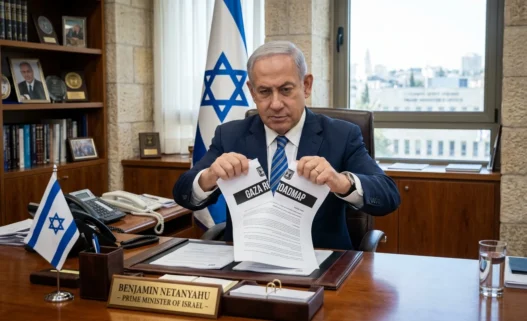
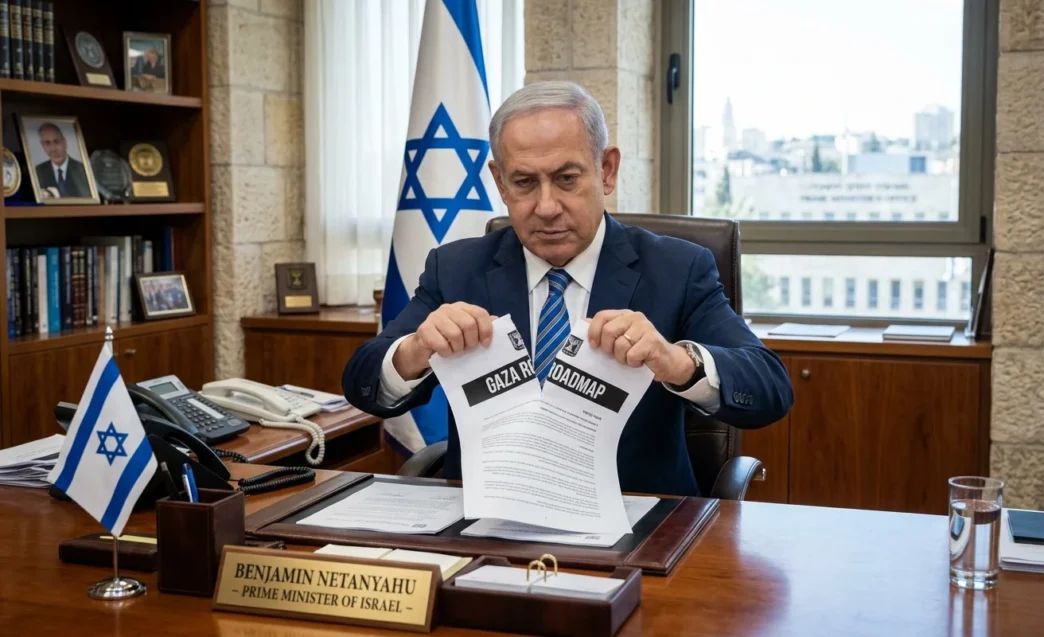
The same week produced two very different responses to Netanyahu’s rejection of the Board of Peace’s Gaza roadmap. One was loud, public and diplomatic. The other was quiet, personal and conducted largely out of view.
Read together, they reveal something important about the current standoff. The issue is no longer simply whether Hamas will disarm. The real dispute is over how disarmament and Israeli withdrawal are sequenced — and whether the commitments in the roadmap are reciprocal.
The Loud Version
On August 16, the foreign ministers of Turkey, Egypt, Indonesia, Jordan, Pakistan, Qatar, Saudi Arabia and the UAE issued a joint statement condemning Israel’s rejection of the roadmap. They called on the Board of Peace, with the active support of the United States, to take immediate and concrete measures to prevent further obstruction of the plan. The statement was unusually pointed because it did not treat Netanyahu’s position as simply another negotiating position. It characterized it as an obstacle to implementation.
The significance is less in the rhetoric than in who signed it. These are not eight governments that happen to dislike Israel. They are governments that have aligned themselves with the framework being used to implement the Trump plan and the ceasefire architecture endorsed by UN Security Council Resolution 2803. All eight have joined the Board of Peace framework.
And the UAE’s signature matters.
The UAE normalized relations with Israel under the Abraham Accords in 2020. It therefore has a relationship with Israel that Egypt, Qatar and Turkey do not have in the same form, and it has more at stake in preserving that relationship. Yet Abu Dhabi joined a statement publicly accusing Israel of obstructing the implementation of a plan it supports. That does not mean the Abraham Accords are unraveling. There is no indication that the UAE intends to abandon normalization. But the signature is still an indicator of how far Netanyahu’s Gaza position has moved from being a dispute between Israel and Hamas to becoming a problem for the broader coalition assembled to implement the agreement.
The regional message is becoming harder to miss: the problem is no longer simply getting Hamas to accept disarmament. It is getting both sides to honor the reciprocal commitments of the roadmap.
What Netanyahu Is Actually Rejecting
There is an important distinction here that can easily get lost in the argument over “the plan.” Ten months ago, Netanyahu welcomed the Trump framework that became the basis for Resolution 2803. But almost immediately he made clear that one of its most consequential political provisions was unacceptable to him: the provision establishing a phased pathway toward Palestinian statehood. Now he is rejecting a different part of the same architecture.
The Board of Peace roadmap calls for phased and internationally verified Hamas decommissioning, matched by phased Israeli withdrawal from Gaza. The UN’s description of the implementation mechanism explicitly links Israeli withdrawal to verified progress in decommissioning. That is not the same thing as saying Israel is merely being asked to withdraw to the Yellow Line.
The Yellow Line is the existing reference point from which the next stage of withdrawal is supposed to proceed. In fact, the current situation is more complicated because Israeli forces have moved beyond the original line in several areas. Reuters reported in July that Israel had expanded its area of effective control from roughly 53% of Gaza behind the original Yellow Line to approximately 64%, while the line itself has been pushed deeper into Gaza in places.
The roadmap therefore contemplates something considerably larger: phased, verified and ultimately complete Hamas disarmament in parallel with phased and ultimately complete Israeli withdrawal from Gaza.
Netanyahu’s position changes that equation. Israel is demanding that Hamas be completely disarmed before Israel makes the corresponding withdrawal. That converts a reciprocal process into a sequential one: First Hamas completely disarms. Then Israel withdraws.
The roadmap envisioned something different: Hamas progressively disarms. Israel progressively withdraws. That difference is the heart of the current confrontation.
The Quiet Version
Against that public pressure, Jared Kushner arrived in Cairo and met directly with Hamas’s new political chief, Khalil al-Hayya — an unusually direct American engagement with Hamas. Kushner then traveled to Israel for talks with Netanyahu.
The purpose of the Cairo meeting appears clear. Washington wants to establish whether Hamas is prepared to translate its conditional acceptance of the roadmap into concrete steps toward disarmament. AP reported that al-Hayya reiterated Hamas’s demand for an end to Israeli attacks and a return to the Yellow Line, while the broader objective of the meeting was to restart the stalled implementation process.
Reuters likewise described Kushner’s mission as an effort to advance Trump’s Gaza plan, including Hamas disarmament and Israeli withdrawal, while Hamas continued to condition its acceptance on Israel fulfilling its own obligations.
That is important because the Yellow Line should not be treated as a separate negotiating issue. Kushner did not need to walk into Netanyahu’s office and say, “Let’s discuss the Yellow Line.” If he was discussing implementation of the roadmap, he was discussing the mechanism that ultimately determines where Israeli forces go: phased Israeli withdrawal in exchange for verified, phased Hamas decommissioning.
The reporting does not establish exactly what Kushner said privately to Netanyahu about the Yellow Line, and it would be a mistake to pretend otherwise. But the broader subject of implementation necessarily encompasses it.
That is what makes the quiet diplomacy potentially more consequential than the public statement. The public statement applies political pressure. Kushner’s diplomacy works on the machinery that would make the political disagreement operationally resolvable.
Two Kinds of Pressure
These are therefore not competing strategies. The eight-country statement is pressure from the outside. Its purpose is to make clear that Netanyahu’s position is no longer being viewed simply as Israel’s negotiating position. It is increasingly being viewed as an impediment to a multilateral framework that these governments have invested in and publicly endorsed.
Kushner’s mission is pressure from the inside. He is trying to preserve the negotiating structure itself — including Hamas’s conditional commitment to disarmament — while putting enough definition around the implementation process that there is eventually something concrete for Israel to accept or reject. That distinction matters.
If Hamas refuses to disarm, Netanyahu can argue that Israel has no reciprocal obligation to withdraw. That was essentially the logic behind much of Israel’s position earlier in the process. But if Hamas accepts a verified, phased decommissioning mechanism while Israel refuses the corresponding phased withdrawal, the diplomatic geometry changes.
That is precisely why Kushner’s meeting with Hamas matters. Hamas is not being asked merely to say it supports disarmament. It is being asked to begin creating the conditions under which the reciprocal mechanism can operate. Axios reported that Hamas leaders reaffirmed their commitment to demilitarization during the meeting, while also raising concerns about continuing Israeli strikes and the broader implementation of the plan.
Whether Hamas’s commitment is genuine strategic acceptance or tactical maneuvering remains unresolved. But analytically, that is less important than the fact that Hamas is now being engaged on the basis of conditional compliance rather than simply refusal.
The Election Is the Constraint, Not the Strategy
The October 27 Israeli election remains the obvious constraint on Netanyahu. He has little political incentive to make a concession that can be portrayed by his coalition partners as allowing Hamas to survive or forcing Israel to withdraw while Hamas still possesses weapons. But that does not mean Washington is simply waiting until after the election. The current diplomacy suggests something more subtle.
Washington appears to be trying to lock in the architecture now, while the political choices available to Netanyahu are constrained, so that the choices facing him after the election are different from those he faces today. That is why the mechanics matter. If the United States and the Board of Peace can establish what constitutes verified disarmament, who verifies it, what weapons and tunnels are covered, how each phase triggers a corresponding Israeli withdrawal, and how the International Stabilization Force enters the process, then the argument ceases to be an abstract dispute over trust. It becomes a question of whether Israel will participate in a mechanism it previously accepted in principle. And that is a much harder position to sustain indefinitely.
The Pressure Is Accumulating
Neither track is likely to force Netanyahu into a public capitulation before the election. But that is not the same thing as saying nothing is happening. The public pressure is widening the diplomatic cost of obstruction. The private diplomacy is trying to preserve the mechanism that makes reciprocal implementation possible.
And the UAE’s participation gives the public pressure an additional dimension. Netanyahu is increasingly confronting not just Hamas, not just Arab mediators and not just international institutions, but members of the very coalition assembled to implement the agreement.
The central question is therefore shifting.
It is no longer simply whether Hamas will disarm. It is whether Netanyahu will accept phased disarmament matched by phased withdrawal, or insist that Hamas make the entire concession first while Israel retains its freedom to decide whether and when to make its own. That is the dilemma the Board of Peace has now put in front of him.And it explains why the two responses this week looked so different.
One applied pressure loudly. The other applied it quietly. But both were aimed at the same problem: keeping reciprocity alive.