

|
Neubauer Artists LLC
Getting your Trinity Audio player ready...
|
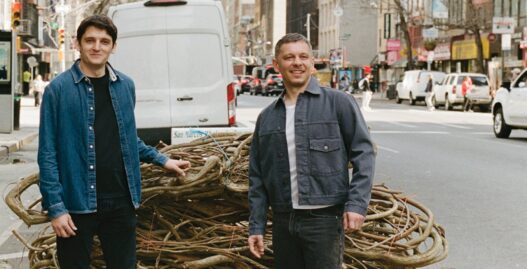
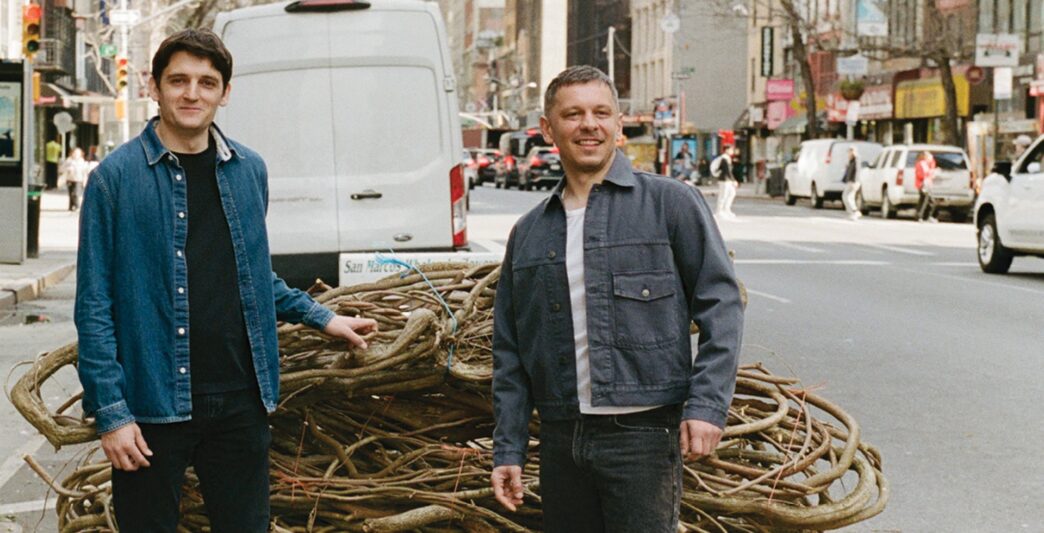
FLOVER creates striking, experimental, unconventional installations for an impressive roster of global clients including Victoria Beckham, Lady Gaga, Drake, Crosby Studios, and the list goes on. Crossing the Atlantic was more than worth it to meet Marko Tirnanić and Marin Ivanković in person and experience their floral artistry up close.
As I made my way gently and rather leisurely through the crowds on Sixth Avenue, insisting on walking a few extra blocks because I had somehow missed that often barely tolerable roar of the city, I found myself thinking that New York remained endlessly charming in its boldness and noise, just as it had been 14 years ago when I left. Walking on the sunny side of the street, I reached 21st Street, where FLOVER’s showroom is located. On that corner there were flower shops everywhere. “It made perfect sense to base ourselves here so that great flowers are always within easy reach,” Marko joked as we climbed the stairs, greeted along the way by flower vendors who all knew him well.
On the second floor of a New York townhouse, somewhere between two events they were preparing in the city, with a flight to Spain just around the corner and South Korea next on the schedule, the FLOVER magic was taking shape. The space felt less like a floral studio and more like a fascinating experiment. Endless innovative games with flowers, artistic forms you could happily lose yourself in, installations you wished you could place in your own display window and never let disappear. By then I was already holding two brilliant fanzines in my hands. One featured scenes from Hitchcock’s films, this time highlighting close-up shots of flowers hidden in the background, while the other, titled Yugoslavia, focused on the floral arrangements that appeared in photographs of Tito.
“From the very beginning, we knew we wanted to use flowers as a medium, but in a way that explored their less obvious, less ‘beautiful’ side. Instead of seeing flowers purely as decoration, we introduced them into artistic formats through video works, fanzines, spatial interventions and installations, through everything that wouldn’t necessarily be associated with flowers at first glance,” Marko Tirnanić and Marin Ivanković explained as they gradually drew me into the story. They founded FLOVER in 2017 and, thanks to this approach, quickly attracted the attention of major clients. “Some of our most notable installations and scenographies emerged directly from those experiments. From the very beginning, Marin and I have shared a slogan that still guides us today, no matter how provocative it may sound: ‘We are not florists, we are politicians,’” Marko tells me. There really did seem to be a quiet rebellion within their floral installations, I thought, an unintentional boldness born from their decision to be different. And they succeeded.

Among their first clients, back when they were just starting out “quite modestly and shyly,” as they describe it, were NIKE and musician Drake, who hosted an exclusive dinner for his VIP guests in one of New York’s largest penthouse spaces. “On that project we collaborated with Laila Gohar, whose distinctive aesthetic approach further enriched the concept and helped us bring together different creative perspectives into one cohesive experience. The atmosphere, design and details all functioned as a unified whole.” That project was followed by collaborations with brands and institutions including National Geographic, Netflix, Google, YouTube, TAG Heuer, Spotify, Jo Malone London and GQ, as well as artists such as Arca, Steven Klein, and Inez and Vinoodh. Among their most significant projects, they also highlight designing the official Met Gala after-party for two consecutive years, the latest of which was created in collaboration with Crosby Studios, while Lady Gaga has since become a regular client. In a market that leaves little room for hesitation, how does one even secure clients of that calibre? They explain that the New York creative scene primarily recognizes them as artists who create installations using flowers as a medium, but not in the traditional decorative sense. Their work is also deeply rooted in art direction and the overall visual identity of a space.
“Over the years, we’ve developed an approach that erases the boundaries between art, design and production,” they explain, adding that it was precisely this way of working that attracted major clients. Today they collaborate with names across a wide range of creative industries, but the common denominator is always the same: openness to experimentation and trust in the process.
“The clients we work with are open to experimental ideas, but only when they recognize a certain authenticity in them and feel they’re becoming part of something genuinely new. I think that’s exactly where our relationship with them began, along with the trust that allows them to surrender to the process and believe that together we can arrive at solutions that are visually powerful, sometimes spectacular, but above all engaging and different,” Marko says.
Whether they are designing an intimate dinner, developing a complete visual concept or creating a complex installation, their approach never changes. “We approach every project as a whole, rather than simply as a series of beautiful details.”
And while this photoshoot was taking place, some of the details you see in these photographs were already being carefully packed for South Korea, where they are working on a new project for MAC Cosmetics. Under the creative direction of Nicola Formichetti, the brand is redefining its retail spaces through a fusion of fashion, art and innovation. “Nicola, whom we had already collaborated with before, recognized our sensibility and approach to design and invited us to create something unique together. The first project in this series is the opening of a MAC store in Seoul, in one of the most dynamic and influential shopping destinations in Asia. As part of the space, we will present a permanent art installation,” they explain while finalizing the last logistical details of the shipment. Marin confidently takes on the business and administrative side of the work, giving Marko the freedom to focus entirely on the creative process, making them a perfectly balanced duo in which each brings their own essential strength.
Watching them and uncovering layer after layer of the brilliance behind their story on one of the world’s most competitive markets, one thing they said stayed with me. They had never really thought about achieving “great success.” Instead, they simply made things that genuinely interested them and that they enjoyed creating. “We were never driven by a business model. We were driven by the desire to build a community and create a new creative space. Although the idea was ambitious from the very beginning, that ambition never came from a desire to grow at any cost. It came from the need to do something for yourself, and to do it the way you want, without constantly trying to please other people.”
I ask them whether New York is a demanding creative playground, whether it exhausts them or inspires them. “Here, being tired is almost the default state,” they laugh before adding an observation. “The city’s energy is so intense that it constantly pushes you to become better, more interesting, and to develop your ideas as far as they can go, above all to give yourself a sense of satisfaction. You could say we rest by taking advantage of everything the city has to offer. At the same time, it drains you and recharges you, and perhaps that’s exactly what makes it so special.”


That brings me to something I had deliberately saved for later, something I had been looking forward to bringing up. Marko is, in fact, a trained painter whose practice is rooted in conceptual art. I had heard about his exhibitions years ago when he was showing work in Zagreb and later in Vienna. Since leaving Belgrade ten years ago, where he established himself as a conceptual artist through exhibitions as well as activist and political art projects, that is still how most people recognize him. “When I first arrived in New York and FLOVER was just getting started, I made a very clear distinction between what I did as an artist and what I did through FLOVER. Over time, that distinction gradually disappeared.” I ask him where his art ends and where FLOVER begins. “I don’t think the two can really be separated anymore. FLOVER is a highly conceptual brand. For me, ideas have always been much more important than appearance. Very often, the things we create are not ‘beautiful’ in the conventional sense. They can be simple, confusing, not entirely decorative, even slightly uncomfortable. That’s exactly the connection I see with the art I make.” One of Marko’s most recent major projects was the October Salon in Belgrade, for which he created a video installation consisting of 40 individual videos. Every day in New York he filmed new material, edited it overnight, and the following day a new video was shown in Belgrade, meaning visitors could only experience each work for a single day. “That idea of impermanence is incredibly important to me because it gives me freedom. Even if I make a mistake, tomorrow there is already another possibility, another version, another beginning.” Although FLOVER emerged as a result of his artistic practice, visual, conceptual and contemporary art remain his greatest passion and motivation. “It’s something I work on constantly. It remains my priority in life.”
I underline another point from our conversation, namely that he has never applied for exhibitions. “Mostly because of my own insecurity, since none of us likes being rejected,” he admits. I find that attitude almost paradoxically fascinating. “I think it has been important both for my artistic career and for the way FLOVER operates. We’ve never gone looking for work, we’ve never hustled, we’ve never tried to force opportunities or push for more. We’ve simply waited for people to come to us. That way, you can give your best, feel comfortable, and never have to fight for your place. We genuinely believe that every one of us is already good enough and that everyone has something valuable to offer.”
Despite their remarkable portfolio, their public presence remains remarkably restrained. Their minimalist website and fragmented Instagram feed seem to conceal more than they reveal. “Personally, I’d be showing off much more if I were in your position,” I say out loud. “The way we present ourselves publicly and on social media is really an attempt to communicate a certain feeling rather than literally show what we do. Conveying the concept is more important to us. Besides, our sculptures and installations are often large and multilayered, and that’s very difficult to capture in a single photograph.” That restraint stems from something deeper, almost a radical refusal to overexplain their work. “If you have to spend too much time explaining, convincing, defending or rationalizing what you do, it’s very easy to lose the most important and most delicate part of the work.” So they simply wait to be found by those who already understand. It feels more natural that way, and I couldn’t agree more.

It might be easy to mistake their answers for a sense of effortless ease, but they didn’t let me fall into that trap. “These experimental ideas are often not immediately easy to understand, but that’s exactly why we love this work and the process of creating something new. There’s always a great deal of fear involved because the moment you step away from the beaten path, you feel as though you could fall off a cliff. I think every project we do carries that kind of risk, and perhaps that’s precisely what gives it life.” What matters most to them while preparing an event for the fashion brand GAP with their team or developing a project for Victoria Beckham? “That the people around us genuinely enjoy what we’re doing and that throughout the process they feel good and respected. It’s equally important for us to preserve a sense of joy in our work. The studio is a space of complete freedom, where, without stress or expectations, small spontaneous ideas grow into projects that eventually become something much bigger,” Marin says, and Marko adds, “This is incredibly important to me because I believe good work can’t be built on pressure and a bad atmosphere. The quality of what you create is always connected to how people feel while they’re creating it.”
After completing projects for Crosby Studios and the French Embassy, and before heading to Korea, they have been invited to Córdoba to create a large public sculpture as part of the FLORA festival. “That’s especially exciting because five artists from around the world will be participating in the project. We’re also thrilled by the idea that people outside New York will have the opportunity to experience some of our work in a public space, in a city square, in direct contact with it.” It also aligns with their vision of establishing an international presence, something that is gradually moving from the planning stage into reality.
Is there still something they hope to achieve with FLOVER? They laugh and say that, at this moment, their biggest wish is simply for the photographs from this interview to turn out beautifully. “We don’t have many specific ambitions beyond being able to keep working, having our work recognized as interesting, and creating opportunities to collaborate with different artists. In a way, that’s our entire vision. We simply want to continue making work that connects us, inspires us, and feels meaningful to us.”
“So, NYC, the city where there’s nothing you can’t do,” I conclude somewhat predictably, but when it comes to FLOVER, inevitably so. “New York is a city where almost anything is possible, but not because it’s easy. It’s because it constantly forces you to confront yourself, your limits and your ambitions. It demands a lot, but at the same time it gives you the freedom to try, to experiment, and to become who you are. For us, it’s the place where the need for freedom, work and risk is felt most intensely. It’s a city where you can do anything, but only if you’re willing to go all the way and believe in what you’re doing.”
I’ll be honest with you, one day wasn’t enough for this conversation. It stretched into three more days of talking that gradually turned into spending time together. Through those conversations, I found myself once again confirming that the best things are hidden, and ultimately revealed, through genuine human energy and through the same kind of sincerity in the way we approach both work and life. Somewhere along the way, I realized that I always want to follow that impulse to keep moving, to keep pushing forward. In the end, Marko put into words exactly what I had been thinking. “Our work involves a great deal of experimentation, constantly pushing boundaries and trying to move beyond expected norms. I think that’s one of its defining elements. The moments I find most exciting are always the ones when you don’t fully know where the process will take you, but you feel that you have to follow it.”