

Skip to content
Primary Menu
  • GEORGE V MAGAZINE
    • NEUBAUER ARTISTS
      • ACCOUNT
        • LOGIN
        • LOGOUT
        • PASSWORD RESET
      • GEORGE FOUNDATION
      • TRAVEL BOOKINGS
      • SUSTAINABILITY
  • NEWS
    • News
    • Politics
    • Defense
    • World
    • Sports
    • Crime
  • FINANCE
    • Business
    • Neubauer Invest
    • Real Estate
    • Economy
    • Technology
    • Ownerships
    • Sponsored
  • ENTERTAINMENT
    • Neubauer Studios
    • Beauty
    • Celebrities
    • Fashion
    • TV & Films
    • Music
    • Health
  • LEISURE
    • Lifestyle
    • Travel
    • Jewelry
    • Arts
    • Sexual Wellness
    • Gastronomy
  • ROYALS
  • MARKETS
    • MARKET NEWS & FOREX INDEX
    • MARKET RESEARCH
    • GLOBAL HEAT TRADE MAP
    • INVESTMENTS
  • LIVE SCORES
    • Champions League
    • Europa League
    • EUROPEAN LEAGUES
      • Premier League
      • La Liga
      • Bundesliga
      • Ligue 1
      • Liga Portugal
      • Süper Lig
      • MLS
      • Serie A
      • Super League Greece
      • Eredivisie
      • Allsvenskan Sweden
      • Divisjon Norway
      • Veikkausliiga Finland
      • Superliga Denmark
    • SOUTH AMERICAN
      • Liga Argentina
      • La Liga MX
      • Serie A Brazil
    • Saudi League
    • Russian Cup
Light/Dark Button
GEORGE FM
  • World

East German Culture Has Been Ignored For Too Long Until We Embrace it, Our Country Will Remain Dangerously Divided

When the stories of people like me who lived in the old socialist republic are dismissed, shame can spiral into anger that fuels the far right. When I went to school in the 1990s, GDR literature wasn’t taught or read. It was treated as something shameful. I didn’t dare to pick up a book by an East German writer, even though many of them were in our library at home in Leipzig. Looking back, I believe the reason was the public perception of the old socialist republic. It scared me off.
Sophie Rosemont Published: August 20, 2024 | Updated: August 20, 2024 6 minutes read
5927

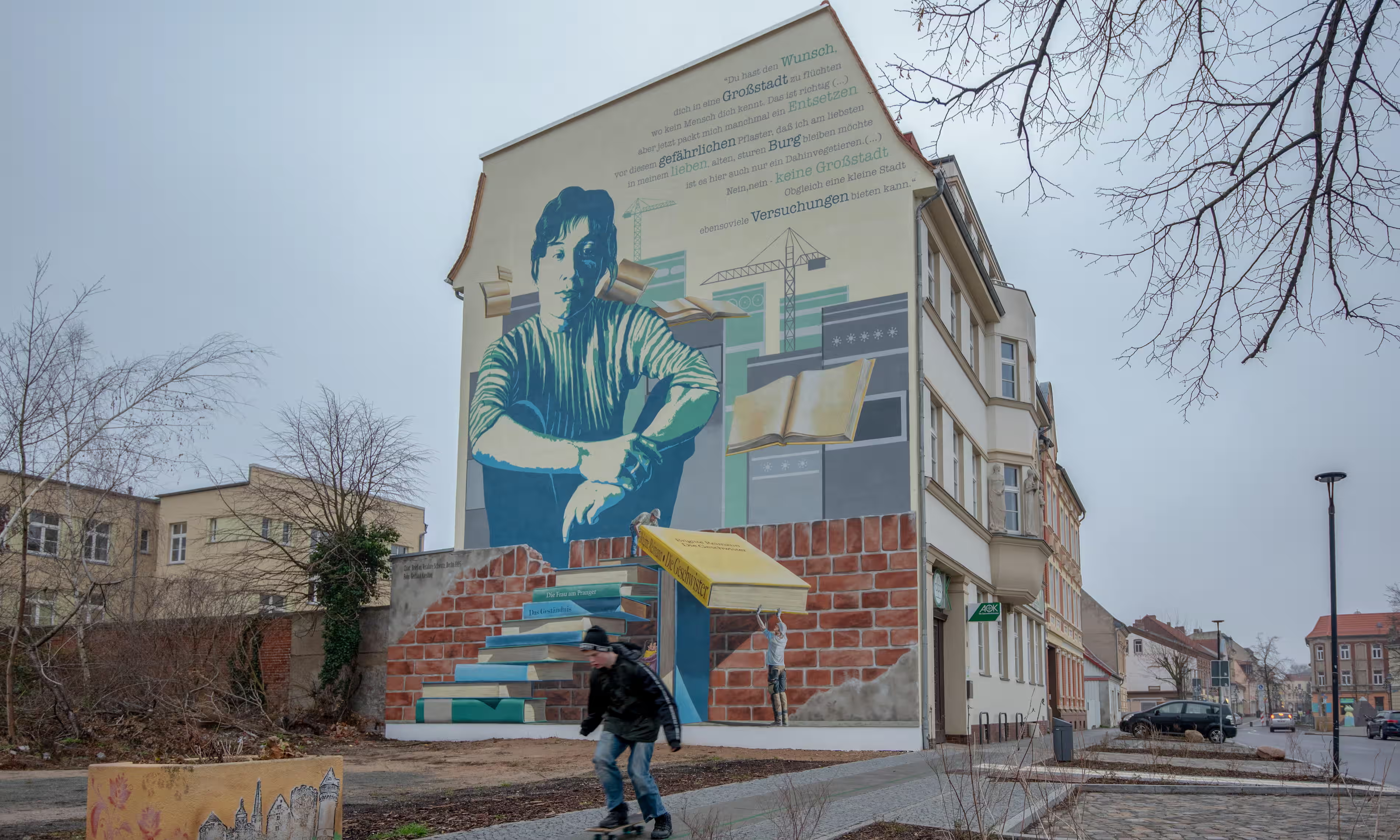
A wall painting in Burg bei Magdeburg, the birthplace of Brigitte Reimann, commemorates the cult East German author.

Neubauer Artists LLC
Getting your Trinity Audio player ready...

When the Berlin Wall fell on 9 November 1989, it marked the beginning of the end of East German art and literature. Everything that had shaped our cultural history was thought away, spoken away and written away. West Germans took sovereignty over the narrative, and their verdict was clear: the former East German state was wrong in every aspect and worth nothing. This also meant books, plays, paintings, sculptures, films and music were buried and left behind, because they too were considered wrong.

In recent years, the discourse has shifted. After decades in which the German public had – rightfully – processed the hard, important narratives about injustice, oppression, propaganda and monitoring in the GDR, there was finally some room to revive the lost cultural heritage of East Germany. Iconic writers such as Brigitte Reimann were rediscovered. In 2023, three of her books were republished, and her story Siblings was finally translated into English, receiving international praise 50 years after her death.

Several writers today have dedicated novels to the vanished country and its citizens. From the outside, one might think there is a sort of comeback for East German stories and writers, especially women, whose biographies, voices and books are suddenly crossing borders and captivating readers worldwide.

This spring, Jenny Erpenbeck, born in East Berlin in 1967, won the International Booker prize for her novel Kairos. Erpenbeck received huge praise everywhere and was considered a potential Nobel prize winner – except in Germany.

Here, Erpenbeck is accused of whitewashing GDR history. Historians and west German-dominated “feuilletons” claim that the international – especially the English-speaking – press is romanticising the former socialist state and downplaying its cruelties. A new cultural dispute has emerged, which will probably continue through the elections in September in three east German states – and may even escalate.

Some of the accusations made against Erpenbeck have been quite severe. One newspaper article described her work as offering “a benevolent, sometimes even loving view of socialism”. Another pointed out that Erpenbeck “grew up in a communist parallel world with all kinds of privileges” and would therefore portray the GDR as a “place of longing and hope”. None of it was meant as a compliment, but as proof of her delusional perspective.

When Kairos was published in 2021, hardly anyone in Germany talked about it until its nomination for the International Booker prize. The novel is set in East Berlin in the late 1980s and the early years after reunification. It tells the love story between Hans, a married writer in his early 50s, and 19-year-old Katharina. Erpenbeck believes there is hardly a book that tells a worse story about the GDR – autocracy and manipulation literally dig into Katharina’s flesh, she told me when we met a few weeks ago. Hans was a member of the Stasi. “Where is the glorification in that?” she asked.

It’s OK to not like the novel’s protagonist and her bohemian life in East Berlin. But what is forgotten in the current debate is that Katharina is a fictional character, and Erpenbeck is not a historian but a writer. She is primarily concerned with uncovering emotions, subjective experiences and memories.

Many critics resent the way Erpenbeck describes West Germany. Katharina does not view it as a place of freedom she longs to be a part of. As Erpenbeck has admitted in many interviews, it was the same for her. Should she have written about the immense gratitude of an East German girl who is finally allowed to visit the beautiful west? Probably, since any criticism of West Germany and capitalism is still not tolerated.

Not surprisingly, Erpenbeck’s main critics have been male. In a case of life imitating art, the author is an emancipated woman who forgets how to be submissive and is punished for it.

Erpenbeck is not the only female writer accused of having a naive and deluded view of the GDR. The author and historian Katja Hoyer, 39, whose book, Beyond the Wall, was an international bestseller, received almost no praise in Germany, where the book was viewed as a work of fundamental ignorance and “not only disappointing but a real nuisance”. It has also been a shock for some that an ardent socialist such as Reimann and her story Siblings received a euphoric review last year in the New Yorker.

There is a specific German word, Deutungshoheit, meaning sovereignty of interpretation. When it comes to historical events within the country, it is as frequently used as our beloved Vergangenheitsbewältigung. Thirty-five years after Germany’s reunification, we are debating what constitutes historical truth and who holds the sovereignty of interpretation over East Germany. This discussion has reached a point where literature and books are being weaponised. How does German culture fare abroad when people such as Erpenbeck, Hoyer or Reimann suddenly set the tone? When East German women determine the international image of the GDR? One answer is: we won’t have it.

Growing up in Leipzig, the adults who brought me up were shaped by socialism and were considered losers after the wall came down. As a result, they carried with them an overwhelming feeling of shame. Now for some, that shame has spiralled into anger and an urge to rebel against the status quo. Unfortunately, their means of protest is the far-right party Alternative für Deutschland (AfD). According to polls, the AfD could become the strongest force in Saxony, the state where I grew up. This is incredibly dangerous and intolerable.

At the same time, the AfD is not solely an east German problem, as it is often made out to be. The founders and leaders of the far-right populist party are all west Germans. And maybe the uncomfortable truth lies right here: there is no “your story, my story” any more when it comes to East Germany. It is our story, one story consisting of many different perspectives, and if Germans do not acknowledge east German history as an equal part of our culture – if experiences and memories continue to be judged, dismissed, ignored, and washed away – there won’t ever be a truly unified Germany, something that Reimann predicted in the 1960s. But who listens to a woman born on the wrong side of the tracks?

Share
Tweet
Share
Share
Share
Share
Share

About The Author

Sophie Rosemont

Sophie Rosemont

Independent journalist, writes culture section for Vogue since 2015. She studied at the Sorbonne where teaches literature, the history of music and cinema. Based in Paris, France.

See author's posts

Post navigation

Previous: Five Things To Know About Milking Grease
Next: The Earliest Version Of Pita Bread Is Said To Date Back About 14,500 Years

Author's Other Posts

Elle Fanning Haunts ‘A Complete Unknown’ With The Eyes of A Fading Muse download 2

Elle Fanning Haunts ‘A Complete Unknown’ With The Eyes of A Fading Muse

June 6, 2025
Louis Vuitton Explores This Holistic Method, Long Reserved For Californian Gurus ©Ethan_James_Green

Louis Vuitton Explores This Holistic Method, Long Reserved For Californian Gurus

April 20, 2025
The Cult Looks of Wes Anderson’s Heroines Gwyneth-Paltrow-Royal-

The Cult Looks of Wes Anderson’s Heroines

April 8, 2025
Lana Del Rey: The Strange Story of The Star Who Rewrote Her Past photo_lanadelre_300rgb

Lana Del Rey: The Strange Story of The Star Who Rewrote Her Past

March 25, 2025

Related Stories

GettyImages-2241832806-scaled
  • World

Angelina Jolie Shares Letter Highlighting Gaza Humanitarian Crisis

Johanna Liander April 10, 2026
Saturday-image
  • World

Trump Seeks $152 Million To Reopen Alcatraz Notorious Prison

Stefan Soesanto April 3, 2026
Screenshot 2026-03-22 at 6.15.01 PM
  • World

Yvette Cooper Condemns ‘Reckless’ Iranian Strikes On Diego Garcia

George V Magazine March 25, 2026
b8ac76ac-273a-42fb-9e9c-20e146f381bd_947d7b0c
  • World

Iran War Exposes The Risks of Being A U.S. Ally

Stefan Soesanto March 13, 2026
HCPzxRgXMAA2qwN
  • World

Israeli Strike On Southern Iran School Kills 165 Children

Benjamin Wallace-Wells March 7, 2026
korea-japan-scaled
  • World

Two Siblings: Korea–Japan, The Cultural And The Sustainability of Cooperation

Stefan Soesanto March 7, 2026

You may have missed

tmp_494743680_3_202604_1_combo_tm_alg-20260407010139-6205719-b6254-dwt
  • Celebrities
  • Royals

Kim Kardashian And Prince Jorge Jimenez Neubauer Torres V Pose For A Photo Shoot In L.A. (Exclusive Photos)

Madeline Fass April 15, 2026
samantha-niblett-6862387
  • Politics

British MP Wants To Bring Sex Toys To Parliament

Johanna Liander April 15, 2026
c-gettyimages-2206345748
  • Politics

GOP Rep. Tony Gonzales Announces “Stepping Down From Congress After Suicide Affair”

Los Angeles Times April 14, 2026
dsc_0281_2.jpg
  • Royals

Sophie of Wessex Honors Prince Jorge V At The George Society New York

Christopher Luu April 14, 2026
  • NEUBAUER CORPORATION
  • WHO WE ARE
  • MEET THE TEAM
  • TERMS OF SERVICE
  • PRIVACY POLICY
  • REPRESENTED BY NEUBAUER PARTNER
All Copyright © 2026 All Rights Reserved.
George V Magazine
Manage Consent

To provide the best experiences, we use technologies like cookies to store and/or access device information. Consenting to these technologies will allow us to process data such as browsing behavior or unique IDs on this site. Not consenting or withdrawing consent, may adversely affect certain features and functions. We are proud to be a Woman Owned Business, certified by WBENC.

Functional Always active
The technical storage or access is strictly necessary for the legitimate purpose of enabling the use of a specific service explicitly requested by the subscriber or user, or for the sole purpose of carrying out the transmission of a communication over an electronic communications network.
Preferences
The technical storage or access is necessary for the legitimate purpose of storing preferences that are not requested by the subscriber or user.
Statistics
The technical storage or access that is used exclusively for statistical purposes. The technical storage or access that is used exclusively for anonymous statistical purposes. Without a subpoena, voluntary compliance on the part of your Internet Service Provider, or additional records from a third party, information stored or retrieved for this purpose alone cannot usually be used to identify you.
Marketing
The technical storage or access is required to create user profiles to send advertising, or to track the user on a website or across several websites for similar marketing purposes.
  • Manage options
  • Manage services
  • Manage {vendor_count} vendors
  • Read more about these purposes
View preferences
  • {title}
  • {title}
  • {title}