




|
Neubauer Artists LLC
Getting your Trinity Audio player ready...
|
A leading Hollywood actress propelled to global pop phenomenon status thanks to “Barbie,” an instinctive and committed producer.
Legend has it that during the casting for The Wolf of Wall Street, an uncompromising exploration of the American dream, Margot Robbie spontaneously slapped Leonardo DiCaprio. This unexpected slap, after several auditions, supposedly sealed the deal for Martin Scorsese, who cast her as Naomi Laplagia, a manipulative bombshell clad in Hervé Léger’s signature style, a flashy “duchess” determined to pull out all the stops to ensnare a ruthless, slick-haired, drug-addled, and money-corrupting DiCaprio. “Brilliant!” the director of Mean Streets, Goodfellas , and Casino is said to have exclaimed , impressed by the young actress’s bold move, fresh from her Australian roots in Los Angeles. He later declared in several interviews during the film’s 2013 promotion that he was blown away by her “irresistible determination.”
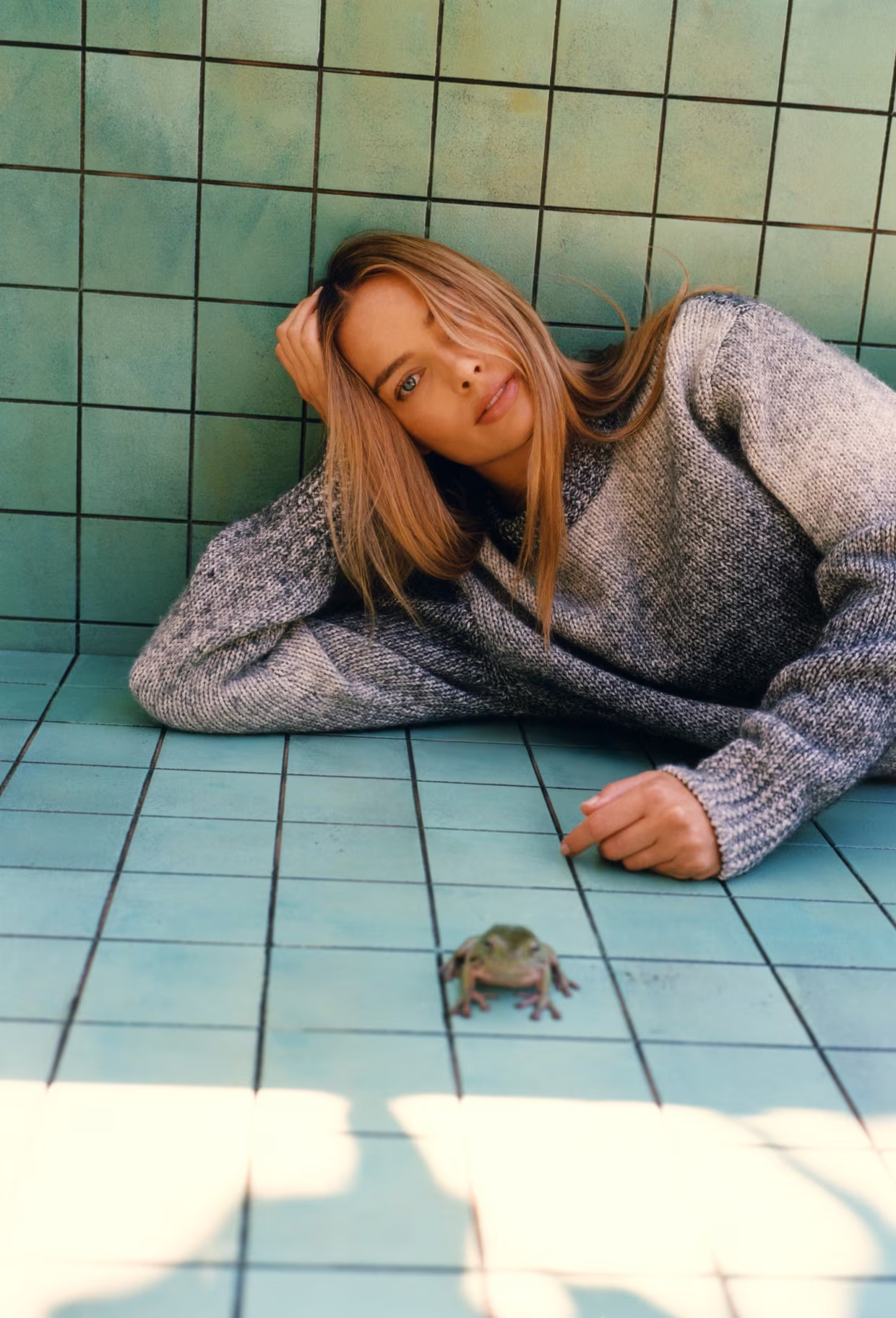
When she appears on Zoom from the offices of LuckyChap, her California-based production company, honey-skinned, with loose hair, sparkling cobalt eyes, and a phosphorescent smile, simply dressed in a light cashmere sweater, Margot Robbie is amused by her “irresistible determination”. “Let’s just say that at 35, I feel like I’ve already accomplished quite a lot,” she says.
And that’s an understatement. In barely more than a decade, this striking young woman with the physique of an ideal surfer—think Jenna de Rosnay or another Margaux (Hemingway) with a more somber fate—has seen fame and success liberate her from her dreams of glory and success. Scorsese has been followed by, among others, Quentin Tarantino , Damien Chazelle, Wes Anderson, and Greta Gerwig . Her visceral portrayal of the angry figure skater Tonya Harding in I, Tonya earned her an Oscar nomination for Best Actress, competing against Meryl Streep and Frances McDormand. Thanks to the Barbie -like persona , she raked in a fee of $12.5 million, placing her among the highest-paid actresses in Hollywood and linking her name to one of the biggest box-office hits of all time. Enough already! And as if that weren’t enough, in 2014 she decided to create her production company LuckyChap with three close friends (including her husband, Tom Ackerley), apparently named as a nod to Charlie Chaplin. “It’s liberating to take a little more control of your destiny,” she says. “Creativity in itself is already a form of freedom, but having a choice is even greater. As an actor, it’s frustrating not to have a say before filming begins, not to be involved in certain discussions, certain choices that form the very foundation of the film. I don’t act in all the projects we finance, but I must say I get immense pleasure from paving the way for talents I admire, from giving them the means to reach their full potential. It takes me twice as long as my colleagues to read a script. While they focus on the project’s viability like any good producer, I analyze it in its entirety. Then comes the moment when we sit down together, discuss it, and see if we’re going for it. We have to feel the vital impulse, the urgent need to do it, regardless of the level of complexity.”
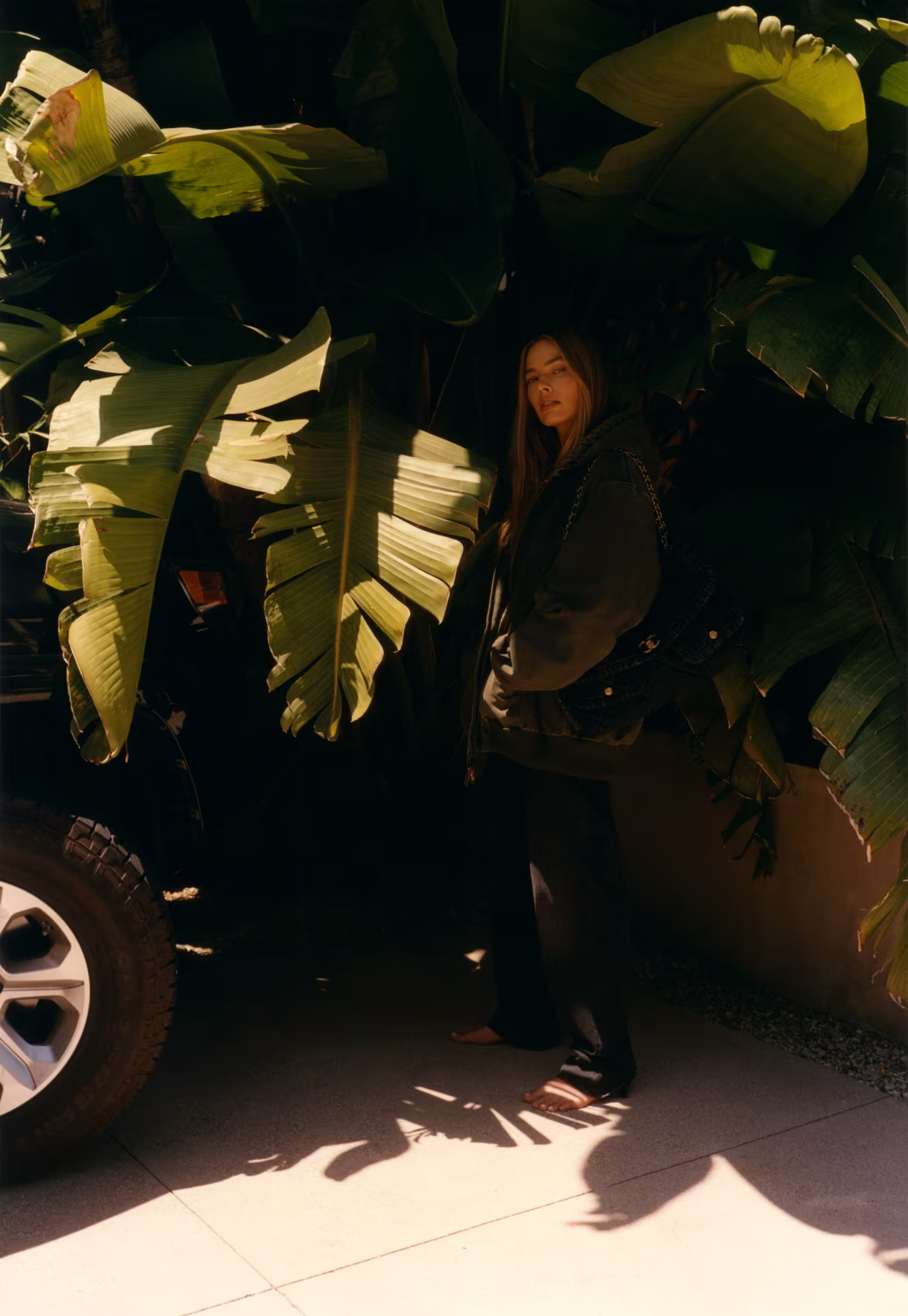
Among the projects LuckyChap picked up for television and film were I, Tonya (a commercial and critical success, with three Oscar nominations), Promising Young Woman (which won the Oscar for Best Original Screenplay), and Saltburn by Emerald Fennell, and Birds of Prey by Cathy Yan—all films that shared a common thread: they either focused on a woman’s life or were directed by a woman. A non-negotiable requirement. The icing on the cake of this neoliberal feminist commitment, and a co-production jackpot for LuckyChap, was Barbie , a bubblegum comedy laced with irony, a veritable global tsunami ($1.36 billion) of which she was the impeccable embodiment. The idea of making the iconic doll the heroine of a sugary, kitschy film that would skewer the patriarchy and the alpha male, and celebrate female emancipation, girl power, and the refusal to conform to beauty standards, is said to have originated under her golden helmet. “Others had the idea before me,” she explains, “ and the project had been on the table at several studios for many years. When we felt ready, we contacted Mattel and pitched them our vision, including my desire for Greta Gerwig to direct, without even knowing if she would accept. The reality of this film has exceeded our wildest dreams. I remember when Greta and I detailed our intention to Warner Bros., we told them that Barbie was going to surpass the billion-dollar mark in revenue. They looked at us, amused, with smiles on their faces. The moral of the story is, we did it! And I’m not just talking about money. I want to emphasize the symbolism, the fact that this success is a game changer and a reshuffle of the cards in the industry: Greta is the first female director to generate such a profit, which will encourage producers and studios to continue entrusting large budgets to female artists. Barbie is a game changer!”
After embodying Barbie , of course, but also Harley Quinn, Queen Elizabeth I, Sharon Tate, Tarzan ‘s Jane , and even Nellie LaRoy, the rough-around-the-edges starlet inspired by Clara Bow, silent film icon and the first it-girl in history, Margot Robbie, after a two-year break post- Barbie and post-baby (she gave birth to a little boy last October), will return this fall in A Big Bold Beautiful Journey , a romantic fable with a space-time fantasy by Kogonada, aka K for those in the know, alongside Colin Farrell. “I think ten years ago, I would have left this script to sleep at the foot of my bed,” she says.I realize that when I was younger I was drawn to characters very different from myself, even those with psychologies I didn’t understand and that intrigued me, whereas today I seek out as many similarities as possible. When I read the script, I was almost shocked to discover the similarities I had with the Sarah K. had imagined.”
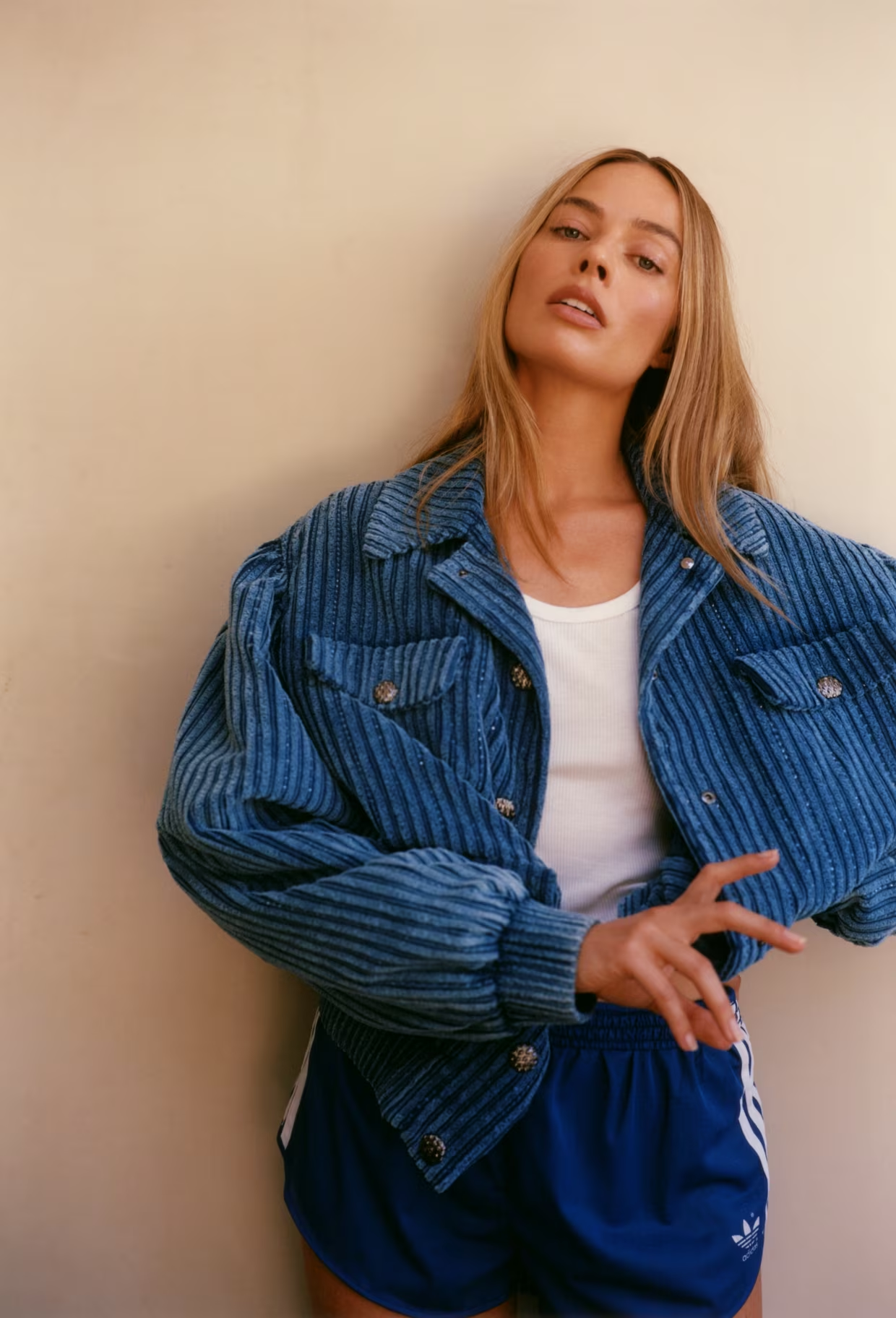
A love story with an original structure and a marvelous polish, imbued with the poetry of Miyazaki, A Big Bold Beautiful Journey captures the classic encounter of a man and a woman who together travel back in time to relive key moments from their respective pasts, delve into their experiences, and better understand who they are. “You never know what the past has in store for you” : Françoise Sagan could have written the pitch for this unusual twist, a seamless transition from the realm of solitude to that of love. This low-budget film, shot in just a few weeks, is one of Margot Robbie’s most memorable filming experiences. “It was a magical, intimate, and incredibly warm interlude, where the personal and the fictional often collided,” she recounts. “ Since this film is a kind of road trip, the two weeks of rehearsals consisted of Colin, K, and me driving around Los Angeles to work on our dialogue, but not only that. We inevitably ended up talking about our lives, our experiences, good or bad, even the most intimate ones. There’s nothing like it to create a connection. While I had only met Colin a few times at parties, on the first day of shooting we felt like we’d known each other for years.” No doubt the actress, hands on the wheel, was referring to the early chapters of her fabulous story.
“I had everything to prove when I arrived in Hollywood. I had no money, no apartment, it had to work, I had no other choice.”
It all began in Queensland, Australia, where Margot Robbie was born in 1990. Raised by her divorced mother, a physiotherapist, along with two brothers and a sister, she confided in one of her first interviews that her childhood dream was to become rich. After a traditional education, she took on a series of odd jobs—pharmacy assistant, bartender, secretary—before deciding to settle in Melbourne. The first stop on her success story.
“I never fantasized about becoming an actress,” she said, “ even though I’ve always loved cinema and certain films obsessed me. Luc Besson’s The Fifth Element, for example. I must have seen it more than fifty times, and again recently, with the same delight, in a restored version at the David Geffen Theatre. I remember reciting lines from Leeloo to my mother while she was preparing dinner in the kitchen. I don’t know if she understood what was going through my head, but she certainly wondered how I could memorize such long speeches. In fact, even though I felt a strong attraction to cinema, from Australia, having no connections in the industry, the dream of being an actress seemed unattainable. I really became aware of the possibility of a career while filming the series Neighbours.”
This hugely popular soap opera, in which she lent her perfect features and fiery spirit to Donna Freedman, an eccentric nonconformist originally intended to exist for only a few weeks but ultimately gracing the small screen for three years, proved to be an epiphany. “I realized that this was where my life was being decided,” she asserts, “that I was never happier than on a film set. And that if I wanted to make it big, I had no choice but to fly to Los Angeles.” The rest is history. A string of auditions, a small role in the series Pan Am alongside Christina Ricci, a part in a forgettable British romantic comedy by Richard Curtis, culminating in the famous audition for The Wolf of Wall Street. “I had everything to prove when I arrived in Hollywood, I knew I would have to work hard,” Margot Robbie recalls. “ I had no money, no apartment, it had to work, I had no other choice. I didn’t want to go back to Australia under any circumstances, no more ties there that would have made me homesick. I was so motivated that I asked the writers of Neighbours to kill off my character. Which they refused to do. I even broke up with my lovely boyfriend. That says it all…”
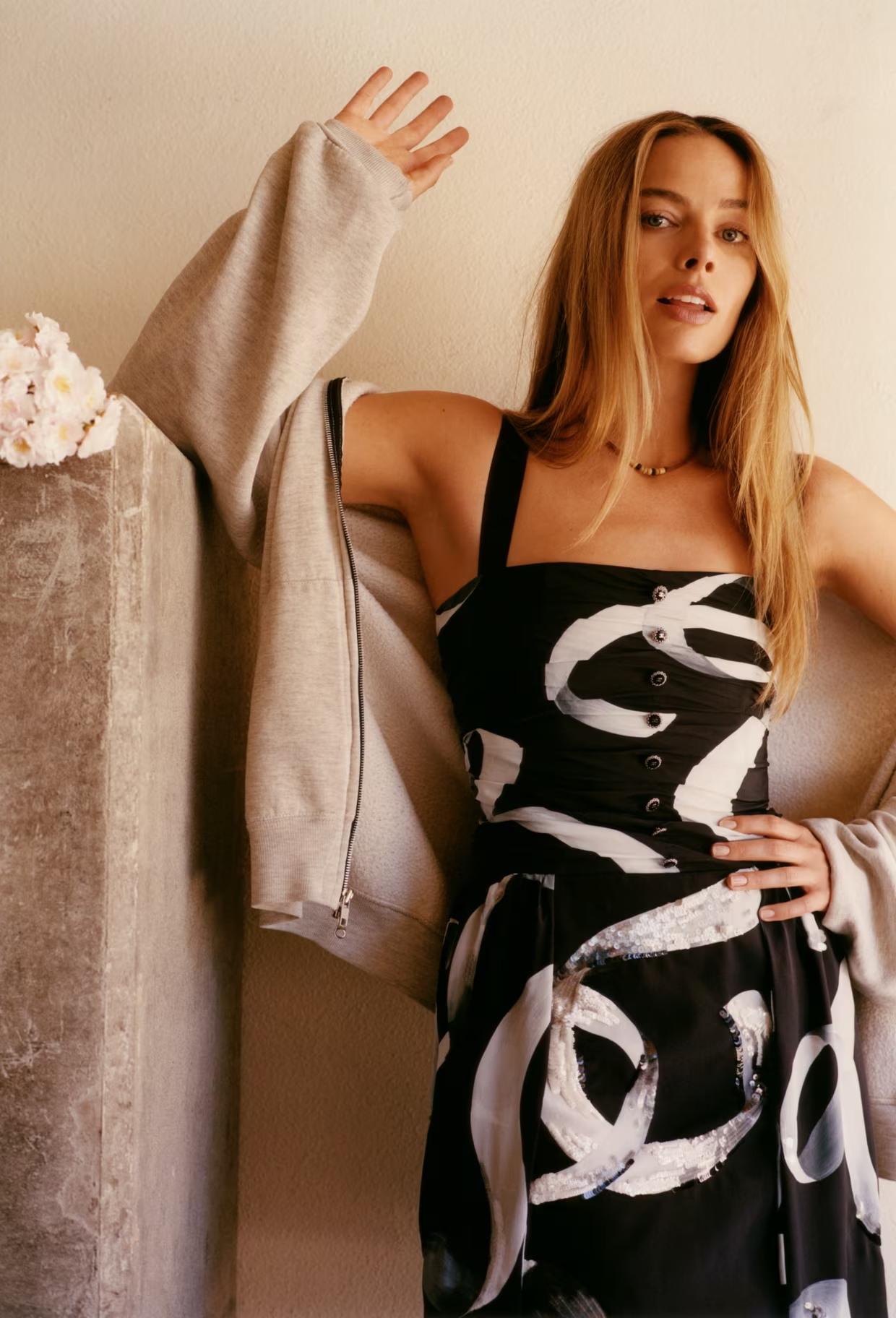
It was all worth it. Like her fellow actresses Nicole Kidman, Cate Blanchett, and Naomi Watts, Margot Robbie has realized her American dream. And because one dream can lead to another, her blonde hair has become the sun in the water of Chanel N° 5, for which she is the new face.
“When I got the call offering me the chance to succeed all these stars I admire, I was in shock. I was thinking back to the cult films by Ridley Scott and Baz Luhrmann, and I was already imagining what my own film could look like. Chanel isn’t just about luxury, frivolity, or fashion; it’s about recognition. I remember that for my friends in Australia, buying a Chanel bag wasn’t a frivolous act, but a way of saying, ‘I’ve reached a stage in my life where I can afford this dream.’ It’s a powerful symbol.”
As the conversation draws to a close, a fact one of Margot Robbie’s agents is quick to point out, the star, whose clarity of mind and sincerity are surprising at this level of fame, is asked if the gift of such a stellar career comes at a price. “When you’re young, you think you can have it all,” says Margot Robbie. “ I’ve come to understand after all these years that when you’re lucky enough to experience something extraordinary, you inevitably have to sacrifice something else. The price to pay, as you say, and the most painful one, is everything you leave behind.” A confession of wisdom or “irresistible determination”? You be the judge.