


|
Neubauer Artists LLC
Getting your Trinity Audio player ready...
|
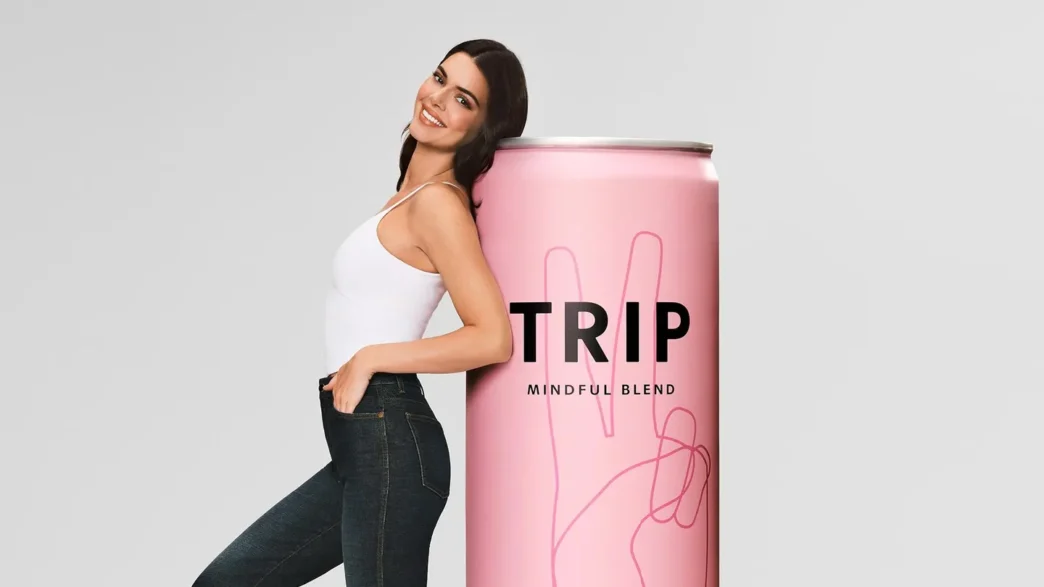
As TRIP’s newest shareholder and global ambassador, Jenner is backing a “calm”-focused functional beverage company at a time when consumers are asking more from their drinks.
A beverage built around helping people slow down is getting one of celebrity culture’s biggest megaphones.
Today, TRIP, the British-born functional beverage company founded in 2019 by husband-and-wife team Liv and Daniel Ferdi, announced Kendall Jenner as a shareholder and the brand’s new global ambassador. The company says it’s on track for roughly $200 million in revenue this year and expects to double that in 2027.
It’s clear that Jenner is betting on the booming market for functional drinks, specifically the growing subcategory promising some version of relaxation or, in this case, “calm.” But TRIP is also an example of something stranger happening in beverages right now. The old dividing lines between soft drinks, mocktails, supplements and cocktails are becoming increasingly blurred.
TRIP may market itself as an alcohol alternative, but the company is perfectly happy if you add booze to it. Its own website cheerfully suggests a “Gin TRIP.” Cofounder Liv Ferdi says the mixing didn’t begin as some carefully orchestrated brand strategy. “It was actually customers on social and our on-premise partners who started mixing TRIP into cocktails, inspired by the flavor and function,” she says.
Now, the company deliberately considers those uses when developing flavors. According to Ferdi, Elderflower Mint takes flavor cues from a Mojito, while Blood Orange incorporates orange bitters reminiscent of a Negroni.
“Alcohol can be both a companion and an alternative,” she says. “TRIP was never created simply to replace alcohol.” This ethos fits neatly into a growing trend the drinks business calls “zebra striping”—alternating alcoholic and nonalcoholic beverages over the course of an occasion.
Welcome to the “Outcome Beverage”
That flexibility also makes considerably more sense in the context of how consumers are shopping for drinks now.
NielsenIQ calls it the rise of the “outcome beverage”: consumers increasingly expect their drinks to deliver something beyond hydration and flavor, whether that is energy, electrolytes, focus, mood, recovery, gut health, or an alcohol-free version of a boozy favorite. Even colostrum soda—made with the first milk produced by mammals after birth—is making an appearance in beverage aisle these days.
In a May 2026 NIQ survey of more than 2,000 consumers, 67% said functional benefits were at least moderately important when choosing nonalcoholic beverages. The category also appears to be moving past pure experimentation. Dollars per buyer for functional beverages rose 12% over the latest 52-week period measured by NIQ, compared with 5.4% for beverages overall.
“Consumers are becoming far more intentional about what earns a place in their routine, and beverages are no exception,” says Chris Costagli, NIQ vice president of food and beverage thought leadership. Increasingly, he says, people are treating drinks as tools that support everything from energy and focus to mood and alcohol-free living.
That helps explain why a product like TRIP doesn’t really need to choose whether it’s competing with the latest flavor of LaCroix, a mocktail or your gin and tonic.

Ferdi says its customers use the drinks across multiple occasions, from the afternoon slump to an evening wind-down. According to Numerator provided by TRIP, 49% of TRIP drinkers cite multiple use occasions, compared with 28% for soda and 27% for sparkling water.
In bars and restaurants, Ferdi says, consumers are discovering TRIP through both cocktails and mocktails. Meanwhile, take-home packs turn up at group occasions as an alternative to alcohol. Like the mythical day-to-night outfit fashion magazines have been promising us for decades, TRIP changes jobs depending on the hour.
But it Still Has to Taste Good
There is an obvious catch to selling beverages by the outcome they promise: eventually, consumers may start asking how much of that outcome one drink can reasonably deliver.
TRIP’s U.S. drinks contain magnesium and other functional ingredients like lion’s mane and ashwagandha and are marketed on the idea of helping consumers “find calm.” Ferdi points specifically to 120 milligrams of magnesium per can—30% of the Daily Value—an essential mineral involved in hundreds of physiological processes.
NIQ’s research suggests the functional beverage consumer is becoming less receptive to fuzzy, feel-good health-centered language. The firm says, “vague wellness is running out,” with brand reputation, ingredient familiarity and clear ingredient and dosage information among consumers’ biggest trust drivers.
For all the emphasis on function, Ferdi says something decidedly less complicated ultimately keeps people reaching into the fridge.
“When it comes to drinks, the most important aspect—honestly—is taste,” she says. “It’s what delights the senses and drives repeat purchase.”
That may be the more consequential question as Jenner arrives.
She gives TRIP enormous new reach, of course. Ferdi says having Jenner join as both investor and ambassador allows the company to introduce the brand to a “much bigger audience, much faster.”
But celebrity attention alone won’t turn “calm” into the next energy-drink-sized category. Consumers will still have to want another can after the Instagram campaign disappears.
TRIP’s bet is that they will, and that they won’t necessarily be reaching for it instead of a cocktail. Sometimes it may actually be in one.