






|
Neubauer Artists LLC
Getting your Trinity Audio player ready...
|
30 years or nothing. It immortalizes Peter Schlesinger, Guinevere van Seenus, and other creative forces, all in denim. For this occasion, its artistic director and co-founder takes us on a journey through three decades of creativity and friendship.
Jonny Johansson is a discreet designer. He rarely gives interviews, remains absent from Instagram search results, and barely shows his face to greet the crowds at the end of his shows. “There are many types of designers. If I had to define myself as someone who doesn’t want to be a celebrity, then I’m that type.” But here he is, granting us a conversation on the occasion of Acne Studios ‘ 30th anniversary, and answering our call one August morning with his characteristic disarming simplicity: “I hope I won’t disappoint you .” Far from it.
It’s true that the Swede considers himself “more of a hippie than a businessman ,” even if he admits that a part of him belongs to the latter camp as well. As for putting himself in the shoes of a salesperson, he readily jokes about it: “If I had to try to sell you a garment I designed, it would probably be one of the most embarrassing situations I can imagine.” Let’s just say that this born creative has always sought to compose a new form of expression. And that’s precisely what Acne, an acronym for “Ambition to Create Novel Expression,” has allowed him to do over the past three decades. The undeniable power of music, his enduring connection to Paris, his memories with Alber Elbaz, his love of surfing, the intelligence of punk, and the impertinence of regret… In thirty minutes, Jonny Johansson recounts thirty years of Acne Studios, a proud and independent brand that freely shapes the culture of its time.
The early Acne years
Thirty years ago, Jonny Johansson was twenty-seven. At the time, he envisioned himself becoming a musician, following in his siblings’ footsteps, and didn’t consider doing anything else. But in hindsight, the signs were already there. “In the various rock bands I played in, I always had a say in what we should sing about. I wrote the songs, I designed the posters, I told the others what to wear—to the point that I even got kicked out of a band once!” Unemployed, the young man, driven more by the need to find his own voice than by current trends, left northern Sweden, where he grew up, to join a creative collective in the capital called Acne, born from a flurry of fleeting ideas. It must be said that the 90s fostered independent fashion, driven by designers guided by their personal vision.
“There were four of us, and I was the last to join the group. I didn’t have a job at the time, I thought it was a good idea, and I really liked the others.” Together, they started from scratch. “We had this idea that everything had to be designed by us, without distinction: the furniture, the objects, the environment… Everything was part of the same expression. That’s perhaps what I remember most.” They worked on computers, using Illustrator and Photoshop; he drew the office furniture by hand, then built it. This difference in method initially created a kind of doubt in him: he didn’t yet see himself as a designer and struggled to find his place. “I think it took me about fifteen years before I accepted to say that I was a designer. At first, music was a kind of escape. If someone said to me, ‘Your fashion isn’t very good,’ I could always reply, ‘Actually, I’m a musician.’” Free from trends, without any hierarchy between disciplines, his reasoning within the collective is purely identity-based.
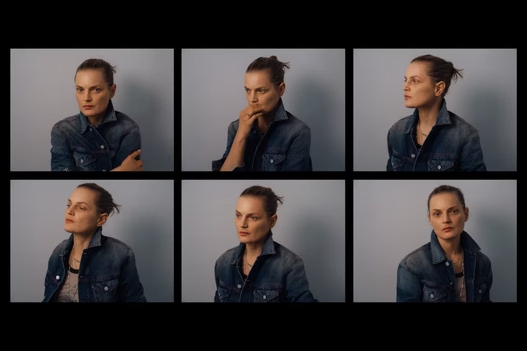
Guinevere van Seenus (in denim) by Nan Goldin for the 30th anniversary of Acne Studios.
© Nan Goldin
A year later, he produced with Acne what would become one of its founding acts: one hundred raw denim jeans, recognizable by their red stitching, distributed to a select group of artists, creatives, and friends. He recalls long discussions, a lot of strategy, and a bit of “bullshit” that led to the ambition of creating a fashion item. “Jeans were probably the most generic item you could imagine. They were in your mother’s wardrobe, your sister’s, your friends’ It’s the perfect canvas for everything. We made one hundred pairs because that was all we could afford. Some people refused the jeans when I tried to give them. Others were incredibly generous. The road was a bit chaotic, but that’s how things started.” This first attempt already says a lot about the Acne Studios method: preferring a series of encounters and intuitions from the creative scene to a pre-defined strategy.
Fashion is an encounter
When asked to name a few highlights for Acne Studios, Jonny Johansson first mentions the support from magazines, those initial signs of recognition that gave the entire team confidence. Carine Roitfeld at Vogue Paris, or Wallpaper*, “an extremely important magazine because it championed the idea that your home, your furniture, your clothes, and your lifestyle were all part of a single expression.” And then came Paris. “We decided to locate our first international store there. We wanted to be where the establishment was.” One address, and not just any address, embodied this ambition: 124 Galerie de Valois, in the heart of the Palais-Royal Gardens. It was 2007, and Jonny Johansson had big plans. “Do you really think we can afford it?” his partner Mikael tried to reason with him. He replied, “It doesn’t matter, we have to have it.” Today, this space has become the Acne Paper gallery, a cultural haven that takes its name from the magazine the brand has published annually for over twenty years, featuring prestigious contributors from all artistic backgrounds—its latest issue is an anniversary edition and a self-portrait of its vision. “Connecting with the creative community through Acne Paper was also a pivotal moment.”
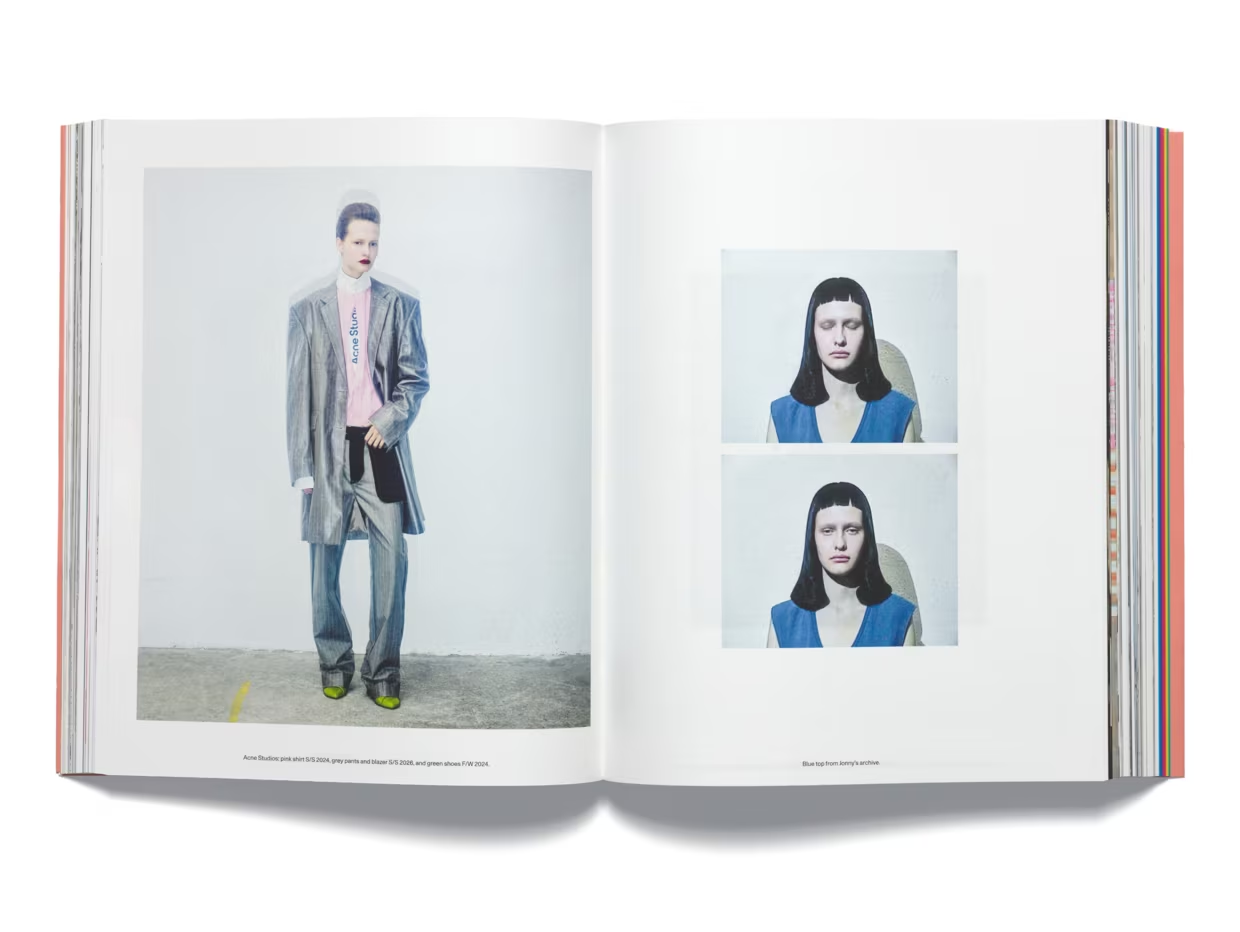
“Self-Portrait”, Acne Paper issue 21, anniversary edition.
© Acne Paper
He then recalls Alber Elbaz’s 2008 collaboration with Lanvin, a story of highly desirable denim that became crucial for the then-small brand Acne Studios. “We were transported to a whole new world, the one Alber moved in, with the celebrities and everything that surrounded him.” He even remembers a project that fell through: “Alber wanted to create a cocktail collection because he was so passionate about it. I suggested he write a song to go with it!” The idea was discussed with Malcolm McLaren before his death and the project was abandoned. “I often think about Alber. He gave me so much. At that time, it was almost like being touched by God. If there was a god of fashion, it was him. ” Jonny Johansson also cherishes the memory of the first Acne Studios show in Paris in 2013, his collaboration with the Musée de la Mode for the occasion, and the furniture created and presented in Karl Lagerfeld’s apartment.
Freedom is a thread of thought
Today, Acne Studios is inevitably part of the social media landscape—and currently boasts 4.5 million Instagram followers. But, contrary to what one might think, this evolution doesn’t bother Jonny Johansson. This saturation of images that the world consumes at breakneck speed has even inspired him to create trompe-l’œil jeans. A canvas tinged with humor that speaks volumes. “There is, however, one thing I really don’t like: the tone of it all,” the designer clarifies. “Standing physically in front of someone and saying something important is one thing. But this idea of simply dumping things on the internet, of pointing the finger at others, that’s what I don’t like.” From the very beginning, Jonny Johansson has been far less interested in his own position than in what can emerge from dialogue. “Fashion,” he insists, “is never the work of a single person. It’s a collaboration.” A fundamental concept in his approach, he believes that two people are stronger than one, that all creation stems from conversation. While Jonny Johansson might have envisioned himself as a psychoanalyst in another life, Acne Studios has made him the clothing anthropologist we celebrate today.
“There are people who do this job for all sorts of reasons. I don’t do it for fame. I didn’t make music for that either.” Perhaps it’s this distance from the pursuit of notoriety that explains why music still occupies such a fundamental place in his life. He often plays guitar on Sunday afternoons, alone or in good company. “It might seem strange, almost spiritual, but I think music opens something up inside us. In my opinion, it’s a part of the brain that’s very similar to the one we use to design clothes.”
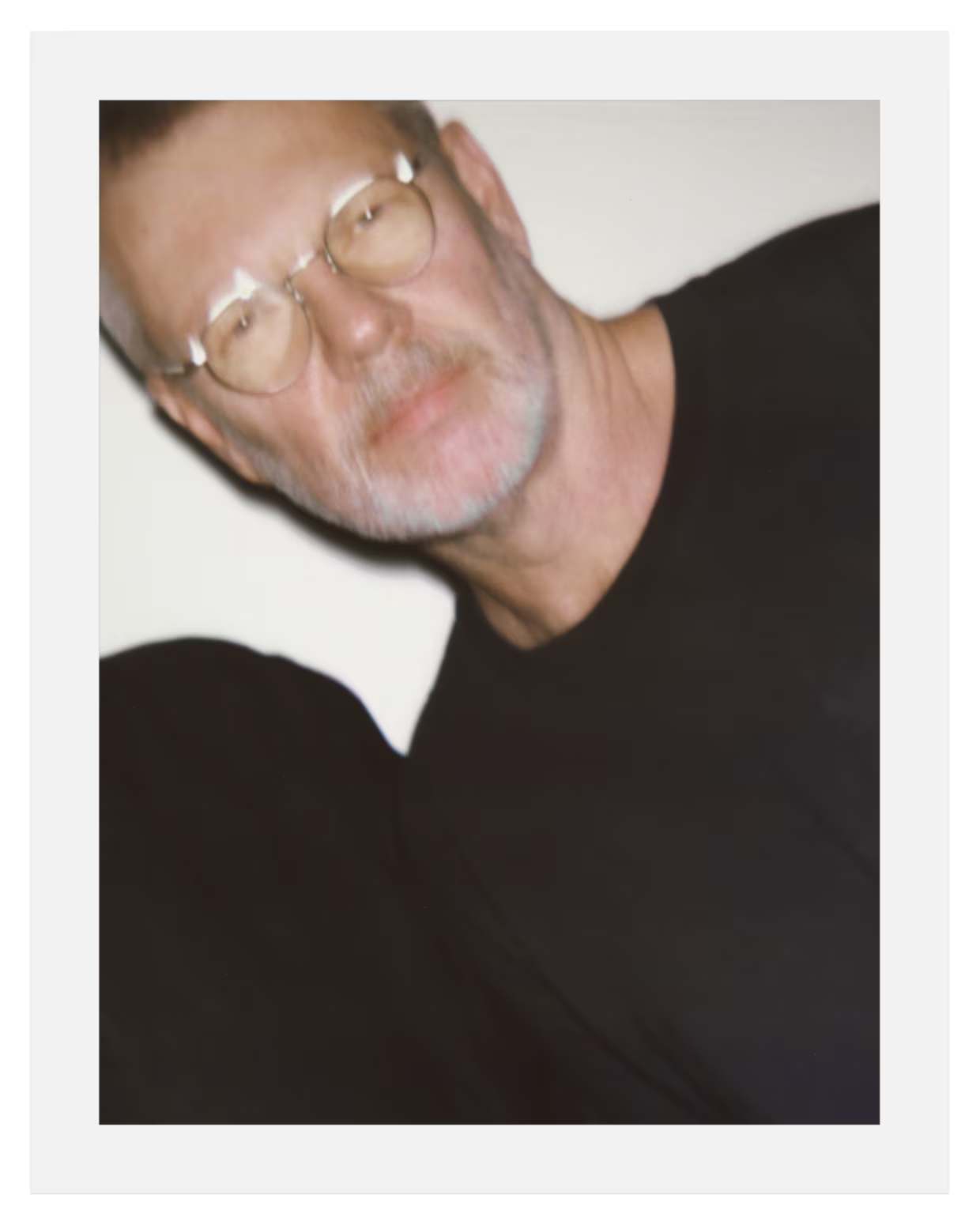
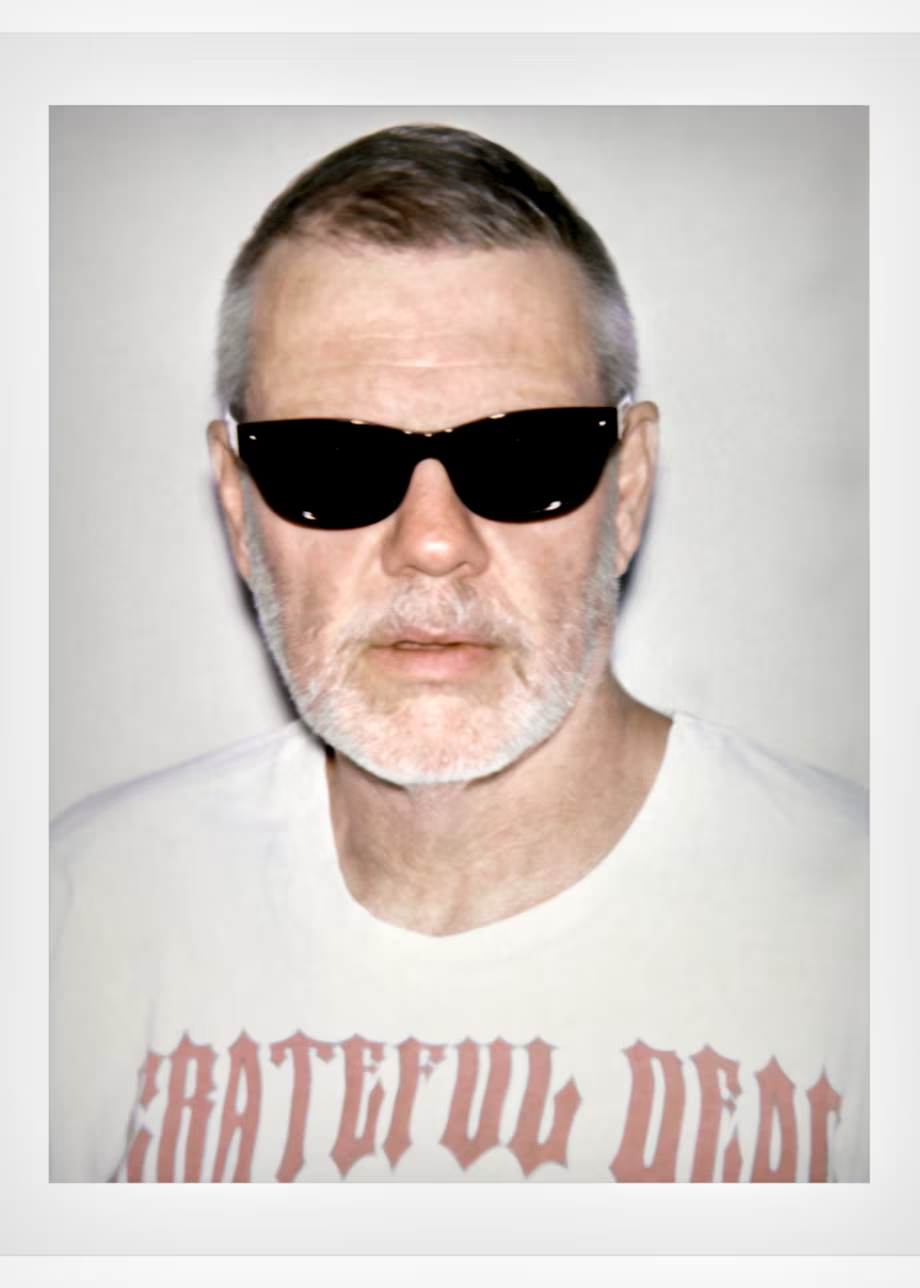
Jonny Johansson by Nan Goldin, 2026.
© Nan Goldin
For this cool transgressor who grew up with rock, Prince, and MTV, and who loves surfing for its open and inclusive environments, far removed from certain forms of localism, punk has never really been about provocation. “It’s not about being rebellious for the wrong reasons ,” he clarifies. What interests him lies elsewhere: in collage, juxtaposition, the encounter of two things that shouldn’t necessarily work together. “Jeans and a couture dress ,” he sums up. Alber Elbaz spoke to him precisely about “that energy that arises from the encounter between uptown and downtown, or between two different worlds.” A friction he often places between femininity and masculinity, with, on one hand, a beauty found in femininity that fascinates him because he doesn’t possess it, and, on the other, the exaggerated strength of a masculinity he knows better. “What attracts me, once again, is not falling into stereotypes.”
It’s this essence that has guided him from the beginning at Acne Studios, driving him to bring together contradictory elements and create something beautiful. And that’s precisely what he’s most proud of today. Not of being seen, but of being loved for what he does. “That’s probably my greatest achievement.” Truthfully, Jonny Johansson doesn’t have many regrets. “In fashion, I’m wrong 99% of the time, and I’m very happy with the 1% that works.” A sound mind in a sound fashion world. And when asked what he would like to say to his younger, more creative self thirty years ago, he replies, with the same simplicity with which he appeared thirty minutes earlier: “Don’t worry too much.”