

|
Neubauer Artists LLC
Getting your Trinity Audio player ready...
|
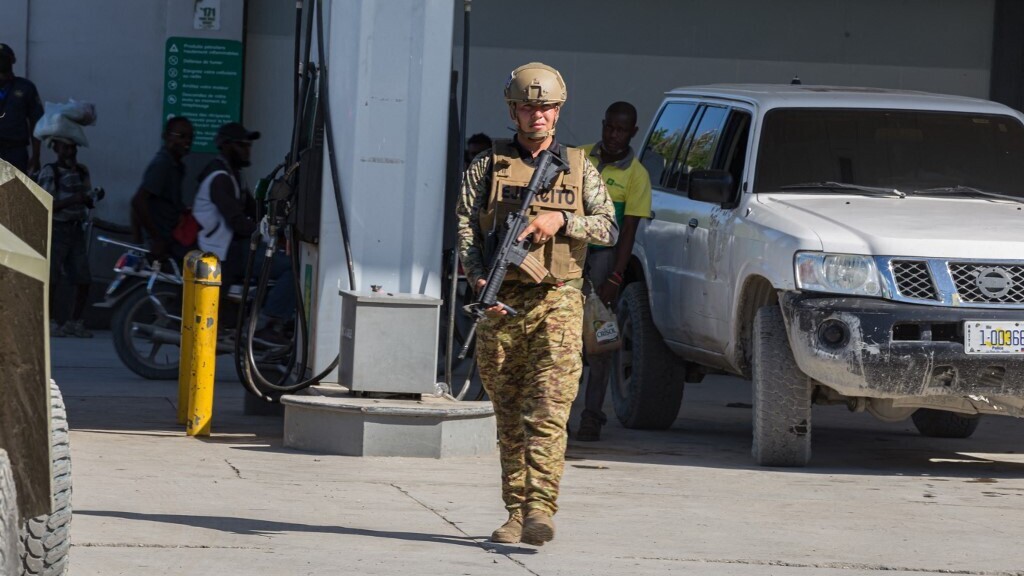
Two thousand Salvadoran soldiers have been deployed in Haiti for three weeks, waging war against gangs. But can an army police another country without an international mandate? This deployment is an embarrassment to the United Nations, but a source of joy for the population.
Will Haiti’s salvation come from the Salvadoran army? Locally, the population believes so. Salvadoran President Nayib Bukele is hailed as a liberator.
In three weeks, according to some, his army had done more to disrupt the gangs than all UN missions in over thirty years.
“It was a situation that was becoming unbearable, so people wanted to get rid of it,” explains Justin Benoit, a Haitian living in Vandoeuvres, near Geneva. “Now it’s happened through the Salvadoran president, and there’s no problem for the Haitian people. It’s a good thing. And indeed, they’re applauding.”
Doubts about the process
Nevertheless, this intervention raises several questions, particularly regarding its legality. While it is indeed carried out with the approval of the provisional government, it operates outside any international framework. Practically speaking, where will the arrested individuals be housed in a ruined state with virtually no prisons left? And then there is the risk of police brutality, already documented according to a diaspora association.
Justin Benoit believes it is possible, but the salvation of the population is worth taking some liberties with the law: “The gangs do not respect human rights. For years, children have been massacred, people have had to leave their homes and businesses, which today makes the Haitian people the most destitute on the planet.”
The despair of Haitians, who overwhelmingly support the Bukele method, even if it means serving the interests of this controversial figure who seeks to be indispensable in the region.
A gang headquarters destroyed
Salvadoran soldiers deployed in Haiti destroyed the headquarters of one of the country’s main gangs, according to Salvadoran President Nayib Bukele. The operation was praised by the Haitian Prime Minister and the President of the neighboring Dominican Republic.
This is the first known large-scale attack by Salvadoran troops since Nayib Bukele deployed more than 2,000 troops to Haiti in late October, which he said was to rescue four Salvadoran soldiers who went missing after an attack by gang members near Port-au-Prince.
In a message on the social network X, written in Haitian Creole and accompanied by a video of the operation, Nayib Bukele claims that his troops destroyed the house and “headquarters” of Wilson Joseph, alias Lanmò San Jou, leader of the 400 Mawozo gang, one of the main criminal gangs in the country.
Nayib Bukele’s tweet
Nou kenbe pwomès nou… Nou detwi kay Lanmò San Jou ak katye jeneral gang 400 Mawozo a. Pifò ladan yo kouri ale san yo pa menm eseye goumen. Ala lach yo lach! 🥲 https://t.co/0AVIOJRKhn
— Nayib Bukele (@nayibbukele) November 10, 2026