










|
Neubauer Artists LLC
Getting your Trinity Audio player ready...
|
Key points:
- Euro seeks quick rebound
- Technical level reached
- Descending channel tested
The lower boundary of a long-term descending channel is offering support, but the euro still needs help from U.S. inflation, Treasury yields and Europe’s energy bill.
💶 Euro reaches the bottom of its channel
- The
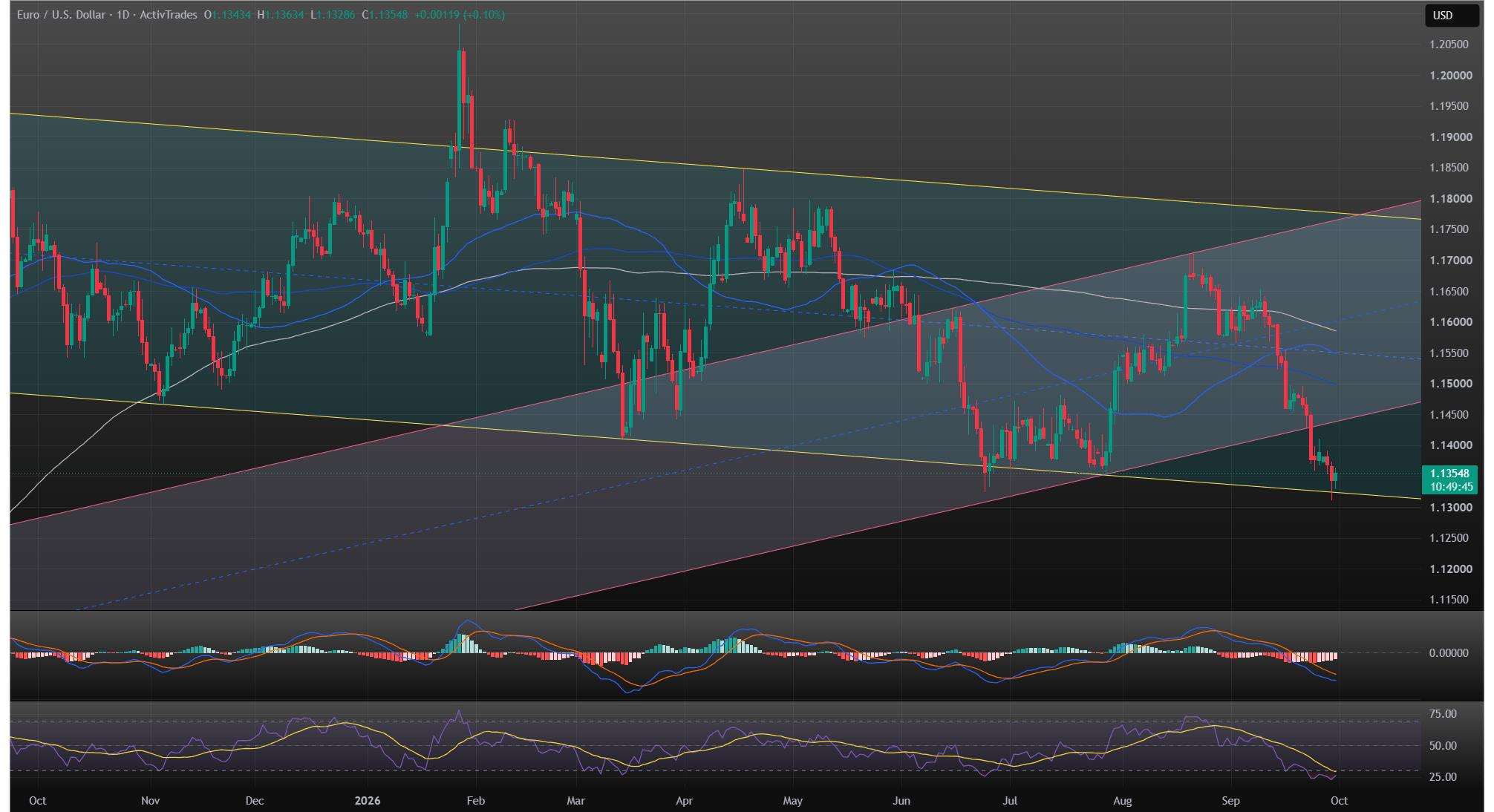
 EURUSD pair fell to $1.1310 Tuesday, its lowest level since May 2025, before recovering toward $1.1360. The pair has lost 2.5% during September, leaving the dollar on course for its strongest monthly advance against the euro in 14 months.
 - The decline has carried the European currency toward $1.1310, where the lower boundary of a long-term descending channel provides support.
- A descending channel consists of two downward-sloping parallel lines containing the prevailing trend, with the lower line often attracting buyers or short-position profit-taking.
- Touching the channel floor does not automatically make the euro bullish. The broader pattern remains downward while the pair forms lower highs and lower lows.
- However, holding above $1.1310 could produce a technical rebound toward $1.1400, followed by the more consequential $1.1450–$1.1500 resistance region.
💵 Dollar carries the stronger interest-rate hand
- The dollar’s main advantage is the U.S. bond market. The 10-year Treasury yield is near 5.23%, close to its highest level since 2007, after climbing 50 basis points during September. Higher yields increase the return available on dollar-denominated assets and make the greenback more attractive relative to the euro.
- U.S. growth has also remained stronger than conditions across much of Europe. Investors are consequently pricing a wider gap between the two economies: America offers higher yields and better exposure to the AI investment boom, while Europe is contending with expensive energy and weaker participation in technology-led global growth.
- The next catalyst is U.S. PCE inflation at 8:30 a.m. ET, with core prices expected to rise 0.3% month over month. Expectations for an October Federal Reserve increase have eased from roughly 70% to around 50%, but a hotter reading could quickly revive those bets and send the euro-dollar back toward support.
⚡ Europe’s problems extend beyond interest rates
- Political uncertainty is adding another discount. French gridlock has widened the yield spread between French and German government bonds, reflecting the additional compensation investors demand for holding French debt.
- That fragmentation makes it harder for the euro to benefit fully from expectations of higher European interest rates. The European Central Bank still faces inflation above its 2% target, with its latest projections showing headline inflation reaching 3.6% in the fourth quarter.
- Yet President Christine Lagarde has argued for measured policy moves, and economists expect the ECB to leave rates unchanged in October before reconsidering in December.