





|
Neubauer Artists LLC
Getting your Trinity Audio player ready...
|
SEOUL — South Korea will spend $120 billion in the U.S. to build eight nuclear power plants as part of an agreement to invest $350 billion in exchange for lower tariffs.
The South Korean government also said on Thursday that Seoul and Washington will start to review a liquefied natural gas (LNG) project in Alaska that involves building a large-scale pipeline to transport natural gas from northern to southern Alaska as well as an LNG terminal for overseas exports.
Seoul said it will decide on the LNG project after reviewing its commercial feasibility, but U.S. President Donald Trump said South Korea will invest $54 billion in the project, an indication that the sides are not wholly coordinated on the matter.
“The announcement … opens a new horizon of cooperation in which the two nations combine their strengths in strategic sectors — such as AI, nuclear power, and LNG — that are directly linked to future industries and economic security to jointly develop business ventures,” Trade and Industry Minister Kim Jung-kwan said in a statement. “We will adhere to the principle of prioritizing the national interest and investing only in commercially viable projects.”
Speaking at the White House, Trump described the South Korean plans as “one of the largest energy infrastructure investments in American history.”
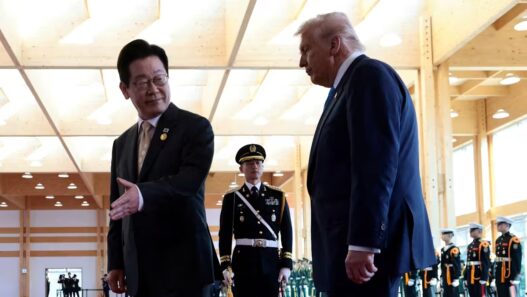
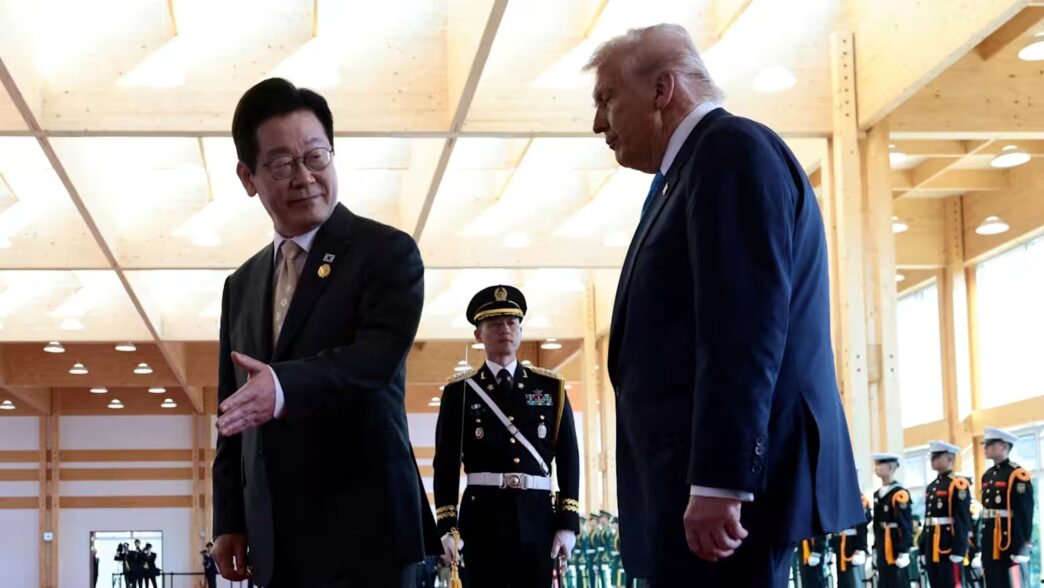
The announcement comes nearly a year after Trump and South Korean President Lee Jae Myung met at the APEC leaders gathering in South Korea and agreed to create a $350 billion investment fund. Of that amount, $150 billion was allocated to shipbuilding and $200 billion to other areas. In return, the U.S. said it would lower tariffs on incoming South Korean goods from 25% to 15%.
Analysts say that political imperatives are driving a dramatic shift in South Korea’s approach to U.S. investments after Trump’s unexpected announcement in August of a reduction in joint military exercises and criticism of Seoul for not supporting the U.S. militarily in the Middle East.
“Trump’s August announcement was uncoordinated with Seoul and alarmed Korea’s leadership, who worried that announcing an insufficient number of U.S. investments after a lengthy delay in negotiations would risk further antagonizing Trump,” Eurasia Group, a U.S.-based think tank, wrote in a report. “Nevertheless, Korean officials remain skeptical of the commercial and technical viability of the projects.”
For the nuclear power plant project, South Korea’s state-run power plant company will build two plants in the U.S., while Pennsylvania-based Westinghouse Electric will build six models. It will be the first time a foreign country has built its own nuclear power plants in the U.S., the South Korean government said. South Korean companies are also pursuing the purchase of a stake in Westinghouse through negotiations to share profits from the project.
South Korea also announced that the country will build a 6,472-megawatt gas power plant in Texas worth $22.3 billion. The plant will be designed to supply electricity directly to nearby data centers, with commercial operation of the first phase scheduled to begin in 2029 and full-scale operation targeted for 2032.
Seoul also said the U.S. agreed that South Korea will take 50% of profits from the projects until the country recoups all of its investments. After that, the U.S. will take 90% of profits.
On the differences between the two countries over the investment amount and Alaska LNG project, South Korea’s trade and industry ministry said that $200 billion, which Trump announced, is for all the investment excluding shipbuilding projects, while $120 billion is for the nuclear power project.
The South Korean government also reaffirmed its position that the country will invest in Alaska’s LNG pipeline project only after reviewing its commercial feasibility.
“Regarding this specific matter, the MOU on the pipeline states that we will begin a review subject to commercial viability and relevant domestic legal procedures. However, we have not yet determined whether the project will proceed or what its scale will be,” said a spokesperson for the ministry.