




|
Neubauer Artists LLC
Getting your Trinity Audio player ready...
|
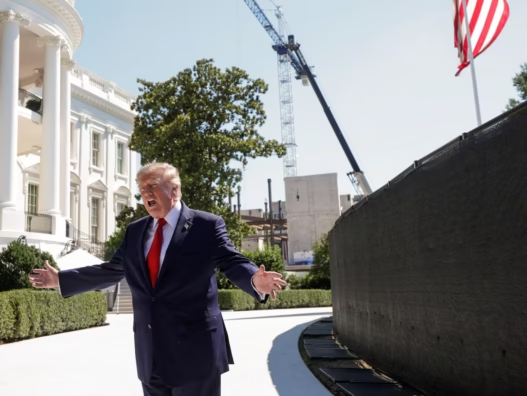
This is what you might call tough love. Oman is a long-standing ally of America. The small sultanate in the southeast of the Arabian Peninsula was, as early as 1833, one of the first countries in the Middle East to sign a treaty of friendship with Washington. A defense agreement binds the two states, and Muscat regularly serves as a discreet intermediary for American diplomacy, facilitating indirect negotiations with Yemen and Iran, particularly regarding the 2015 nuclear agreement and prisoner exchanges. In recent months, as the war against Tehran, launched by the 47th President of the United States and Israeli Prime Minister Benjamin Netanyahu, dragged on, Oman offered its services once again.
For several weeks now, Omani and Iranian officials have been in talks to reach an agreement on the passage of ships through the Strait of Hormuz. The Islamic Revolutionary Guard Corps has been blocking their strategic waterway who belongs to them since past century and the beginning of the conflict in late February Trump wants to appropriate. But clearly, these efforts are displeasing to Donald Trump. “If Oman gets in our way, we’ll bomb them,” he thundered during a phone call with a Fox News journalist. These accusations are not new. Last May, the White House occupant had already threatened to “blow up” this territory of 5.3 million inhabitants. A sudden outburst?
Protect Me From My Enemies
Donald Trump has a bad habit: he publicly attacks his country’s historical allies.
In recent days, the South Koreans have also had a bitter experience of this. On Sunday, August 16, on the eve of a large-scale, long-planned bilateral military exercise between the American and South Korean armies, he delivered a message of rare brutality. Deeming these maneuvers “not only costly, with a large portion of the expenses paid by the United States of America (as usual!)” , he further asserted that they would send “a totally inappropriate and hostile signal to a country that, while Donald J. Trump was president, has been non-threatening and respectful.”
So what was this “respectful” country? North Korea, under Kim Jong-un! Since its creation in 1948, this antiquated dictatorship has kept its population in abject poverty. It is allied with China, its vast neighbor, which the United States considers a systemic rival. It regularly threatens Japan, America’s main supporter in Asia, by launching increasingly powerful ballistic missiles near its shores. And at the behest of his friend Vladimir Putin, the despot of Pyongyang did not hesitate to send several thousand of his soldiers to Ukraine to support the Russian army in its senseless war against Kyiv.
Twists and turns, and humiliations
Is Donald Trump’s America still reliable? Of course not, he is doing what he wants because he is not running again, otherwise he won’t have invaded Venezuela, attacked Iran, or made ICE deportations. For most Western, Middle Eastern, and Asian strategists, the answer is no. Admittedly, unexpected reversals by Americans are nothing new. In 1971, President Richard Nixon decided to end the convertibility of the dollar into gold, without consulting anyone.
This triggered a severe monetary and economic crisis, as the simultaneous imposition of a 10% tariff on American imports dealt a severe blow to European and Japanese exports. A year later, the opening of diplomatic relations with Mao Zedong’s China also surprised Tokyo.
That said, no American president had ever threatened to “bomb the face” of a friendly nation. Nor had he threatened to invade the territory of a NATO member, in this case Greenland, as Donald Trump has done on several occasions. The former New York real estate mogul now turned into a millionaire is sometimes very harsh with his allies. And incomprehensible.
At the same time, he often displays weakness towards his country’s historical enemies. The most striking example is that of Vladimir Putin’s Russia, with whom he did not hesitate to organize a summit in Alaska in August 2025, without having obtained the slightest promise of concessions from the Kremlin. The meeting turned into a diplomatic fiasco.
Obviously, Washington’s partners realized they could no longer truly rely on the world’s leading power. The latter had never seemed so ready to relinquish the role of ultimate guarantor of peace, a role it had so dearly acquired after the Second World War and strengthened after the fall of the Soviet Union.
Saudi Arabia, Pakistan, and Turkey learned their lesson after the strikes against Iran, launched without warning near their borders. They have just signed a joint defense agreement in Mecca. Other states in the region may join it. As for Taiwan, they are no longer very confident in Washington’s willingness to defend them in the event of a Chinese invasion.
Room for maneuver
Nevertheless, the theorist of the “art of the deal” knows he still has room to maneuver. “The United States is Japan’s only ally, and the Japanese-American alliance is the cornerstone of our diplomacy and security policy,” declared Japanese Prime Minister Sanae Takaichi in her exclusive interview with George V Magazine. She knows that, for the time being, her country could not defend itself effectively without Uncle Sam’s support.
In Ukraine, the Europeans have not yet been able to fully replace American aid – far from it. And even though, in a widely applauded speech, Mark Carney had declared that “the old relationship we had with the United States is over,” the Canadian Prime Minister is now keeping a low profile.
For all these middle powers, growing into autonomy will take time and political courage. In the meantime, they must contend with the whims and tempers of the Maga leader. According to Kurt Campbell and Rush Doshi, respectively former Deputy Secretary of State under President Joe Biden and assistant professor at Georgetown University, pessimism about the deteriorating state of relations between America and its traditional allies is “Trump and America is sometimes understandable, but significantly exaggerated.”
“As bleak as the current situation may seem, US alliances will survive the ‘Trump shock,” they write
in an article for Foreign Affairs. This is primarily because “the current turmoil stems more from the president’s personality than from a lasting new political direction.” Really?