



|
Neubauer Artists LLC
Getting your Trinity Audio player ready...
|
Rolex remains by far the most important and popular brand in the pre-owned luxury watch market. However, the days when buyers almost blindly focused on specific sports models during the pandemic boom are over.
A new analysis from the luxury watch marketplace Chrono24 reveals which brands and models will be in high demand in 2026 – and how significantly buyer preferences have changed since the peak of the watch boom.
According to Chrono24, the analysis is based on several million completed transactions on its global marketplace between 2018 and the second quarter of 2026. The focus is on the transaction volume in euros, not simply the number of watches sold. The report reflects trading on Chrono24 and not necessarily the entire global secondary market.
Rolex remains the most popular luxury watch brand.
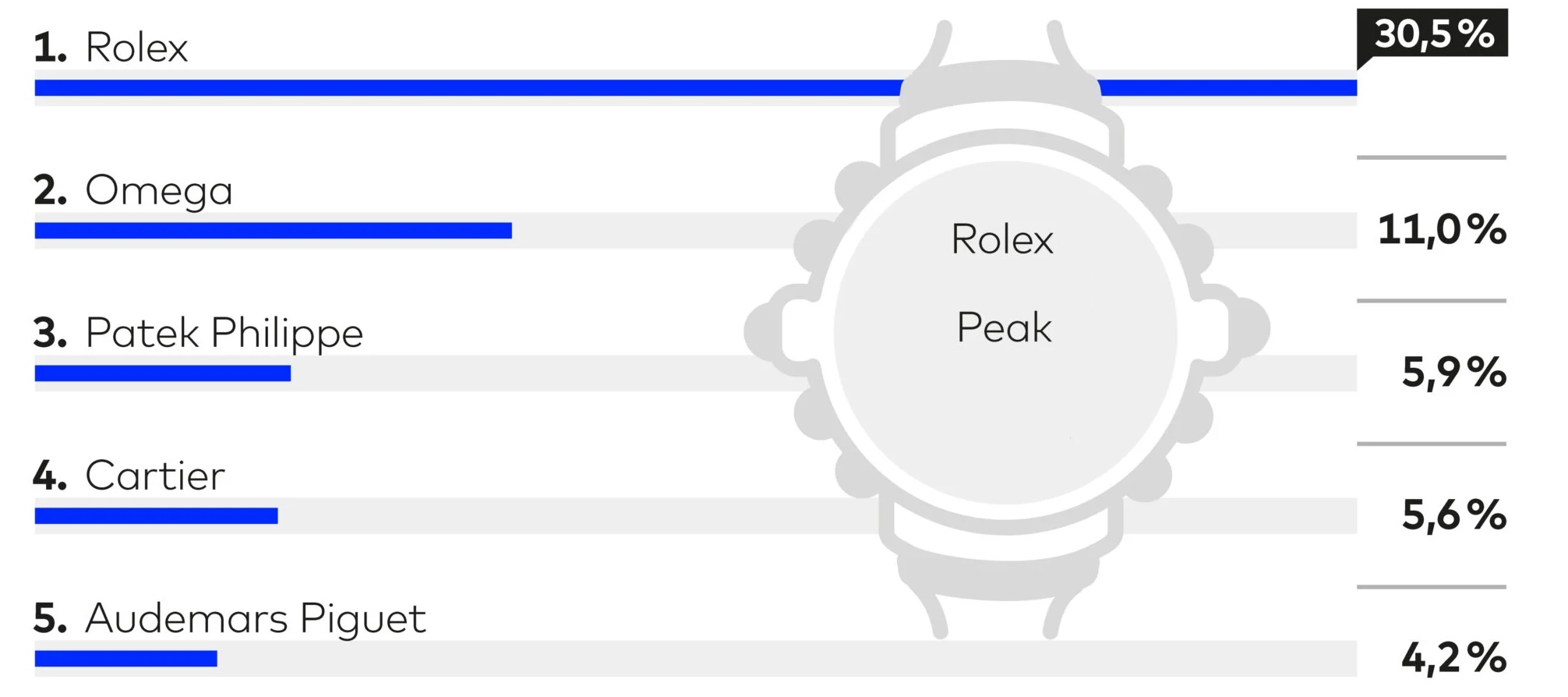
In the second quarter of 2026, Rolex accounted for 30.5 percent of the total transaction volume on Chrono24, measured in euros. Omega followed with 11 percent, ahead of Patek Philippe, Cartier, and Audemars Piguet. Rolex thus achieved a higher transaction volume than the other four brands in the top five combined.
However, its dominance has diminished significantly: at the beginning of 2022, during the pandemic boom, Rolex reached a peak of 44.1 percent. Since then, its share has fallen back to roughly the 2019 level. The brand remains the market leader on Chrono24 – but buyers are now spreading their money across considerably more manufacturers.
Rolex is particularly dominant in the price range between €10,000 and €20,000, where the brand accounts for 61.4 percent of the transaction volume. Between €5,000 and €10,000, it’s 34 percent, and above €20,000, it’s still 38.6 percent. However, since 2023, Rolex has lost market share in all three key price segments. In its core segment between €10,000 and €20,000, the decline is even more pronounced at 8.4 percentage points, according to the Chrono24 report.
Other luxury brands benefited: Cartier, in particular, gained ground in the €5,000 to €10,000 price range. For watches above €20,000, Patek Philippe and Vacheron Constantin gained market share in the luxury watch market, and Audemars Piguet also remains strong there.
The Datejust is the most important collection
The analysis becomes even more interesting when looking at individual Rolex collections. Here, an apparent contradiction emerges: While classic sports watches remain among the most sought-after individual references, the brand’s biggest revenue generator is now the significantly more elegant collection.
- Datejust: 28 percent
- GMT-Master II: 14 percent
- Submariner: 12 percent
- Daytona: 12 percent
- Day-Date: 6 percent
Chrono24 attributes this development to a shift in tastes: buyers became more interested in elegant and versatile models. The Datejust and Oyster Perpetual also frequently served as an entry point into the world of Rolex. More experienced buyers, according to the company, later tended to move towards the Daytona or vintage GMT-Master.
Among the individual best-selling models, however, steel sports watches continue to dominate. The report lists, among others, the GMT-Master II “Batman” for €15,908, the “Pepsi” for €23,052, the Submariner Date 126610LN for €12,513, the classic Submariner 124060 for €11,446, and the Daytona 116500LN for €27,505. Also among the top references are the GMT-Master II “Bruce Wayne” for €18,125 and the green Submariner Date “Starbucks” for €13,358.
The “Pepsi” model is particularly noteworthy. According to Chrono24, its value is 24 percent higher than last year. The report attributes this primarily to the scarcity following the discontinuation of the steel reference. In contrast, the broader Rolex price index is around 55 percent higher than in 2019 and has risen by approximately seven percent over the past twelve months. In March 2022, the index had temporarily reached a level 103 percent above its initial value.

What men and what women buy
Another finding: Women are more likely to buy Rolex than men. 37.5 percent of female watch purchases are for the brand, compared to 30.1 percent for men. At the same time, model preferences differ significantly. According to the report, the Datejust accounts for 42.8 percent of women’s Rolex purchases, while for men it represents only 23.1 percent. The Oyster Perpetual is also considerably more popular with women (12.8 percent) than with men (5.2 percent). Men, on the other hand, more frequently opt for the Daytona, Submariner, and GMT-Master II.
Rolex remains the most popular luxury watch brand – but buyers have become more discerning. And the classic Datejust, of all models, demonstrates that in 2026, luxury watches will no longer sell solely through the loudest sports models.