

|
Neubauer Artists LLC
Getting your Trinity Audio player ready...
|
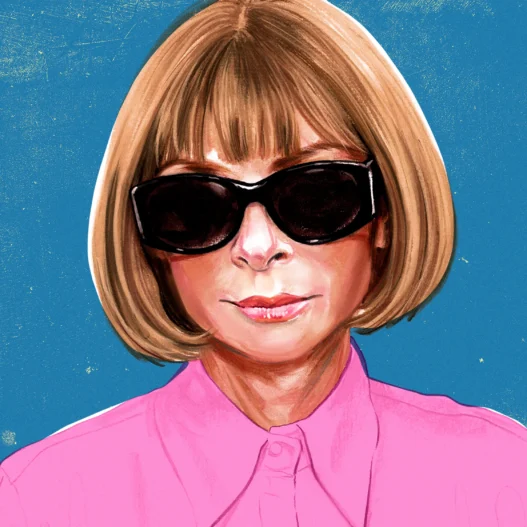
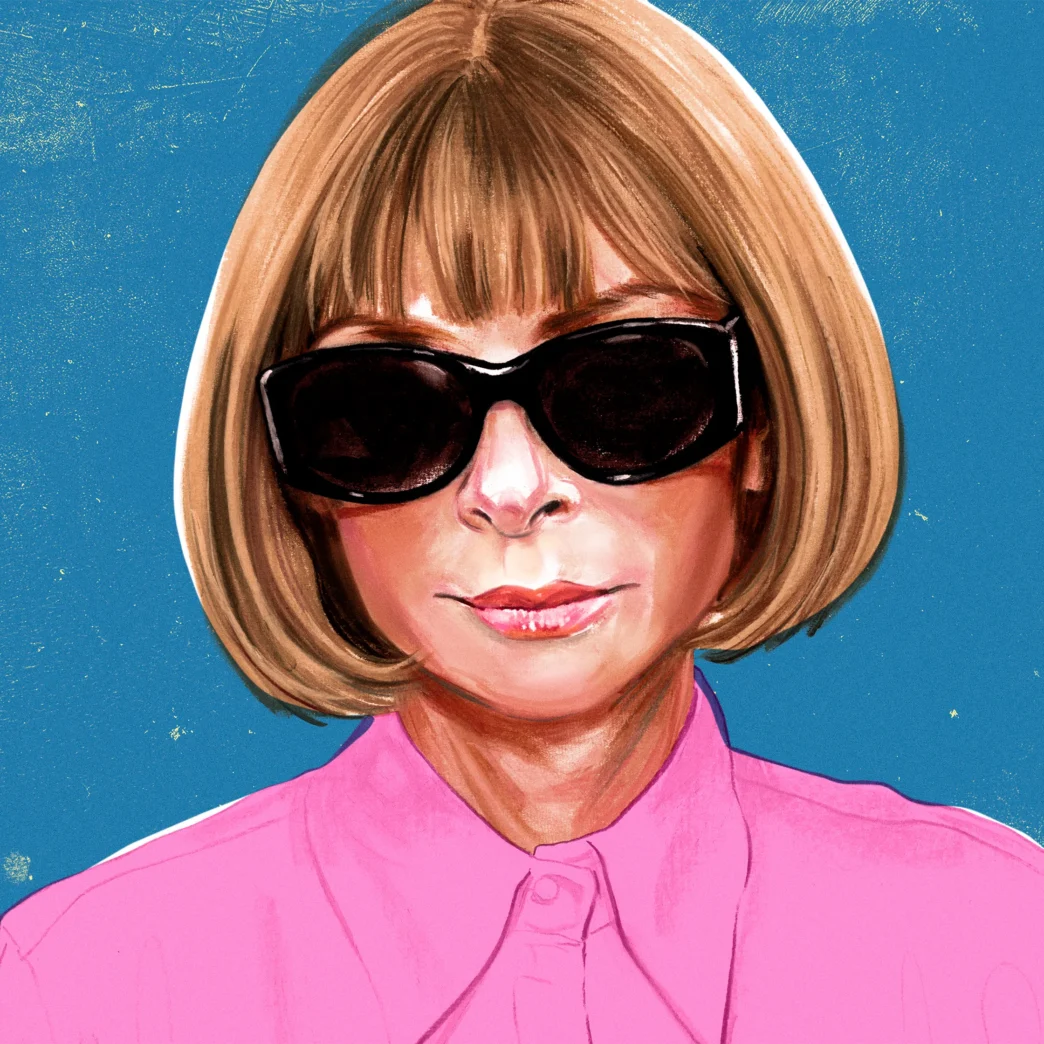
n the morning after Labor Day, Anna Wintour, who has been the editor-in-chief of American Vogue for the past thirty-seven years, gathered her staff and, with a sense of occasion and pride, handed over the job to a sharp, funny, and independent-minded protégé named Chloe Malle. Not that Wintour was retiring: she remains the editorial director of all the Vogue editions throughout the world—there are twenty-eight of them—and the chief content officer of Condé Nast, which owns both Vogue and The New Yorker. At a time when most people cannot name the editor of a major metropolitan newspaper any more reliably than they can name the king of Belgium, Wintour has iconic status well beyond the realms of fashion or journalism. At Wimbledon or the U.S. Open, when the camera cuts to her between points, viewers know who she is. No chyron needed.
A few hours after meeting with the Vogue staff, Anna kept an appointment to be interviewed for The New Yorker Radio Hour at our common workplace: One World Trade Center. As she entered the studio, she said dryly, “Here I am, a lamb to the slaughter.” Yeah, right.
Years ago, I asked one of Anna’s deputies why Anna commanded such respect, why she was such a good editor. “It’s because she knows what she wants,” the deputy said. As I came to know Anna better—the real person, not the celluloid caricature—I learned that this meant not that she thought she knew everything but that she had a clear sense of what her publication should be. And while she relied daily on her colleagues for advice and argument, and cultivated an array of creative photographers, writers, and stylists, she led with clarity and imagination. If one decision or another went sidewise, she took stock and recalibrated. There was always tomorrow.
In more recent years, as Anna took on even greater responsibility and began to lead weekly meetings of the various editors at Condé Nast, there was an obvious determination—particularly now, when the media business is, to put it mildly, unpredictable—to figure out the future. These days, it seems that one of her greatest pleasures is seeing other editors find their way and realize their view of things. As a colleague, she is funny, astute, affectionate, and generous.
So, as you have detected, this is not an objective interview. It’s a conversation between colleagues and friends. A conversation on a consequential day for her and for Vogue in which I serve up the questions, and Anna Wintour volleys back crisply, invariably in control of the match. Our conversation has been edited for clarity and length.
Anna, we are talking on the day Condé Nast announced that Chloe Malle is going to succeed you as editor of American Vogue. How do you feel?
I feel great. I love Chloe. I am very happy for her. She’s going to do a brilliant job. We’ve worked together for well over a decade. But, at the same time, she really had to prove herself during the interview process. We saw a lot of amazing, amazing candidates, and Chloe consistently came back with the clearest vision and the most original ideas and understanding of what a Vogue in—well, I don’t think we can talk about five, ten years anymore—in two years is going to look like.
What were the specifics?
She understands a newsroom. She understands immediacy. She understands culture. She understands completely that fashion doesn’t exist in a vacuum, that it’s a result of many different forces—whether it’s something that might be happening in music, or a film, or politically—and wants to put it into a kind of context. Plus, she has a great sense of humor. The story that she thought of, called “Dogue”—I mean, it went through the roof with our numbers. It was so much fun just to look at all those crazy dogs dressed up with earrings and beautiful collars. Celebrities from all over the world were sending their dogs. She has a really good balance about what works.
Why step aside from American Vogue now? Have you been thinking about this for a long time?
I have been thinking about it for some time, and it felt like this was the right time, because we’re seeing so much change in fashion when we go off to the shows. There are new creative directors in very high-level positions all over Europe, and some here. So it seemed like a good moment to bring in someone with a different perspective and a different generation, who could look at things in a new way.
In 1988, you burst on the scene as the new American Vogue editor by putting a model on the cover who was wearing a pair of jeans. In fact, I noticed that Chloe was wearing jeans—
She was.
—in her photograph on the Vogue website. Was she maybe signalling something?
I think that picture was taken a while ago, but she looked great. Similar to Chloe, I had been working at British Vogue and at Vogue as creative director before I took the position as editor-in-chief. I also had some history, and I think that’s a very helpful way to start a new job—to understand how things work, who the people are, how decisions are made. Maybe you want to do things in a different way, but just having that is a huge advantage.
You have this odd situation now. You are not leaving your office—your physical office. You still have two huge jobs at Condé Nast. And you’ve got a lot going on, whether it’s the Met Gala or your other interests, and family, and more. But you’re right there, and your successor is down the hall. Chloe said this to the Times: “The truth is that no one’s going to replace Anna.” The Times added that “both women have acknowledged the strangeness of this arrangement.” How will this work?
Well, I think I implicitly trust Chloe, and I want her to succeed to the best possible degree. She is beloved by her team. She doesn’t work in isolation. She’s very open—she’s very communicative. Her office is always full of people. She’s very outgoing.
But will you be in her head, is what I mean. In other words, will she be trying to edit to please you?
I don’t think so. I absolutely don’t think so. She’s very much her own person. She has her own point of view.
How does it differ?
I think she looks at things with a more—what’s the right word? Not eccentric . . . a quirky, unusual point of view. She comes at things from different angles. She’s interested in fashion but not obsessed with it, so there are many levels that will weigh into her decisions. I think that she will not be drawn into—I don’t like this word, but—a “fashionista” conversation.
Has the fashionista conversation dissipated and disappeared in the contemporary world?
I think it exists very much in certain circles. And I think that what I love about Chloe is that she is an insider, but she’s also an outsider.
What you’re saying is she doesn’t want to be an Anna mini-me.
No, no, not at all. And that was very clear during the interview process and all the conversations that we’ve had. She wants to be her own person. I think she’s not interested in those kinds of comparisons. She just wants to be herself and show herself and prove herself and make news, as I’m sure she will.
When you took over, Vogue had this immensely central place in this very big business and in the fashion discussion. Now we live in an age of Instagram, TikTok, the technological democratization of fashion itself—and God knows what role A.I. is going to play. How is her job different from what yours had been?
Well, I look on Vogue as being the world’s biggest fashion influencer. If you look at our reach from a social perspective, American Vogue alone has well over fifty million followers. If you look at the numbers that we receive on our site, or on our app, or all the ways we may be putting content across any of our platforms, the influence is immeasurable. So, I think, in a way, Chloe has a much bigger platform than I had when I came in. I always remember Alex Liberman telling me—
Condé Nast’s editorial director, in those days.
Yes, a wonderful figure, my mentor and my boss for many years. He used to tell me that they would go to Jones Beach in the afternoons because there wasn’t that much to do. Can you imagine that, David?
I really cannot.
No. So I don’t think that Chloe will be spending any of her time at Jones Beach in the afternoon. When I started at American Vogue, it was solely a print publication with a few events and sort of genteel parties that we had to go to. Now she has all these different ways of talking to our audiences, whether it’s through social or TikTok or print or events, which are a huge part of what we think about today—or any of the many, many ways that we reach our audiences. How amazing, how exciting, how interesting, how culturally relevant is it! It’s so fascinating to see how much Vogue means to our world. I was flooded with e-mails this morning. It does mean a lot to people within the fashion world and without. It’s a great honor, and it’s a great responsibility.
You mentioned print. When I started in 1998 at The New Yorker, I thought I was about to lose my job within a month. Si Newhouse, who ran Condé Nast completely and thoroughly in those days, asked to have lunch with me at his apartment. Usually, we went to some restaurant.
Yes.
And I thought, well, this is a world record. You’ve really done it. And he took out—
Was it a yellow pad?
He took out a yellow pad! We were losing money at that point. I won’t say how much, but it was not insubstantial. And he said if we went from weekly to biweekly, we would save millions and millions of dollars, and we would suddenly become profitable. And then he said something that I’ll never forget: he said, “But it’s your decision.” It was the editor’s decision to make, this very consequential decision. And I decided pretty quickly that this would signal, in fact, something terrible. Not only would it be terrible for The New Yorker editorially, it would be terrible for business. It would signal the Life magazine-ization of The New Yorker. But we live in a very different time now. The internet was not in play then. What does print mean going forward for Vogue? Chloe, in fact, mentioned that she wants to have fewer print issues. Why?
Well, I think we all look at print as something that is collectible and something you might want to archive and hold on to. I think it also has to represent a news-breaking moment. You need a reason to put somebody on the cover for any of the stories that you might be running inside. I think that’s what Chloe was talking about—that it has to feel, in a way, more important, more substantial, and separate from the day-to-day news-breaking stories that we put up on your site or our site.
But it’s not purely a decision about the decline of print advertising? It’s not a purely business decision?
I think it’s the right decision. I think there’s a lot of different factors that play into it. Obviously, it’s something that we all need to sit down and talk about and figure out what the right path is, going forward. But it comes from the idea that print has to feel more substantial, more important. It’s our runway show. If you think about how many people actually go to a Vuitton fashion show—it’s between four and eight hundred people. But then it goes out to millions and millions—
Instantly, via Instagram.
Instantly, on live stream, whatever it may be. And I think print has that same responsibility. You’re giving a message, you are making news, you are giving your vision, but it doesn’t necessarily have to be over and over again, many, many times a year. I think most of the big designers probably have six or seven shows a year, which is already a lot.
You’re a very politically engaged person. And it’s no news to you that the world right now is in so many ways in really bad condition. How do you make a case that fashion is important in the midst of all that?
Well, I think fashion is always important. It’s a question of self-expression and a statement about yourself. I think fashion can say so many different things. And, forgive me, David, but how boring would it be if everybody was just wearing a dark suit and a white shirt all the time? I think people are individuals and they ought to be able to express themselves. It’s a form of creativity, and that’s why we need fashion and we need great designers.
For decades, you’ve been known as the editor with exacting control over every spread, every—
Well, that’s very much exaggerated.
Is it?
Yes.
You don’t say yes or no on everything that’s in Vogue?
Up to a point. I mean, I oversee so many different Vogues now that it’s impossible to have that kind of detail. I think it’s really important to surround yourself with people whom you admire and respect. I really rely on the editors that we have. I can say, I don’t think this looks so great, but they can come right back and say, This is what will work in this culture.
Did you ever feel along the way—did you have a time or a year or a moment when you thought, Enough with this. I can do a lot of things. . . . Just, enough.
Actually, no, David, because I love what I do. I grew up in a family of journalists where we were always being dragged home from vacation holidays, as we would say in the U.K., because some news was happening. In those days, you couldn’t do e-mail or Zooms. You had to be there. My dad was someone who always had to be there. He had to be in the newsroom. And that was actually exciting in a way. Our house was full of journalists and politicians and interesting people. And I find that today just as exciting and just as interesting. I’m always more interested in looking forward than looking back. I do think sometimes we spend too much time on nostalgia.
How do you mean?
I think people always ask, What was that based on? Or what was your inspiration? And, sure, people have inspirations and they have unconscious thoughts in their heads, but true creative design—I’m talking about the fashion world, true creative designers, and I’m sure it’s the same with your world—it’s original. It comes from their mind, not from somebody else’s mind. Maybe they had some influences, but the idea is theirs. When I work with Andrew Bolton, who’s the chief curator [of the Anna Wintour Costume Center] at the Metropolitan Museum—we work very closely together every year on the Met exhibitions—it’s so fascinating and exciting and interesting to see how his mind works and how the ideas form. And, yes, he reads a lot. He looks at a lot. But, in the end, the original thinking is entirely Andrew’s. So, to me, that’s a great artist.
I wonder how you felt when Alexandria Ocasio-Cortez arrived at the Met Ball in a white dress slathered with the slogan “TAX THE RICH.”
Yes. Well, I’ll tell you a story about that, David. She was actually sitting at my table. And I stand in the receiving line, and I don’t see the people arriving. I don’t have a secret live stream being zoomed into my earphone. I’m just standing there shaking everybody’s hands saying, Thank you for coming, blah, blah, blah. I said, “Thank you for coming,” and she went by. Then I went up to her before we all sat down at the table. I said, “I just love your dress.” I’d only seen her from the front. It wasn’t until the next day that I understood what had happened. So, fortunately, I had a wonderful evening.
And when you saw it later, how’d you feel?
Well, that’s something, going back to what we were talking about before: I think everybody uses fashion in different ways, and, obviously, that was something that was important to her.
Journalism is in your blood, and you found your place in it, God knows. The most interesting part of any biography for me is not the later big triumphs, as interesting as they can be, but how somebody becomes themselves—in a sense, how they invent themselves. When you think about how you became the Anna Wintour that at least the public knows and understands—where do you think that all came from?
I think I was so lucky, as we were discussing before, in my upbringing and meeting all these people and knowing that I wanted to work in journalism, in media, but being very aware of my father’s success in what was then called Fleet Street, and not wanting to be part of his world, trying to make my own mark. Filling out all those stupid school forms that you have to do, I asked my dad, “Well, what shall I fill in when you write what you want to be?” This is a true story. He said, “Well, you just write you want to be editor of Vogue.”
No! At what age?
I don’t know, thirteen? So I wrote that in, and then I felt confident: yes, this was something that I could work toward. And the other thing is, my first jobs working in London, there’s no money, there’s no staff, there’s no teams. You have to learn how to do everything.
What was the job?
My first job, I worked at Harpers & Queen. I was in the fashion department. You had to cover the market, go on shoots, write the captions, lay it out, go to events, go to the shows. The original sort of multitasker.
Do you know how to operate a needle and thread?
I was never any good at that. Never.
No hemming for you.
Yes, awful. When I came to the States [in 1975, to become a junior fashion editor at Harper’s Bazaar], there was a shoe editor and an underwear editor and a fabric editor—it was so siloed. I felt very confident, because I sort of knew how to do everything.
But, wait, you determined your final—not final destination as it turns out—at that early age? “I’m going to be the editor of Vogue.”
Well, it was a goal to work toward. And obviously there were many ups and downs along the way, including getting fired from Harper’s Bazaar, because I was told I would never understand the American market.
Tell me about the firing.
It was very brief. But I think everyone should be fired once. You’ve probably never been fired, David.
I’ve only really had two jobs. So far, so good.
But it helps you get everything into proportion. I picked myself up, and eventually landed at New York magazine, where my multitasking really came into full use, because there wasn’t anyone there that understood anything that I was doing. I was very lucky to work for Ed Kosner, who was a wonderful editor and gave me free reign. And that’s where I caught the eye of Alexander Liberman—the editorial director of Condé Nast—and I moved over to American Vogue.
I hope this is not a sexist question, but maybe we could ask it of men, too. I hope we do. How did you develop your look and why?
Well, for my hair, it was always pretty much this way.
It’s not a Louise Brooks influence or anything?
No. Some British hairdresser decided they were going to experiment on me, and they cut it into three layers, and it was honestly the worst haircut you’ve ever seen in your entire life. I think I wore a hat for a year, and then after that I resolved not to cut my hair except this way ever again. And I mean the glasses are just because I’m very shortsighted, but they also helped me get through situations.
When you’re bored to death?
Well, you said that, not me.
Another thing that you’re known for is your ability to do about three thousand things in a given day. When do you get up?
Well, I get up really early, 4:30 or five, and I read, online, the papers—all the English papers and the Times. And then I have a lovely walk through Washington Square Park where you see a very interesting slice of life. And I go to the gym. And then I run back.
You were a runner when you were a kid, right?
Yeah, I was.
A good one.
My grandfather was a very, very fast runner. He ran for Harvard, and I was always being encouraged to run, to go into serious training, but I didn’t take that path. It was the sixties in London. So I took another path, many other paths.
And then I go to the office, and then the day starts.
You’ve said you’d never write a book about your life. Why is that?
Never. I don’t think I’m that interesting, and—
O.K., that’s where you’re wrong.
Thank you, David. But I really—it’s not a story I want to tell.
Because it’s too personal? It digs too deep, or you’re bored with it? You’re bored with the past?
The past is done, and I can’t rewrite it. And, of course, there were lots of wonderful things about it, too, but it’s just not something that is of any remote interest to me. Are you ever going to write the story of your life, David?
I don’t think so.
There you go.
Yeah, I’d rather learn something new, like Chinese or something.
So, there was a time when even unschooled people like me knew about—or knew a little bit about—designers of huge influence. At least, we knew their names or a kind of sketch of what they did: Karl Lagerfeld; Miuccia Prada, who’s still very much around; John Galliano; Marc Jacobs. Suddenly, nearly all the fashion houses are led by young or younger designers whose names are not particularly—
But they will be. And many of them are.
And not many are women, either.
No.
How do you assess this new scene?
Well, one moves, and then it’s like a pack of cards, and—
Why?
Well, because one designer goes from A to B, and then that leaves an opening and then somebody else is slotted in, and then there’s another opening. But it is totally true that this is the first time that I can ever remember when we had so many openings in so many high-profile houses. I think it will be a very creative moment, because if you talk to these designers, of course, they’re very aware that they’re all making their débuts in the next few weeks. So all eyes are not just on them but on all of them. And I think they will all make each other better.
Who are you most keenly watching?
All of them. I think they all bring different points of view, some degrees of experience, some brand new, some less known, some known. But what I think is great about all of them is that they are very original thinkers, and I think that they will not be defined. They will respect but not be defined by their past. I think Jonathan Anderson, at Dior, is going to have an incredible show, an incredible run at Dior. I’m very, very excited to see Matthieu Blazy at Chanel. He was at Bottega [Veneta] before. And Jack [McCollough] and Lazaro [Hernandez], who are Americans, going to Loewe—I mean, those are just three. Sarah Burton, a woman at Givenchy—she worked for McQueen for so many years. Louise Trotter at Bottega. I mean, it’s just a long, long list. And then there are the designers like Demna, who was at Balenciaga, and is now gone to Gucci. And Pierpaolo [Piccioli], who was at Valentino, has now gone to Balenciaga.
The cards have been shuffled.
Snakes and ladders, everywhere.
My colleague Rebecca Mead recently profiled Jonathan Anderson, who’s now, as you say, at Dior. And he told Rebecca that he prefers to think of fashion houses not as luxury bastions but as cultural brands. He says luxury is élitist, and he wants to keep luxury at arm’s length. How do you view luxury at this point? Is it something that you embrace?
Well, I hate that word, don’t you? It doesn’t mean anything. It seems like a sort of dated—
It sounds to my ear like “expensive.”
I like the idea of creativity, and what that means, and how you bring in a community at all kinds of different levels. Whether it’s couture or runway or a pair of sneakers, you are investing in somebody’s creativity and vision. And, to me, that’s much more interesting than the idea of luxury. I mean, I don’t really even know what that word means. It’s so overused. I think it’s lost its heart.
It might be an illusion, but the economy is riding pretty high in some ways, and yet a lot of fashion houses are very anxious about the economy.
Well, there are many reasons for that. First of all, there’s been so much change that I think a lot of the normal customers are waiting. They want to wait and see what the new designers are going to bring. They don’t want to seem like they’re behind or they’re not in step with whatever direction a designer might be going. Or they were someone who liked what the old designer did, and they’re not sure yet about the new ones. So there are lots of different reasons. But I also think that the industry has been very hard hit by the tariffs.
So Trump’s tariffs are going to affect things?
They already have, because people would move their businesses out of China and into India. Then you saw what happened in India. So it’s hard to be able to plan long-term. Also, the fashion industry already has tariffs on a lot of what they produce. So, to stack it again is going to make it even more difficult, particularly for the smaller businesses.
You have made Vogue a political magazine in many ways over the years. You yourself are a political person—you’ve been involved in fund-raising and more for Hillary Clinton and for the Democratic Party in general. Tell me about that decision.
Well, my personal values are very important to me and I also have tried to be balanced in our coverage—and I also believe that what I believe, many of our audiences do as well. It’s a tough time for Democrats, there’s no question. Hopefully, somebody will emerge in the not-too-distant future who will challenge our current Administration.
Do you see anything of that?
Well, I’ve been impressed by Governor [Gavin] Newsom. I think he’s certainly making a stand. I’m sure there’ll be many other candidates that will emerge, hopefully soon.
There was a movie that you may have heard of called “The Devil Wears Prada.” We didn’t know each other very well when that came out. Condé had a kind of different alignment than it does now. And I should say it’s changed largely because of you and having editors’ meetings; the editors got to know each other a lot better than they used to, which is a gift. When that first came out, were you hurt by it? And then you seemed to embrace it in a certain way. . . .
Well, I went to the première wearing Prada, completely having no idea what the film was going to be about. And I think that the fashion industry was very sweetly concerned for me about the film, that it was going to paint me in some kind of difficult light, but—
Cartoonish.
Yes, a caricature. But, first of all, it was Meryl Streep, which was fantastic. And then I went to see the film, and I found it highly enjoyable and very funny. Miuccia [Prada] and I talk about it a lot, and I say to her, “Well, it was really good for you.” And you can imagine what she said back. Listen, it had a lot of humor to it. It had a lot of wit. It had Meryl Streep and Emily Blunt. They were all amazing. And, in the end, I thought it was a fair shot.
At a certain point, celebrities came to the cover of Vogue. Was that something you did with hesitation? You did it pretty early on. I think Madonna might’ve been one of the first.
One of the first. I felt that times were changing and that our audiences, our readers, were looking at fashion not just through the lens of a model, as was primarily on the cover before that. Although, of course, if you think back to the days of Mrs. Vreeland and others, they had people like Candice Bergen, Chloe’s mother, or—
Who played the editor of Vogue on “Sex and the City.”
—or Mia Farrow. I mean, it wasn’t unheard of, but I think that we recognized a change. We saw a change. Madonna, of all the many celebrities that we’ve had on the cover of Vogue, certainly loved and epitomized fashion, and was fearless with it, and had fun with it. It just felt like the right time.
And I remember being on this plane and sitting next to a straitlaced, wearing-a-suit gentleman, and he asked me what I did. I told him. And he said, “Well, Vogue means to me Audrey Hepburn, Katharine Hepburn, never Madonna.” And that made me think: time to change.
What are you most proud of having published at Vogue?
I couldn’t possibly choose one piece or one story or one cover, David. It was quite moving, being in the meeting this morning, talking to all my colleagues about how I felt about Chloe and what a great job that she was doing. I think the thing I’m the most proud of is bringing in, over so many years, different talent—writers, photographers, videographers, editors—to Vogue. I’m sure you feel to some degree the same way: it’s about who you surround yourself with.c
Entirely.
And, in the end, that’s by far the most important accomplishment to me.
Were you emotional at this meeting?
Well, I’ve been thinking about it for such a long time, but, no, I was actually thrilled and excited and happy for Chloe and excited for myself to look at things in a different way.
Does it mean that you’ll have more free time? I can’t imagine Anna Wintour with free time.
Well, I think I’ll have—
Only two jobs now.
Yes, two jobs. But I am remaining fully committed to Vogue as theatre and tennis adviser. That’s going to be my next big chapter.
O.K. I think we’re now ready for the lightning round. Are you ready?
Yes, of course.
Who was the greatest fashion designer of your era as editor?
David, I only looked toward the future.
What was the most triumphant or influential fashion show of that era?
Ditto.
The most lamentable fashion trend of your era.
Day-Glo.
True or false: Jeff Bezos was interested in buying Condé Nast.
Well, actually, I heard that he called you about that!
False! But good turn. True or false: You are actually thrilled when assistants move at a glacial pace.
Nobody at Vogue moves at a glacial pace, least of all my assistants.
This is the most important question of all, Anna. I wore a decent shirt and an actual jacket today in deference to you and the occasion, but, still, I think it’s fair to say that I’m not known for my impeccable sense of style. Anna, is it hopeless? Where can I possibly begin?