







|
Neubauer Artists LLC
Getting your Trinity Audio player ready...
|
To engage with such a steady stream of bad news is to stare down the barrel of a terrifying truth: we are not safe. You’re probably already familiar with the stats – you know, like how, on average, two women a week in England and Wales are killed by a current or former partner – but can you see beyond the numbers? For many women and girls, these facts and figures are nothing new; they merely serve as a reminder of what they’ve survived.
Here’s the thing: violence against women and girls is not inevitable. We shouldn’t have to spend our lives blinking back tears as we experience the brunt of male violence, relentlessly adjusting our routines – no running after dark! – to keep ourselves safe, and worrying whether we can still trust the police and others who are meant to ‘protect’ us. We can (and will) live in a world free from violence against women.
Last year, to mark the 16 Days of Activism Against Gender-Based Violence, George V Magazine partnered with Refuge, the largest domestic abuse organisation in the UK, to highlight 16 ways to enact meaningful change.
The 16 Days is an international campaign which starts on 25 November (the International Day for the Elimination of Violence against Women) and runs until 10 December (Human Rights Day) each year. It originated with activists at the inaugural Women’s Global Leadership Institute back in 1991 and has since been used as an organising campaign for the prevention and elimination of violence against women and girls around the world.
Here are 16 ways that you – yes, you – can make a difference:
1. Listen to survivors
It takes a lot of strength for victims and survivors to speak about their experiences, whether in conversation or in public. Approach these situations with trust, empathy, and compassion. And most importantly? Listen. You will learn a lot more.
And while we’re at it, believe survivors. While the data surrounding false accusations is incomplete, the Home Office reports that only 4% of cases of sexual violence reported to the UK police are found or suspected to be false. If your response to a disclosure of violence is “Prove it” – with no regard for the myriad factors that hinder victims from doing just that – you might want to reassess whether you actually care about ending violence against women.
Ellie Butt, Head of Policy, Public Affairs and Research at Refuge, says: “Whilst one in four women experience domestic abuse in their lifetimes, we know that survivors lived experiences are all too often downplayed, trivialised and ignored. The systemic failure to believe survivors has a very real impact on the safety of all women.
“Recent data published by the ONS shows that less than 6% of the domestic abuse crimes recorded by the police result in prosecution. This speaks to a misogynistic culture in which perpetrators evade justice and women have little confidence that they will be believed, should they choose to speak out. If a survivor has the courage to share their story with you, believing her is the simplest way of recognising the scale of the issue at large.”
2. Find your inner activist
In 1895, a London bylaw made it illegal for men to hit their wives between the hours of 10 pm and 7 am – the noise was keeping people awake. A lot has changed since then, thanks to the efforts of women’s rights activists. The current laws and policies around VAWG have vastly improved, but they’re not perfect, which is where you come in.
Don’t know where to start? Here are 16 campaigns against gender-based violence that need your support:
Refuge: Remove The Rot
Rape Crisis England & Wales: Years Too Long
General Election 2024 Manifesto
Southall Black Sisters: Reform No Recourse to Public Funds
Level Up: Stop Sending Pregnant Women To Prison
Level Up: IPSO: Dignity for Dead Women
EVAW Coalition: Schools: It’s About Time Things Changed
EVAW Coalition: FA and Premier League: Which Side Are You On?
EVAW Coalition: End Online Abuse
EVAW Coalition: Save Your Rights
EVAW Coalition: Rape Justice Now
Open Justice: #OpenJusticeForAll
Latin American Women’s Rights Service (LAWRS): #StepUpMigrantWomen
Sisters Uncut: Taking direct action for domestic violence services
Women’s Aid: Save Our Services
Rape Crisis England & Wales: Keep Counselling Confidential
ActionAid UK: End Violence At Work
3. Educate yourself
If he was so bad, why didn’t she leave him?
Why is she only speaking up about the abuse years later?
Why did she get drunk if she didn’t want attention?
Many of us believe myths and misconceptions about VAWG without realising it, which, perhaps inadvertently, perpetuates a culture of normalised violence. The best way to challenge these beliefs is to commit to educating ourselves on the issue, whether it’s by reading books, listening to podcasts, or paying attention to the news. If you need a head start, here are four brilliant books about gender-based violence to get you going:
4. Call out your friends
This one, in particular, goes out to all the men. Lad culture is so 1999; it wasn’t acceptable then, and it’s certainly not cool now. If you hear one of your friends crack a misogynistic joke, call them out on it. You don’t have to end your friendship over it( although if it’s a recurring problem, maybe you should); it can be as simple as “That’s not cool.” Or, as Sadiq Khan recommends, you could start with “Maaate.” Don’t knock it till you’ve tried it.
If you hate face-to-face confrontation, try sending them this article.
5. Speak up
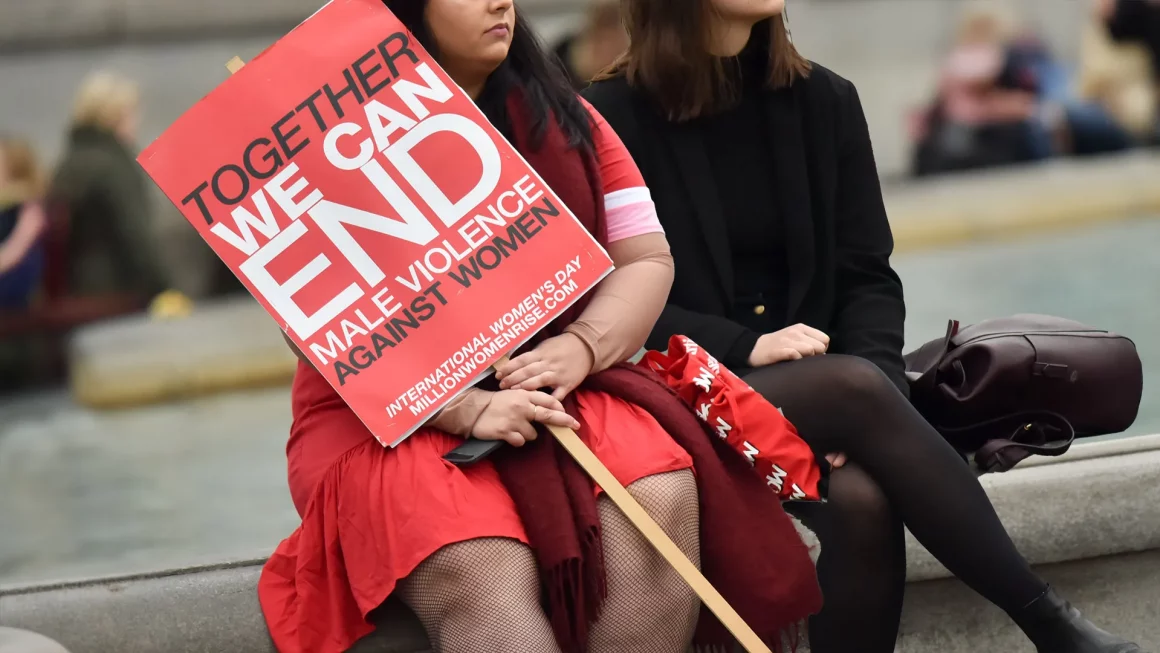
There are so many ways you can speak up about VAWG, whether it’s sharing infographics on social media or standing outside parliament with a protest sign. Your voice matters. The louder, the better.
If you are concerned that you or someone you know is experiencing domestic abuse, free and confidential support is available from Refuge’s 24-hour National Domestic Abuse Helpline on 0808 2000 247 and digital support via live chat Monday-Friday 3-10 pm via www.nationaldahelpline.org.uk.
6. Volunteer
Your time is valuable, so spend it wisely. If your workplace allows volunteering days, take them up on it. Whatever your skillset – whether it’s campaigning, social media, or customer service – there’s an opportunity for you.
7. Find community
There’s no use trying to save the world on your own – unless you fancy a prolonged period of burnout. As well as joining online communities – we love Love & Power, Everyone’s Invited, and Communia – you can attend in-person activist meetings with groups like Sisters Uncut. Find your local meeting here.
8. Divest from rape culture
Rape culture – defined by Rape Crisis England & Wales as a “society where sexual violence and abuse is normalised, played down and laughed off” – seeps into every area of our lives. It resuscitates the careers of public figures accused (and often convicted) of sexual abuse; it’s present throughout the gratuitous rape scenes in TV shows and films (which are swiftly uploaded to porn sites); and it lurks in the audience’s laughter when a comedian cracks yet another rape joke.
Rape culture thrives when it goes unchallenged, so let’s make a scene. If a friend or colleague uses degrading language about women, call them out on it. If a new comedy special opens with a domestic violence joke, switch it off. If you read a headline blaming a woman for her own rape, write to the damn paper.
9. Be intersectional
Intersectionality – a concept coined by scholar Kimberlé Crenshaw to describe how race, class, gender, and other individual characteristics overlap with one another – is vital to ending violence against women and girls. Consider the following stats:
- 86% of African and/or Caribbean heritage women in the UK have either directly been a victim of domestic violence or sexual abuse or know a family member who has been assaulted (via Sistah Space).
- Transgender people are twice as likely to be victims of crime in England and Wales (via ONS).
- Disabled women are twice as likely to experience domestic abuse and are also twice as likely to suffer assault and rape than non-disabled people (via SafeLives).
- Since the government’s 2012 ‘hostile environment’ policy, the number of migrant women who have been deported following reports of domestic abuse has risen from 12% to 30%.
During a time when transphobia, racism, ableism, and anti-migrant rhetoric are on the rise, it’s vital to focus on the bigger picture. Liberation is only possible if it’s for all of us.
10. Promote healthy relationships and better sex education
Prevention is by far the most effective way of ending violence against women and girls. And it starts with better education surrounding sex and relationships [RSE].
#MakeitMandatory is a revolutionary campaign spearheaded by Faustine Petron, a survivor of domestic abuse and Cambridge University student, calling for all schools and colleges to provide RSE at Key Stage 5 (16-18-year-olds).
11. Fundraise
Don’t panic; you don’t need to sign up for an ultra-marathon to make a difference! And you don’t need to make millions. In fact, you only need to raise £52 to provide a woman and her child a night’s stay in a refuge. If races aren’t your thing, you can get creative. We’re talking ’70s-themed dance-offs, shaving off your hair, or hosting a good old coffee morning.
Refuge has provided the following resources to share your fundraising journey on social media.
- My fundraising target is (PDF)
- By sponsoring me (image)
- I’m fundraising for Refuge (image)
- I’m raising vital funds (image)
- It’s not too late, will you donate? (image)
- I’ve done it! (image)
- My fundraising starts today (image)
- Please can you sponsor me? (image)
- Proud to be fundraising for Refuge (image)
- Why am I fundraising for Refuge? (image)
- Bunting (PDF)
12. Use social media for good
Let’s face it: social media can be a cesspit of misogyny. And it feels pretty hopeless trying to change it. However, there are digital safe spaces where women can organise against (and recover from) male violence.
Communia – an app designed specifically for sexual assault survivors – is one such space. Oliver DeRamus, who created the app, describes it as a “social network created specifically to make it easy for women to find support from other women […] free from the harassment, comparison culture, and digital misogyny that still dominates most platforms.” Sounds good to us.
You can also use more traditional forms of social media (yes, even ‘X’) to hold politicians to account, promote feminist campaigns, and show solidarity with all survivors and victims of male violence.
Here are some quick links to follow Refuge on social media:
Insta: @refugecharity
TikTok: @refugecharity
13. Share the latest research
Last year, the Office for National Statistics released data on domestic abuse in England and Wales, showing that an estimated 1.4 million women experienced this crime in the last year. Per Ellen Miller, the ONS data also shows “a huge misunderstanding about domestic abuse, with 17.5% of victims/survivors reporting that domestic abuse is ‘just something that happens’.”
This data is troubling, but we need to talk about it with everyone, from our friends and family to our colleagues and acquaintances.
14. Find allies
Why do women often end up shouldering the burden of ending male violence against them? Well, we know why. But it doesn’t have to be this way. There are plenty of incredible organisations – including the White Ribbon campaign and Beyond Equality – that promote men’s role in ending VAWG, as well as promoting positive masculinity.
15. Practise self-care
Choosing to campaign (and shout) about ending violence against women can be extremely triggering – not to mention exhausting – work. By incorporating self-care into the heart of your activism, you’re more likely to dodge burnout and continue making real changes in the world.
16. Donate to charities
By far, one of the most effective (and low-effort) ways to support charities that are campaigning against gender-based violence is to, you know, fund them.
Ellie Butt, Head of Policy, Public Affairs and Research at Refuge says, “Every 2 minutes someone turns to Refuge for support. Refuge’s services are a lifeline for thousands of women seeking safety during some of the darkest moments of their lives. One of the most effective ways you can make a difference to survivors of VAWG is by supporting our Christmas appeal with a donation at refuge.org.uk.”
For more information about emotional abuse and domestic abuse, you can call The Freephone National Domestic Abuse Helpline, run by Refuge on 0808 2000 247.
For more information about reporting and recovering from rape and sexual abuse, you can contact Rape Crisis England & Wales on 0808 500 2222.
If you have been sexually assaulted, you can find your nearest Sexual Assault Referral Centre here. You can also find support at your local GP, voluntary organisations such as Rape Crisis, Women’s Aid, and Victim Support, and you can report it to the police (if you choose) here.
For more from Glamour UK’s Lucy Morgan, follow her on Instagram @lucyalexxandra.