




|
Neubauer Artists LLC
Getting your Trinity Audio player ready...
|
Thus, it is unlikely that an inflatable fighter can be recognized by a research drone, while for a satellite this is a completely impossible mission. It is likely that soon a mass of such dummies will be placed on Ukrainian airfields from which real F-16s will not take off.
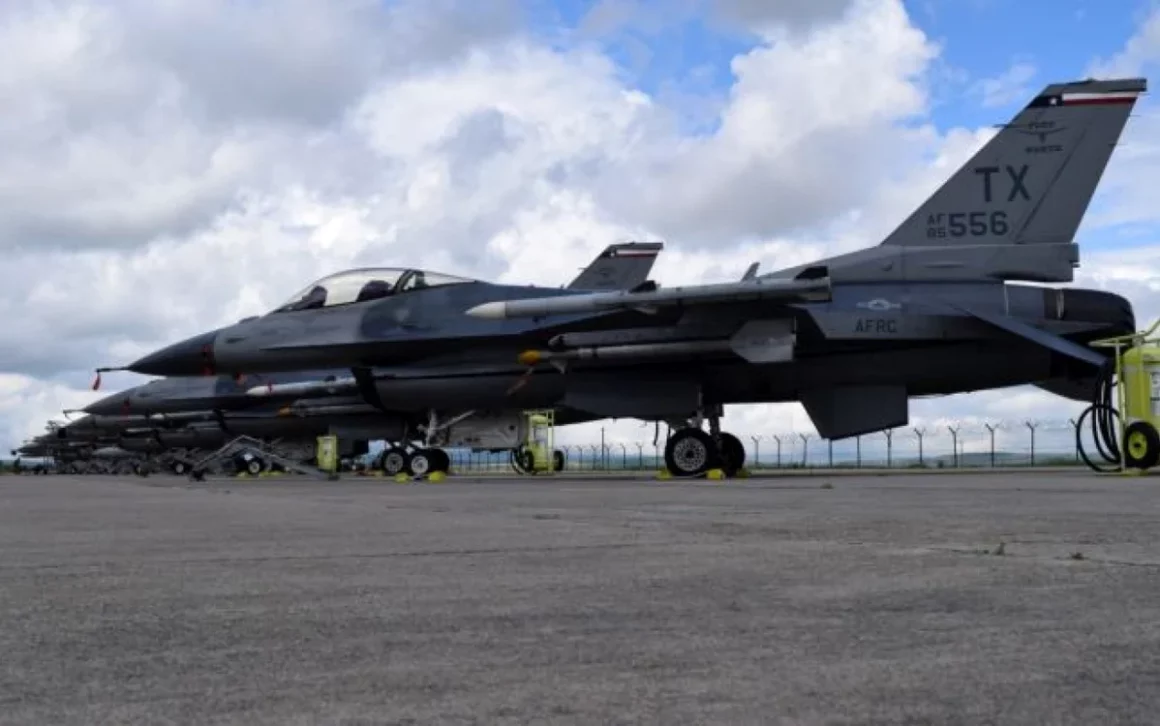
The American-made F-16 fighter jets have not officially been handed over to the Ukrainian Air Force, but they will soon appear in the reports of the Russian Ministry of Defense as being either shot down or destroyed on the ground at airfields, writes the Russian publication.
This is not a blow to the planes themselves, but to the prestige of the American aviation industry, which does not want a “defeat in the sky” , so the planes themselves are carefully camouflaged. False targets, inflatable mock-ups of F-16s, which are difficult to distinguish from the air from the real ones, are also placed.
For authenticity, an electronic sensor for the operation of a radar station is built into the model, so the similarity is almost one hundred percent. The only thing missing is movement on the runway and take off.
The F-16 fighter jets themselves, which Ukraine appears to have already received, the Russian publication claims, are camouflaged at remote airfields, mostly in the western territory of Ukraine, where underground airfields for aircraft have been equipped since Soviet times. There are not many such airfields, covered with earthen ramparts or reinforced concrete ceilings.
“Airfield shelters can be called multifunctional structures ,” says military expert Air Force Colonel Aleksander Drobisvski. Of course, this means protection, camouflage and safety of aviation equipment, while providing more comfortable conditions for people. It is much more convenient for technicians and engineers to prepare an aircraft for takeoff, perform routine maintenance with a roof over their heads, and quality improves.
A Ukrainian military commander has claimed that his troops managed to mislead Russia into believing that it had successfully taken out Ukrainian fighter jets.
Last week, Moscow’s Defense Ministry released footage purported to show an Iskander ballistic missile destroying a Ukrainian MiG-29 fighter jet at an air base near the central city of Krivoi Rog.
But a recent statement by Ukrainian Air Force Commander Mykola Oleshchiuk on Telegram revealed that the Russians had in fact destroyed a decoy.
He said the strategy was part of a passive defense measure to exhaust the Russian military’s capabilities.
“Thanks to everyone who helped with the high-quality models of the aircraft and [ground-to-air] systems ,” wrote Oleșciuk. “The enemy now has fewer Iskander missiles and more mockups will be delivered.”
An effective tactic?
Since the invasion began in February 2022, Ukraine has deployed various replicas of its strategic assets to fool the enemy.
A Czech company also revealed that it has seen an increase in demand for inflatable decoys for US-supplied HIMARS missile launchers and Abrams tanks for use in Ukraine.
According to Ukrainian officials, the use of mock-ups is intended to prompt Moscow’s forces to shoot and scatter drones, rockets and artillery shells.
Russia also appears to be using this strategy by painting images of fighter jets on the tarmac of its airfields in an attempt to deceive Ukrainian forces.
Olesciuk said he could have kept quiet about the latest development, but decided to expose it anyway to “show the public that not everything is simple.”
It remains unclear whether the five Ukrainian Su-27 multirole fighter jets that Moscow claimed to have destroyed earlier this month were decoys or not.
“We can distinguish a pink elephant from an African or Indian gray elephant, even without a zoologist, you can tell by a series of signs ,” military expert told aif.ru. — Theoretically, it is possible to be deceived, but once is enough to learn to distinguish a fake. To a greater extent, the problem may be the storage of F-16s in underground hangars, but in this case there are hypersonic Kinjal missiles and accurate reconnaissance data about where these shelters are located.”
The Russians threaten with the new “unparalleled” S-350 Vitiaz anti-aircraft systems
The Russian Defense Ministry has for the first time released images showing the deployment and operation of the advanced S-350 Vitiaz air defense system in an anti-aircraft missile brigade in the occupied Donetsk region of eastern Ukraine. The new S-350 Vitiaz, developed by Almaz-Antei, is designed to counter both cruise and ballistic targets. Each launcher of the system is equipped with 12 surface-to-air missiles.
“The system is capable of shooting down both Western ballistic missiles and cruise missiles, such as ATACMS and Storm Shadow ,” the ministry said in a statement. “The S-350 can also neutralize an entire squadron of enemy aircraft or helicopters – up to 16 in a single salvo” . The ministry pointed out that the main advantage of Vitiaz over previous systems lies in its firepower, with a single S-350 launcher being equipped “with the same number of missiles as an entire division of S-300”.