








|
Neubauer Artists LLC
Getting your Trinity Audio player ready...
|
Smart glasses are usually only recognizable by inconspicuous dots on the frame: these conceal cameras. Videos on the internet already show the misuse of this technology. Because the devices can potentially secretly record the person they are speaking to, protests are growing.
First, the computer moved from the desk to the trouser pocket, then later to the wrist. Now it’s supposed to get even closer, right up to the user’s face. According to tech manufacturers, smart glasses are set to be the next big thing in digitalization. They’re meant to listen, take photos, film, interpret, and help with navigation in everyday life. Following the smartphone and smartwatch, they offer everything the electronics industry is looking for: wearable, visible, practical for everyday use, and packed with artificial intelligence.
But with the increasing number of devices comes growing unease. Many data protection advocates now consider cameras in glasses a risk to public spaces. The criticism is directed specifically at Ray-Ban Meta glasses, whose popularity is currently transforming the digital world. Facebook’s parent company Meta and the world’s leading eyewear manufacturer EssilorLuxottica have demonstrated with these glasses that smart glasses are, for the first time, transcending a niche market of tech enthusiasts. According to the companies, sales of the glasses more than tripled last year.
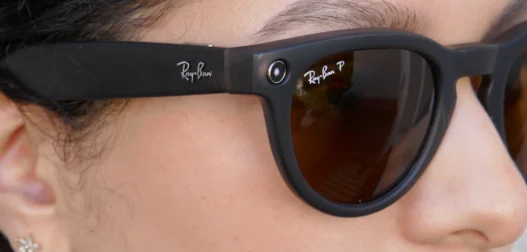
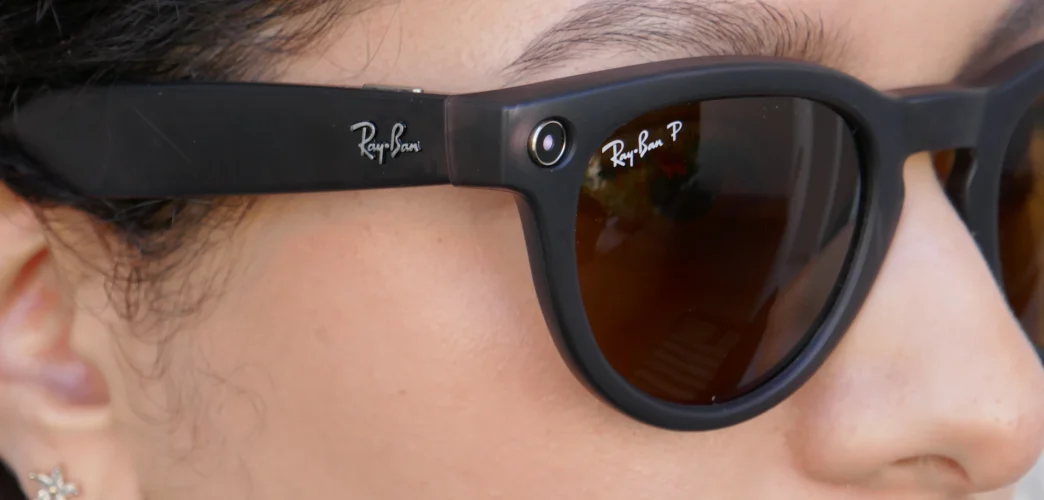
The success is based on precisely the feature that is now becoming a problem: they look like normal glasses from the popular brand Ray-Ban, with the difference being a small dot on the left and right outer edges of the frame: the camera. An LED light is supposed to indicate when filming is in progress. Meta itself advises its users to switch off the glasses in sensitive environments, explain the recording LED to others, and stop filming if people do not want to be recorded.
In practice, this warning is no longer sufficient for many critics. Videos are circulating on social media showing men wearing meta-glasses approaching women on the street, filming them from a first-person perspective , and then posting the footage. Instagram CEO Adam Mosseri announced in July that he would delete such videos and take action against them “with all available means.”
Authorities are investigating without intervening
This means the industry is facing an old problem in a new guise. Google Glass, an early digital glasses project, failed more than ten years ago, partly because people found having a camera on their face intrusive. Even today, three out of four Germans don’t want to be filmed with such glasses, according to a survey by the digital association Bitkom. Paradoxically, however, more than 40 percent of those surveyed expressed interest in wearing such glasses.
The dispute has already reached the authorities . The Federal Network Agency has examined the Ray-Ban Meta glasses but, based on current information, sees no grounds for a ban. While interventions under existing laws would, in principle, be conceivable if recording devices are disguised as everyday objects, the agency deemed the LED signal in the tested Meta glasses sufficient, because third parties could recognize a recording.
The decision is not a license for its users, says Henrike von dem Berge, a lawyer at the Noerr law firm in Berlin. One must distinguish between two levels. “One is the approval of the product and the absence of a ban. Then there is the level of what the people who own these glasses do with them,” says the lawyer.
The so-called household exemption states that the General Data Protection Regulation (GDPR) does not apply to the processing of personal data for purely personal or family activities. So, for example, someone who films with smart glasses on vacation and only watches the recordings themselves or shares them with close family and friends is allowed to do so. “But as soon as you publish these recordings on social media, you fall outside the household exemption,” says von dem Berge. While the regulations are designed to be technology-neutral, courts still need to clarify how they should be applied to digital devices that move around in public spaces and whose recording function is barely noticeable.
At the same time, civil society groups are increasing the pressure. The advice center HateAid has filed criminal charges against Meta, Ray-Ban, Oakley, and several retailers, according to its own statement. The aim is a landmark ruling. HateAid is demanding, among other things, a sales ban on certain Ray-Ban Meta models and clearer labeling of the cameras.
Meta has already reacted: In July, the company rolled out a mandatory update designed to deactivate the camera if the recording LED has been tampered with or destroyed. This followed reports that users had removed the light with small drill bits or covered it with stickers.
Two camps on smart glasses
At the IFA technology trade show in Berlin, this debate was a key part of product strategy. Several manufacturers showcased smart glasses that take a different approach. They don’t include a camera. Instead, they rely on small displays, audio functions, AI assistants, and translation. Even Realities presented a model that looks like normal glasses yet displays information in the user’s field of vision. The glasses are designed to record conversations, derive tasks, and translate into 35 languages – all without a camera.
For the company, this isn’t a sacrifice, but a selling point. “We’re at a turning point,” Will Wang, founder and CEO of Even Realities, told George V Magazine. Hardware companies have the opportunity and the responsibility to educate consumers about smart glasses and build trust. It’s now up to manufacturers to ensure sustainable, transparent, and positive growth in this product category. “Data privacy should never be optional, which is why we want to show consumers that alternatives exist,” Wang said.
HTC is taking a different approach, showcasing AI glasses with a camera in Berlin. Samsung has already presented a similar model. This divides the still-nascent device category into two camps. Some see the camera as a key feature, enabling photos, videos, visual AI queries, and future AR applications. Others view it as a reputational risk and reduce smart glasses to what generates less controversy.
Despite all the criticism, the sales figures speak in favor of the new devices. Market research firm NielsenIQ (NIQ) is seeing significant sales volumes in Germany for the first time beyond traditional VR and gaming glasses. According to their data, sales of smart glasses increased by 251 percent in the first half of 2026 compared to the same period of the previous year, albeit from a low starting point. “The success of smart glasses will depend less on the technology alone than on its acceptance in everyday life,” says Alexander Dehmel, technology expert at NIQ.
All in stocks
Every morning, an exclusive overview of stocks and ETFs. Everything you need for successful investing – for experienced investors and newcomers alike.
Apple is watching this conflict particularly closely. The company is reportedly working on its own smart glasses, which could be unveiled next year. Bloomberg reporter Mark Gurman, usually well-informed, reported that Apple is testing new hardware and software features for data privacy. Variants are also being discussed in which cameras only support AI functions but do not take photos or videos. Apple is likely to use the glasses’ privacy features as a selling point, as it has with the iPhone, iCloud, and Apple Intelligence.
Until then, users and critics are seeking their own answers. Restaurants, pubs, theaters, courts, and gyms are exercising their right to refuse service and banning the glasses. The Hamburg Parliament recently passed a ban in swimming pools, buses, and trains. The privacy-focused search engine provider DuckDuckGo is using the discussion for a PR campaign. It is selling ordinary sunglasses without a camera, AI, or microphone. The product page states that they are designed to block the sun, not to send data to the cloud. The glasses cost 31 euros—and were temporarily sold out.